Casualties unknown

2007-12-20: Douglas DC-3T (C-FMKB) — Kenn Borek Air Ltd. — Mcmurdo Station, AY

Mcmurdo Station, AY

On December 20, 2007, a Douglas DC-3T (registration C-FMKB) operated by Kenn Borek Air Ltd. was involved in an aviation accident near Mcmurdo Station, AY. Investigators recorded the probable cause as: The captain's decision to lift off before attaining a proper airspeed, resulting in a loss of control during takeoff. This summary draws on records from the U.S. National Transportation Safety Board (NTSB) historical archive; 3 related events involving the same aircraft type or operator are linked below.

Sourcesthe U.S. National Transportation Safety Board (NTSB) historical archivePrimary reportUpdated 1781061362Data APIEditorial standards
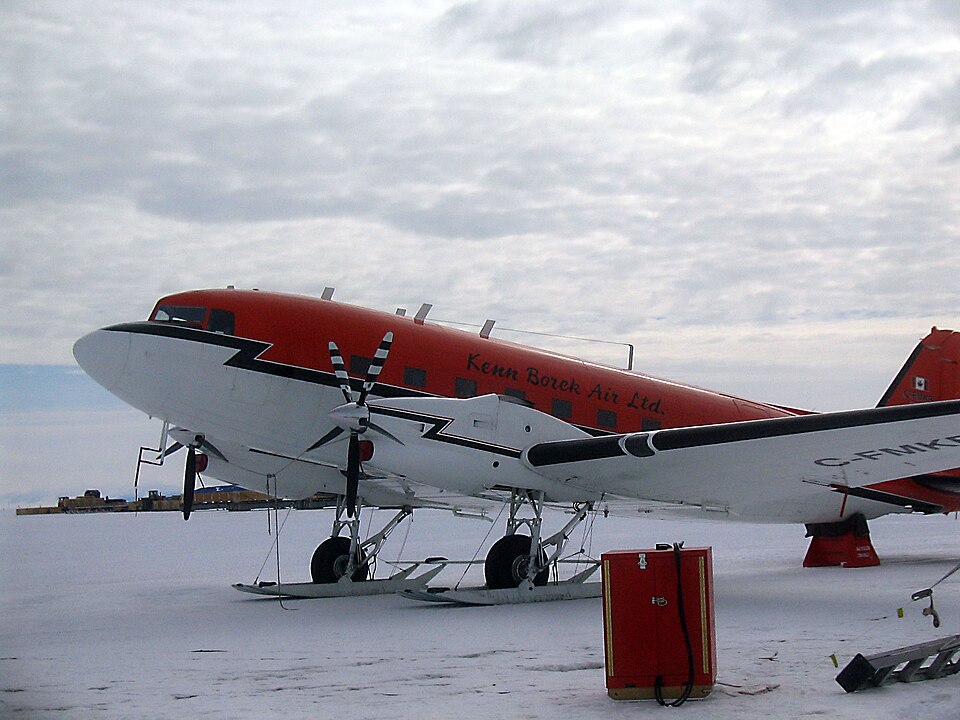
Aircraft registered C-FMKB
Aircraft registered C-FMKB. Photo: D. V. Wiebe / CC BY-SA 3.0, via Wikimedia Commons

During takeoff on snow-covered terrain, the left wing of a turbine-powered wheel/ski-equipped airplane struck the ground, causing the aircraft to pivot 90 degrees. Both main landing gear assemblies collapsed, resulting in substantial damage to the left wing and fuselage.

Accident Description

A turbine-powered, wheel/ski-equipped airplane experienced an accident during takeoff from an area of snow-covered terrain. The captain reported that during the takeoff run, as the airplane neared 70 knots, he moved the control column aft in an attempt to lower the tail and attain a flying attitude. Just before the airplane became airborne, the right wing lifted and the left wing struck the snow-covered terrain, which pivoted the airplane 90 degrees to the left.

Damage and Landing Gear

Both main landing gear assemblies collapsed during the event, and the airplane came to rest on its belly. Substantial damage was sustained to the left wing and fuselage.

First Officer's Account

The first officer reported that during the takeoff run, as the airplane neared 60 knots and as the captain moved the control column aft, she felt the airplane's tailwheel contact the hard packed snow. The first officer noted that other captains she had flown with usually attain a higher airspeed before becoming airborne.

Cockpit Voice Recorder

The cockpit voice recorder revealed that the highest airspeed the first officer called out during the takeoff run was 60 knots, about 3 to 5 seconds prior to the crash.

Investigation

No probable cause was explicitly stated in the source material. The investigation focused on the events described by the flight crew and recorded data.

Investigation report by the U.S. National Transportation Safety Board (NTSB) historical archive. Original record: https://carol.ntsb.gov/event/20080117X00066. This page is a structured re-presentation; facts and quotes are in the National Transportation Safety Board (NTSB), United States.