Incident Overview
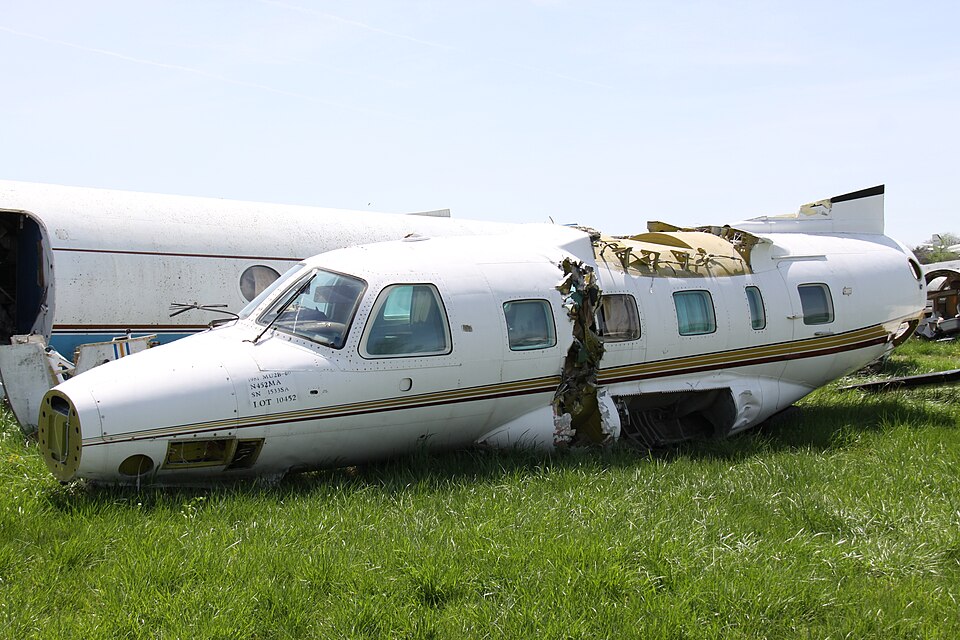
On December 9, 2008, at 1058 central standard time, a Mitsubishi MU-2B-60, registration N452MA, was substantially damaged while returning to land at Millington Regional Jetport (NQA) in Millington, Tennessee. The airplane had experienced a reported loss of engine power shortly after departure. The certificated airline transport pilot sustained minor injuries. Visual meteorological conditions prevailed at the time of the accident. The flight was conducted under 14 CFR Part 91 as a positioning flight from NQA to Charles W. Baker Airport (2M8), also in Millington.
Flight History
According to the pilot, the airplane was based at 2M8. He had flown to NQA to purchase fuel and was returning to 2M8 to pick up a passenger. Prior to departure, air traffic control held the airplane on the ground for 15 minutes on two occasions to allow storm cells to pass. After being cleared, the pilot took off from runway 4 with 20 degrees of flaps. Following takeoff, he raised the landing gear while maintaining the flap setting and proceeded northwest. Approximately 2.5 miles from the airport, the pilot noticed a loss of power from the right engine. Suspecting possible rain effects, he observed torque drop to about 40 percent and decided to feather the propeller, which was accomplished without issue. He then secured the engine.
The pilot applied full power to the left engine while keeping flaps at 20 degrees. When the controller offered to continue to 2M8 or land on Route 51, the pilot declined both and requested a return to NQA. As he maneuvered, winds and wind shear increased, and the airplane encountered heavy rain. The pilot was able to maintain altitudes between 1,000 and 1,400 feet due to turbulence. He attempted to climb but was uncertain if wind shear prevented it. He later stated that the airplane "conformed to standards."
Approaching midfield at NQA, the pilot attempted to land on runway 22 but found himself too tight for half turns on one engine. He made the approach at about 105 knots (normally 100 knots) and touched down approximately two-thirds of the way down the 8,000-foot runway. During landing, the nose landing gear and left wing collapsed, and the airplane veered off the left side of the runway.
ATC Communications
Review of air traffic control transcripts provides additional detail. At 1037, the airplane was released for departure. By 1041, radar identified the aircraft and the controller instructed a climb to 2,300 feet. The pilot initially requested a visual approach to 2M8 but later opted for a GPS approach to runway 18. At 1044, the pilot reported a problem with the right engine. He declared an emergency at 1045 when losing power. Subsequent transmissions included discussions about approach options, with the pilot deciding to attempt the ILS runway 22 approach into Millington, requesting a long approach. At 1050, the controller advised the airport was 4 miles at one o'clock; the pilot responded "looking no joy" and reported losing altitude. A low altitude alert was issued. The pilot asked the controller to notify his office of the engine loss and mentioned hearing a popping noise followed by a sound like a lockup. He continued to lose altitude, reporting a terrain warning and airspeed of 120 knots. The controller suggested highway 51, but the pilot declined due to traffic. At 1057, the controller cleared the pilot to land any runway at Millington, and the pilot had the airport in sight.
Aircraft and Engine Information
The airplane was a Mitsubishi MU-2B-60 powered by two Honeywell TPE 331-10-511M turboprop engines, each flat-rated to 715 shaft horsepower, driving Hartzell four-blade propellers. The most recent 100-hour, 200-hour, and 1-year inspections occurred on June 24, 2008.
Wreckage and Impact
According to the FAA inspector, tire marks from the left main landing gear were first located about 6,200 feet from the approach end of runway 22, near the left edge. Marks continued left into the grass, with nose gear marks 50 feet beyond and right main gear marks 200 feet further. Ground tracks formed a shallow arc to the left over 250 yards, then passed through a chain link fence and continued another 150 yards. The left wing was found broken off along the track, and the left fuselage was severed near the left propeller. The flaps were extended to 20 degrees, and the landing gear was down. The right engine was feathered and appeared undamaged except for a dent in the spinner; the propeller rotated normally, and no damage was evident in the compressor or turbine.
Meteorological Conditions
Weather recorded at NQA at 1050 included calm winds, visibility 3 statute miles, light rain, mist, scattered clouds at 500 feet, broken at 1,200 feet, overcast at 2,300 feet, temperature and dew point 12°C, altimeter 29.82 inHg. A special observation at 1101 reported winds from 080° true at 3 knots, visibility 4 miles, light rain, mist, few clouds at 400 feet, scattered at 2,300 feet, broken at 3,100 feet. On-scene firefighters reported heavy rain and thunderstorms present throughout the incident. ATC transmissions at 1037 indicated heavy and extreme weather east of Charles Baker, moving east-northeast, with heavy precipitation just north of Charles Baker.
Engine Examination and Testing
Both engines were removed and examined at Honeywell under FAA oversight. The right engine showed no preexisting condition that would have interfered with normal operation. It started and ran in a test cell, producing a maximum of 1,018 shaft horsepower (18 shp above overhauled engine requirement and 2 shp below new production requirement). Torque transducer calibration checks revealed a 3.0 percent indicated torque error at 100 percent torque. The left engine had a separated torsion shaft precluding test cell runs; disassembly revealed rotational scoring on compressor and turbine shrouds and metal spray along the gas path. No preexisting condition was identified on the left engine either.
Pilot Information
The pilot, age 42, held an airline transport pilot certificate with single-engine and multiengine land ratings. He reported 5,311 total flight hours, 4,246 multiengine hours, and 662 hours in the accident make and model. His most recent FAA second-class medical was dated March 1, 2007, and his last flight review was completed on July 17, 2008, in the accident airplane.
Performance and Procedures
According to the Airplane Flight Manual (AFM), after takeoff with 20 degrees of flaps, the procedure calls for maintaining pitch attitude, retracting gear, accelerating to 113 KCAS, then retracting flaps to 5 degrees and later to up, with a minimum airspeed of 140 KCAS. In visible moisture encounters, the AFM advises not moving power levers unless EGT drops below 630°C. For engine failure after liftoff with gear down or in transit, the AFM warns that continued climb performance is not assured unless landing gear is completely retracted and flaps are at 5 degrees or less. For engine failure in takeoff climb with gear fully retracted, the procedure includes retracting flaps to 5 degrees and then up. For engine shutdown, if a sudden loss or significant fluctuation of indicated torque occurs, the pilot should promptly shut down the affected engine. The AFM did not have a specific procedure for engine failure in flight except a driftdown procedure above 25,000 feet, and did not address drag influences from landing gear or flaps. For single-engine landing, the AFM warns not to attempt a go-around below 400 feet or after 20 degrees of flaps are selected.
Performance charts indicate that under the ambient conditions and accident weight, with one engine feathered and the other at maximum continuous power, flaps up, the airplane should have been able to climb about 650 feet per minute at 145 KCAS. With flaps at 20 degrees and takeoff power on the operating engine, the climb rate would be about 350 feet per minute at 135 KCAS. The pilot reported using single-engine power between 90 and 100 percent, airspeed 140 knots, and no controllability issues.
The NTSB investigation did not assign a probable cause in the public docket.