History of Flight
On January 19, 2010, at 0715 central standard time, a Hawker Beechcraft Corp. B200, registration N586BC, operated by Blue Cross and Blue Shield of Iowa (BCBS), sustained substantial damage during landing on runway 31 at Sioux Gateway Airport/Col. Bud Day Field (SUX), Sioux City, Iowa. Instrument meteorological conditions prevailed. The pilot, copilot, and two passengers were uninjured. The flight was conducted under 14 CFR Part 91 as a business flight on an instrument flight rules (IFR) plan. The flight departed Des Moines International Airport (DSM) at 0636 en route to SUX.
The right-seat pilot stated that the pilot-in-command (PIC) for each leg was the flying pilot. Four legs were scheduled; the left-seat pilot was to fly the first two legs. Both pilots obtained weather and discussed the WSI screen for SUX and Rapid City Regional Airport (RAP). They agreed there was a good chance they might not land at SUX. RAP was chosen as the alternate because it was their second destination. The right-seat pilot later did not know what alternate airports were filed by the left-seat pilot.
During the approach, the pilots obtained SUX ATIS. Air traffic control instructed N586BC to switch from approach control to tower while on the ILS Runway 31 approach. The tower issued RVRs of 1,800 feet for touchdown and rollout. The right-seat pilot stated they had the runway environment in sight at minimums, seeing lights at 250 feet and the runway at decision height. The left-seat pilot did not go below minimums. At less than 100 feet, the right-seat pilot turned off the yaw dampener and turned on landing lights. The left-seat pilot used approach flaps and a higher reference speed. The right-seat pilot warned the left-seat pilot of misalignment; the left-seat pilot responded, “those are edge lights” and added power to correct. The airplane touched down 3,000–3,500 feet down the runway near the intersection of runway 35, with the left main landing gear off the runway surface, then veered off.
The left-seat pilot described the transition from instrument to visual flight into a white-on-white landscape. He considered the event not reportable.
Personnel Information
The left-seat pilot, age 55, held an ATP certificate with multiengine and single-engine land ratings, a Cessna 560XL type rating (SIC only), and an expired flight instructor certificate. He had 6,018 total flight hours, with 1,831 in the accident make and model. He was employed by Wellmark, Inc. since 2002, serving as PIC on the B200 and SIC on the Cessna 560XL. He completed recurrent training at CAE SimuFlite in June 2009.
The right-seat pilot, age 36, held an ATP certificate with multiengine and single-engine land ratings, a Cessna 560XL type rating, and flight instructor certificates. He had 6,892 total hours, with 2,186 in the accident make and model. He was employed by Wellmark, Inc. since 2005, serving as PIC on the B200 and Citation Excel. He completed recurrent training at CAE SimuFlite in August 2009.
Meteorological Conditions
At SUX, at 0652, wind 120° at 6 knots, visibility 1/2 statute mile, moderate freezing fog, vertical visibility 100 feet AGL, temperature -4°C, dew point -6°C, altimeter 29.91 inHg. At 0725, visibility 1/4 statute mile, freezing fog, vertical visibility 100 feet. At DSM, at 0654, visibility 1/4 statute mile, freezing fog, overcast 100 feet. RAP reported 10 statute miles visibility and clear skies.
Airport and Approach Information
SUX ILS Runway 31 approach minimums were 1,296 feet MSL and 2,400 feet visibility (200 feet above threshold and 1/2 SM). Runway 31 is 9,002 feet long, 150 feet wide, grooved concrete. The approach lighting system was MALSR with HIRL; no in-runway lighting (centerline or touchdown zone) was installed.
Flight Recorders
The airplane was not equipped with a flight data recorder or cockpit voice recorder, as not required under Part 91.
Damage
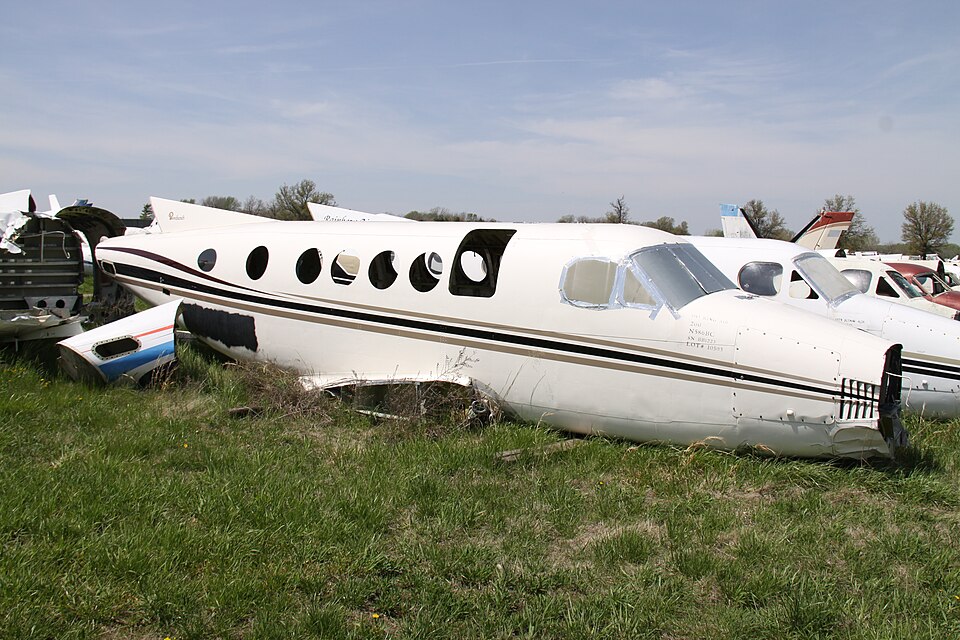
The nose landing gear collapsed, damaging the nose section and avionics. The underside fuselage skin buckled, and the nose structure was damaged.