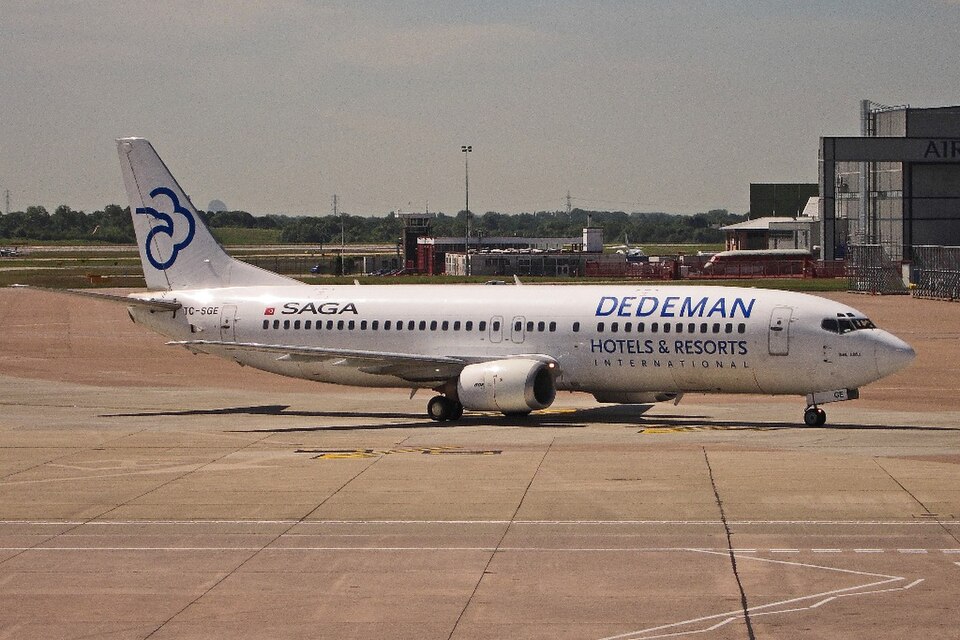
Incident Overview
On 3 September 2010, at 03:47 local time, a Boeing 737-400 (registration TC-SGE) operated by SAGA Airlines encountered a serious incident during takeoff from runway 29 at Poznań-Ławica Airport (EPPO). The aircraft was operating a charter flight (SGX426) to Izmir, Turkey, with 6 crew members and 171 passengers on board.
Sequence of Events
Before departure, the crew performed a pre-flight inspection of the aircraft at 03:15 LMT and found no abnormalities. After receiving clearance, the aircraft taxied to runway 29 and began its takeoff roll at 03:45 LMT. During the takeoff roll, up to a speed near V1, no abnormal phenomena occurred. However, as the aircraft approached and exceeded V1, slight vibrations were felt.
After rotation and liftoff, the LOW PRESSURE warning light for the hydraulic system illuminated. The crew attempted to retract the landing gear multiple times, but all attempts were unsuccessful. At 03:47 LMT, with the aircraft approximately 4 nautical miles south of the airport at an altitude of about 5,000 feet AGL, the crew declared the situation to the tower and requested permission to return, without declaring a need for firefighting assistance.
The aircraft landed at 03:55 LMT and taxied to the parking position at reduced speed using alternate steering for the nose gear. A post-landing inspection revealed the destruction of the right inner main landing gear tire, a hydraulic fluid leak from the right main gear bay, and failure of the right hydraulic system. Inspection of the runway and taxiway revealed numerous fragments of the destroyed tire, metal hydraulic line pieces, and a piece of wing skin. The debris was cleared by airport fire services.
Investigation Findings
The Polish State Commission for Aircraft Accident Investigation (PKBWL) arrived at the scene later that day and conducted an investigation. The flight data recorder (FDR) was removed and analyzed at the BEA in Paris, while the cockpit voice recorder (CVR) contained no useful data as the incident period had been overwritten.
Key findings from the investigation:
- The FDR showed no exceedances of parameters that could have directly affected accelerated tire wear.
- The explosive rupture of the right inner main landing gear tire occurred at the end of the takeoff roll at a calibrated airspeed of 132 knots.
- The destroyed tire had accumulated 178 flight cycles and was retreaded, not new, but was accompanied by all required quality documentation.
- Both the destroyed tire and the left inner main landing gear tire showed signs of noticeable wear, including localized full tread wear and edge damage consistent with underinflation.
- The operator did not perform additional tire pressure checks beyond those required by the manufacturer.
- No foreign objects were found on the runway that could have initiated the event.
- The crew's actions and ground services were deemed entirely correct.
- The damage to hydraulic lines by tire fragments prevented gear retraction, which was considered a safety-enhancing factor during the landing.
Damage to Aircraft
The incident resulted in the destruction (burst) of the right inner main landing gear tire. Additionally, hydraulic system lines in the right main gear bay were cut and torn by fragments of the destroyed tire, and a piece of the upper wing skin above the wheel well was punctured.
Probable Cause
The probable cause, as stated by the investigating body, was operational wear of the tire of the inner wheel of the right main landing gear.
Conclusions
No safety recommendations were issued. The operator did not inform PKBWL of any preventive measures taken.