History of the Flight
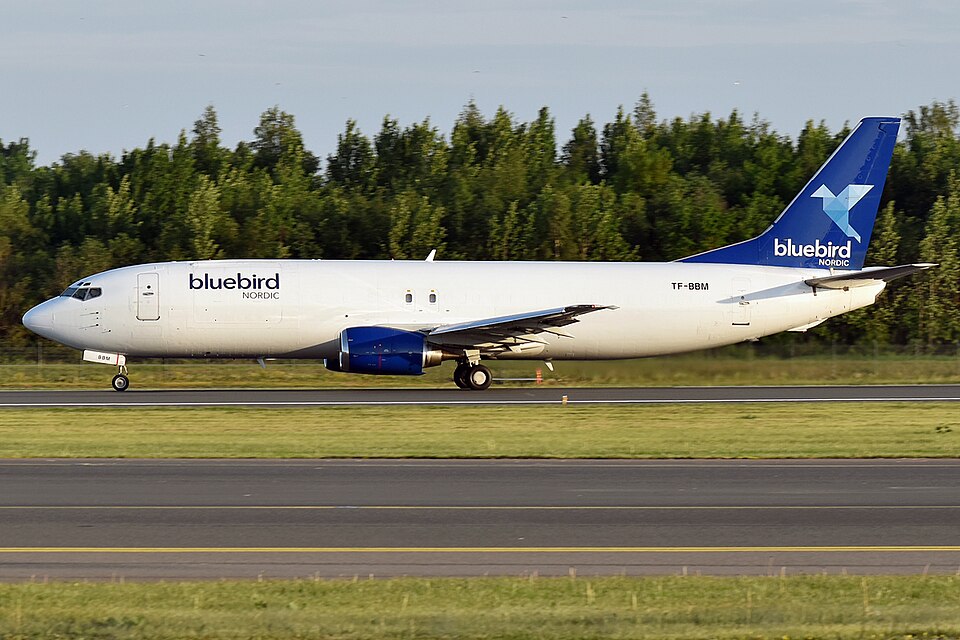
The crew of a Boeing 737-400, registered TF-BBM and operated by Bluebird Nordic, was preparing for a freight flight from Paris-Charles de Gaulle to Lisbon. At 21:24 local time, they received clearance to start engines and push back from stand I81. Due to an inoperative APU, the first engine was started using a GPU connected on the right-hand side, which required starting engine No. 1 (left) first, contrary to the normal procedure of starting engine No. 2 first.
The push-back proceeded normally. A ground operator with a headset walked alongside the aircraft while another drove the tug. A steering lockout pin was installed on the nose gear. After push-back, the aircraft, with only engine 1 running, was on taxiway BM1. The operator asked the crew to apply the parking brake so the towbar could be removed. The crew confirmed the parking brake was applied.
After the towbar was disconnected from the tug, the operator noticed the aircraft moving forward with the bar still attached to the nose gear. He repeatedly asked the crew to apply the parking brake. The crew replied that the brake was on and they could not brake. The tug and operator moved out of the way as the aircraft accelerated to a maximum recorded speed of 12 knots. With the towbar and steering lockout pin still in place, the crew could not steer, and the aircraft struck a lamppost and a jet blast barrier before stopping.
Damage
The damage was confined to the left wing, which was substantially damaged. The lamppost and jet blast barrier were also struck.
Examination of Systems
The BEA, in coordination with Boeing, tested the braking system after the accident. The tests showed correct operation of electric motor pump ELEC 1 (which pressurizes hydraulic system B and the accumulator), the accumulator pressure (2,900 psi, within specifications), the parking brake lever mechanism, engine driven pump ENG 1 (system A), and all indicator lights and pressure indicators. No malfunction was found that could explain the accident.
Flight Data Recorder (FDR) analysis revealed that hydraulic systems A and B were not pressurized: both BRAKE PRESSURE NORMAL and ALTERNATE parameters were below 100 psi, and all four LOW PRESSURE indicator lights were on. Based on the recorded parameters, the most likely switch positions were: SYS A ENG 1 OFF, SYS B ELEC 1 OFF, and the positions of SYS A ELEC 2 and SYS B ENG 2 unknown but irrelevant since engine 2 was not running and APU was inoperative.
Procedures
The Bluebird Nordic Standard Operating Procedures (SOP) did not differentiate between having the steering lockout pin installed or not. The crew was instructed to depressurize system A (ENG 1 and ELEC 2 switches OFF) and pressurize system B (ENG 2 and ELEC 1 ON) without verifying that system B pressure reached 2,800 psi or that LOW PRESSURE lights were off.