Incident Overview
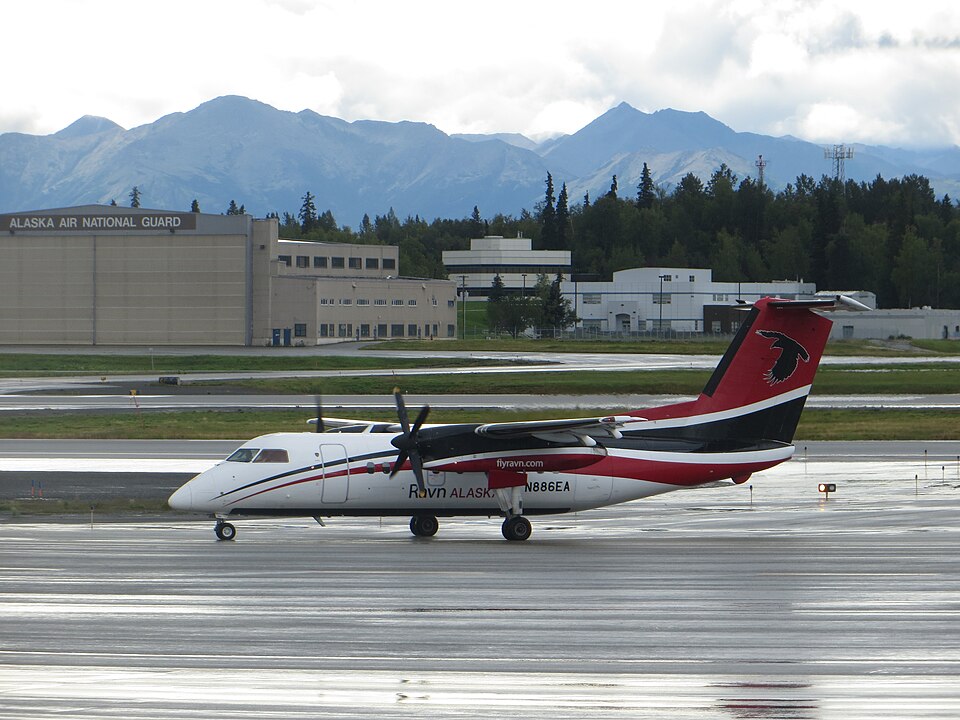
On September 5, 2012, about 1041 Alaska daylight time, a Bombardier DHC-8-103, registration N886EA, experienced an uncommanded left roll and uncontrolled descent while climbing through about 12,000 feet mean sea level. The flight crew regained control of the airplane at about 7,000 feet, and the flight returned to Ted Stevens Anchorage International Airport (ANC) in Anchorage, Alaska. The 12 passengers and 3 crewmembers were not injured, and the airplane sustained minor damage. The airplane was registered to and operated by Era Aviation as flight 874 under 14 Code of Federal Regulations Part 121 as a regularly scheduled commercial flight. Day instrument meteorological conditions prevailed, and the flight operated on an instrument flight plan.
Flight History
The incident occurred on the third flight of a six-leg trip sequence. The flight departed ANC about 1029 en route to Homer Airport. The captain was the pilot flying, and the first officer was the pilot monitoring. The weather forecast along the route indicated occasional moderate turbulence below 12,000 feet agl and isolated moderate rime icing between 10,000 and 22,000 feet agl with a freezing level of 5,000 feet agl. Forecasts for ANC and Homer showed broken to overcast skies with good surface visibility and gusty winds.
The flight was cleared to a cruise altitude of 10,000 feet. The captain engaged the autopilot at about 1,000 feet agl and set an indicated airspeed climb speed of 150 to 160 knots. Between 7,000 and 8,000 feet, the airplane entered a cloud deck and began accumulating ice; the captain turned on de-icing equipment, which was working normally but not clearing all ice off the airframe.
At 1037:24, the crew contacted Anchorage Air Route Traffic Control Center, reporting moderate mixed ice. At 1038:32, they requested a block altitude of 10,000 to 14,000 feet to avoid icing; the clearance was issued. During the climb, the captain initially set 14,000 feet in the altitude alert controller, engaged the IAS button, and did not use vertical speed mode. According to flight data recorder data, initial airspeed was 170 knots, climb rate 850 feet/minute, and engine power was not increased. Airspeed decreased steadily while altitude and pitch increased.
Loss of Control and Recovery
Passing through about 11,500 feet, the flight emerged from cloud tops, and the captain set the altitude alert to level at 12,000 feet. As the airplane leveled, it began shuddering, attributed to unbalanced propellers from uneven ice shedding. According to FDR data, the airplane lost lift at 1041:18 while climbing through 12,192 feet at 103 knots. The shudder increased, the airplane rolled left, and pitched down. The left roll began at 1041:23 at 97 knots, reaching a left bank of 47° in about 11 seconds. No stick shaker activated before the roll. The control column moved back gradually from 3° to 8.5° over 9 seconds, increasing pitch to about 20° nose up. The autopilot remained on initially. The captain opposed the left roll with control wheel input, but the roll increased to 55°.
The captain attempted to regain control with power and control inputs. The autopilot disconnected at 1041:26.7. At 1041:27, the column was pulled back rapidly from 8.5° to 33° in 3 seconds. The column remained aft at greater than 33° until 1041:43, when the captain released back pressure. The airplane pitch decreased from 20° nose up to 37° nose down. The captain did not push the column forward until 1041:50. At 1042:04, the airplane reached its lowest altitude of 7,072 feet and began to level out after descending over 5,200 feet in about 37 seconds. The flight made a left 270° turn during the upset.
FDR data showed engines were at about 70% maximum torque when level at 10,000 feet until the upset. After the left roll, power was reduced to about 30% for 10 seconds, then increased above 100% exceeding torque limits, then reduced to about 90% before the lowest altitude, then increased further. The crew declared an emergency and returned to ANC, landing uneventfully about 1056.
Personnel Information
The captain, age 41, held an airline transport pilot certificate with type ratings in BE-1900 and DHC-8 airplanes. He had 8,000 total flight hours, including 4,000 as pilot-in-command, 258 of which were as PIC in DHC-8 airplanes. He had no prior accidents or enforcement actions but had 10 moving violations between 2004 and 2011; after a June 2010 traffic accident, Era Aviation restricted him from operating company motor vehicles.
The first officer, age 44, held a commercial pilot certificate with type ratings in BE-1900 and DHC-8 airplanes (SIC privileges only). He had about 6,000 total flight hours, including about 2,360 hours as SIC in DHC-8 airplanes. He had been involved in a previous accident on August 4, 2008, in a PA-31 aircraft. He had certification disapprovals earlier in his career and surrendered his ATP certificate after a reexamination in 2008.
Aircraft and Systems
The incident airplane was a Bombardier DHC-8-103, a twin-engine turboprop. It was equipped with a stall warning system using lift transducers on each wing leading edge, transmitting angle-of-attack information to lift computers that activate stick shakers when a stall speed warning threshold is reached. The activation threshold could not be changed for icing conditions. Due to lack of FDR and CVR evidence, stick shaker activation could not be determined.
Cockpit Voice Recorder
The airplane was equipped with a 30-minute solid-state CVR that overwrote the incident sequence. The airplane did not have the required 2-hour CVR as mandated by FAA regulations effective April 7, 2012. The principal avionics inspector for Era was aware of the regulation but believed Era had upgraded its CVRs. After the incident, Era reviewed its fleet and found none met the 2-hour requirement; operations were suspended until compliance was achieved.
Meteorological Information
The NWS area forecast issued about 6.5 hours before the flight expected mountain obscuration, broken to overcast clouds, scattered rain showers, freezing level at 5,000 feet, and isolated moderate rime icing. No other icing advisories restricted operations. The TAMDAR system on the airplane indicated likely entry into clouds at about 9,800 feet with ice accumulation; the cloud layer extended to 10,500 feet with liquid water droplets at -11°C. The TAMDAR sensor detected pitot static icing issues before the upset and reported unreliable airspeed.
Aircraft Performance Study
An NTSB aircraft performance study analyzed the loss of control. It calculated the drag coefficient during the climb and found it increasing around 10,000 feet, consistent with possible ice buildup that worsened during the climb. The study used FDR, TAMDAR, ATC, and radar data to define the airplane's position and orientation.