History of Flight
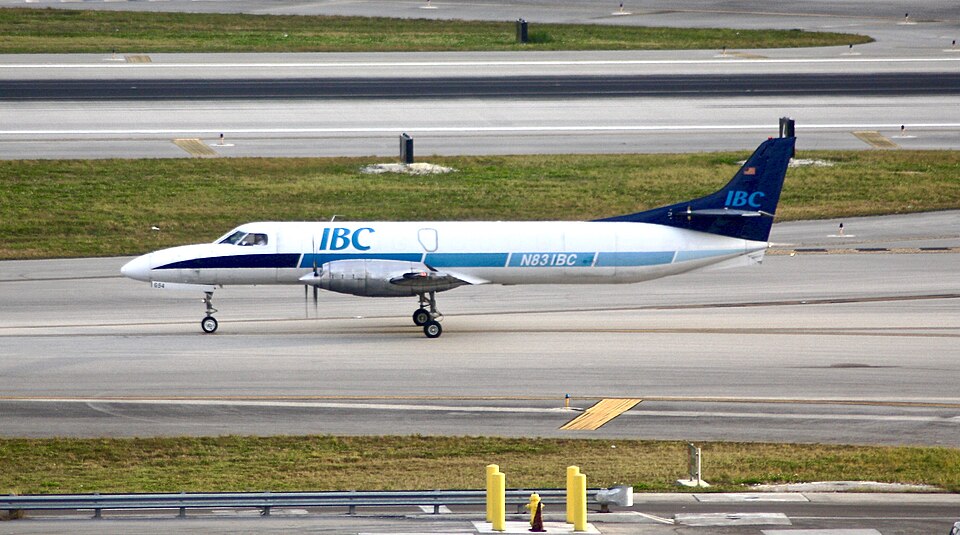
On December 2, 2013, at 2010 Atlantic standard time, a Fairchild SA227-AC, registration N831BC, operating as IBC Airways flight 405 (callsign "Chasqui 405"), was destroyed during a rapid descent and subsequent inflight breakup near La Alianza, Puerto Rico. The captain and first officer were fatally injured. Night visual meteorological conditions prevailed. The international cargo flight was conducted under 14 CFR Part 135 on an instrument flight rules flight plan between Las Americas International Airport (MDSD), Santo Domingo, Dominican Republic, and San Juan International Airport (TJSJ), San Juan, Puerto Rico.
According to operator records, the accident flight was the return leg of a round trip between TJSJ and MDSD. The airplane departed MDSD at 1936. A review of radio transmissions showed the crew first contacted San Juan Combined En route Approach Control (CERAP) at 1948, 13 nautical miles west of MELLA intersection at 11,000 feet. At 2001, they were instructed to descend to 7,000 feet at pilot's discretion. At 2007, they were advised to change frequency. The crew reported "leaving one one thousand, descending to seven thousand." The controller then instructed them to maintain 3,000 feet, expect the ILS approach, proceed direct to TNNER fix, and noted information Tango in effect. After a readback at 2007:46, no further transmissions were received. Radar contact was lost at 2011:52.
A witness reported hearing engine noise and seeing the airplane with the right wing down, "turning in a spiral form," along with a red light spinning. He then heard an impact noise, followed five seconds later by another solid impact noise.
Radar data indicated that after crossing MELLA, the airplane proceeded toward TJSJ on a heading of about 085 degrees true, crossing the west coast of Puerto Rico south of Stella. The airplane maintained 11,000 feet until 2007 and descended to 8,300 feet by 2010:08. The track then showed a 20-degree left turn and descent to 7,300 feet by 2010:13, followed by a 45-degree right turn and descent to 5,500 feet by 2010:18. Descent rates between 2010:08 and 2010:13 were about 12,000 feet per minute (fpm), and between 2010:13 and 2010:18 exceeded 21,000 fpm. Groundspeed averaged about 260 knots until descent initiation, with last two readings of 280 and 290 knots.
Personnel Information
The captain, age 35, held a commercial certificate with single-engine and multiengine land and sea ratings, instrument-airplane rating, and a flight instructor certificate. His first-class medical was dated April 16, 2013. He was assigned captain on June 5, 2013, after proficiency and line checkrides. As of November 30, 2013, he had 1,740 total flight hours, 686 hours in type, 239 hours as pilot-in-command, and 121 hours in the previous 90 days. Night hours could not be ascertained.
The first officer, age 28, held a commercial pilot certificate with single-engine and multiengine land and instrument ratings. His first-class medical was dated September 9, 2013, reporting 1,850 hours. He was assigned first officer on October 3, 2013, after a proficiency checkride. As of November 30, 2013, he had 1,954 total hours, 92 hours in type, and 92 hours in the previous 90 days. Night hours could not be ascertained.
The Director of Operations stated that after arrival in Santo Domingo, the crew typically rested at a local hotel for about 10 hours, with each pilot having their own agenda. The non-flying pilot was normally responsible for radio communications, though not always. The DO identified the first officer's voice on the radio recordings.
Aircraft Information
The airplane was a twin-engine, propeller-driven, low-wing, pressurized Fairchild SA227-AC originally configured for 19 passengers but modified for cargo. It had a cruciform tail and retractable tricycle landing gear. The fuselage was semi-monocoque with aluminum alloy frames and skins. The wing was one-piece with continuous spars, integral fuel tanks, and removable flaps and ailerons. Wing extensions increased span to 57 feet. The empennage included conventional horizontal and vertical stabilizers; the horizontal stabilizer could pivot for pitch trim. Flight controls were cable-driven.
The fuel system had a usable capacity of 648 U.S. gallons in integral left and right wing tanks. A cross-flow line allowed gravity-based fuel balancing, controlled by a shut-off valve. The manufacturer's checklist required the cross-flow valve to be closed on engine start, taxi, and descent. The maximum allowable fuel imbalance was 500 pounds. A weight and balance sheet from the accident site indicated 1,800 pounds of fuel onboard from Santo Domingo to San Juan.
The engines were two Honeywell (Garrett) TPE331-11U turboprops producing 1,100 horsepower each, driving four-bladed McCauley propellers. No full auto-feathering was installed; a negative torque sensing system would drive the propeller to a coarser pitch upon negative torque, with manual feathering.
The airplane was loaded mostly with letters and small boxes. Weight and balance calculations showed it was about 2,800 pounds under maximum gross takeoff weight and about 3,100 pounds under maximum landing weight. No autopilot or yaw damper was installed. No cockpit or flight data recorders were required or installed; a cockpit voice recorder had been removed when the airplane was converted from passenger to cargo configuration.
Maintenance Records
The airplane was manufactured in 1985 and acquired by IBC Airways on March 29, 1999. As of November 29, 2013, it had 33,883.4 total hours and 35,698 total cycles. Maintenance was performed under a Continuous Airworthiness Maintenance Program (CAMP) with phased inspections every 150 hours (phases one through six) and 85-hour service checks. Particular attention was given to pitch control, tail inspections, flight controls, engines, and flight instruments. A review of daily flight logs from January 2012 through November 29, 2013, showed no significant or unusual findings. Fourteen major alterations and 21 major repairs were recorded, including right wing damage repair in June 2008 and multiple repairs in June 1991. The pitch trim warning box was overhauled in September 2008 and installed in December 2009. The left elevator outboard attach hinge was replaced for corrosion in October 2011.
Flight crew who flew the airplane on the days before the accident reported no mechanical irregularities or discrepancies.
Meteorological Information
Weather at TJSJ (33 nm east) at 1956 included wind from 170 degrees true at 5 knots, visibility 10 miles, a few clouds at 7,000 feet, and scattered clouds at 10,000 feet. Weather radar showed no precipitation in the area. Sunset occurred at 1749, with end of civil twilight at 1813. The accident occurred near the Arecibo Radio Telescope, where a passive project was ongoing with no transmitting radars.