Accident Details
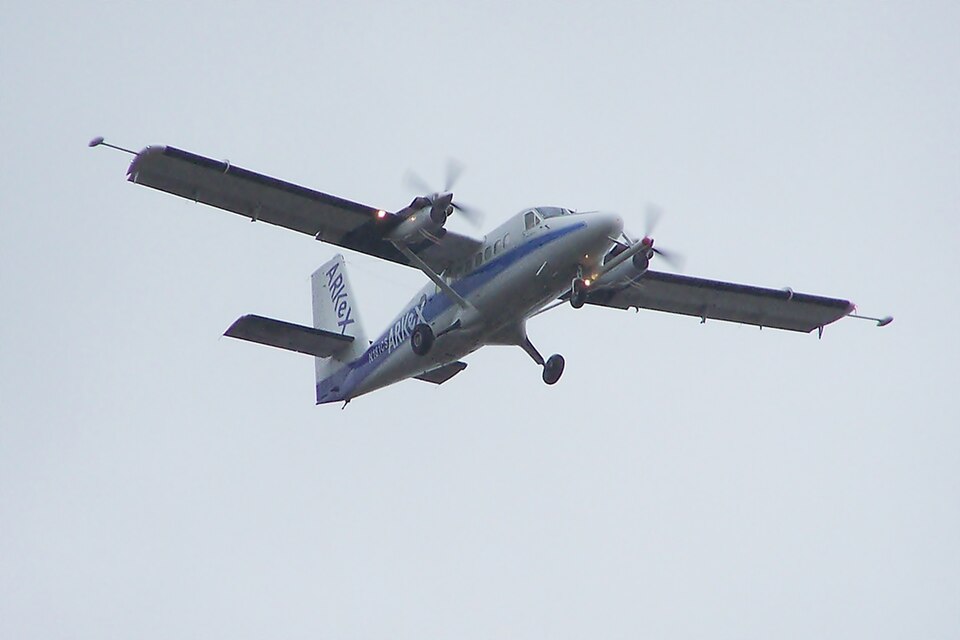
On September 6, 2015, about 1540 eastern daylight time, a DeHavilland DHC-6-200, registration N181CS, operated by Rampart Aviation, LLC, sustained substantial damage during landing at North Raleigh Airport (00NC), Louisburg, North Carolina. The airline transport pilot flying received minor injuries, the airline transport pilot not flying was seriously injured, and the passenger was not injured. Visual meteorological conditions prevailed, and no flight plan was filed for the aerial observation flight that departed Washington County Airport (AFJ), Washington, Pennsylvania, around 0915. The flight was conducted under Title 14 Code of Federal Regulations Part 91.
According to the pilot, during the final leg of the traffic pattern, he reduced the power levers for landing and noticed that the right engine sounded like the propeller was heading towards beta. He increased engine power, and the sound stopped. Closer to the runway, he decreased engine power, the noise returned, the airplane yawed to the right, and he applied left aileron and rudder to remain aligned with the runway centerline. While over the runway, the pilot reduced engine power to idle, and the airplane pushed hard to the right. He then applied full power to attempt a go-around, but the airplane yawed about 30 degrees off the runway centerline, touched down in the grass, and impacted trees before coming to rest.
Aircraft Information
The airplane came to rest about 80 feet from the right side of the runway. The right wing, right engine, and right propeller assembly were impact separated. The right side of the cockpit exhibited crush damage. The right engine propeller came to rest approximately 50 feet forward of the main wreckage and was observed in the feather position. Examination of the bolt holes where bolts secured the propeller to the right engine exhibited elongation and smearing.
According to Federal Aviation Administration records, the airplane was manufactured in 1968. It was equipped with two Pratt and Whitney Canada PT6A-27, 620 horsepower engines that utilized 4-bladed McCauley controllable pitch propeller assemblies installed per Supplemental Type Certificate (STC) SA1385GL.
Postaccident examination of maintenance records indicated the most recent continuous airworthiness inspection was performed on September 3, 2015. An overhauled propeller was installed on the right engine, and a test flight was performed on September 4, 2015, which was 8.7 flight hours prior to the accident. The maintenance logbook entry for the right propeller stated: "Reinstalled propeller [in accordance with] McCauley Owner Operators Manual…[torqued] nuts to 57 ft lbs with [torque] wrench. No defects noted." At the time of the accident, the airplane had accumulated 6,915.4 total hours.
Propeller and Governor Examination
According to the McCauley Propeller Owner/Operator Manual, the propeller was designed to operate in two modes: beta mode and governor mode. Beta mode could be selected for ground reversing or taxi operation via the aircraft engine mechanical linkage, repositioning the propeller reversing lever and beta valve to provide access for high pressure oil to move the blades toward reverse pitch. The propellers were a single acting unit where hydraulic pressure opposes springs and counterweights to obtain correct pitch; hydraulic pressure urges blades toward low pitch (increasing RPM), while springs and counterweights urge blades toward high pitch (decreasing RPM).
According to STC SA1385GL, the McCauley propeller installation on the accident airplane required the propeller retaining nuts to be torqued to 68 to 72 foot pounds.
The right propeller governor was sent to the manufacturer for examination and testing. During the examination, the governor functioned without anomaly. Nicks and "chatter marks" were observed around the mounting hole of the base closest to the drain port. The speed setting lever was bent outward, the max stop screw had been adjusted out an excessive number of threads, and the control lever return spring was not engaged to the speed setting lever. The maximum speed was set about 170 rpm below the factory specification, and the pneumatic control valve settings for overspeed and underspeed were reset to compensate. Additionally, the beta valve travel from null, or neutral position, was out of tolerance; however, during testing, the governor operated without anomaly.
Additional Findings
The right propeller governor control rigging could not be examined and tested due to damage to the right wing incurred during the accident sequence. Manufacturer installation guidelines stated to ensure proper rigging of engine controls, referencing the aircraft maintenance manual or STC maintenance manual supplement, and noted that feather, reverse, and low blade angles are set during assembly or overhaul and are not adjustable in the field. The propeller manufacturer preflight checklist indicated that the control system (governor) should be checked to determine whether the system is operating properly and is not leaking.