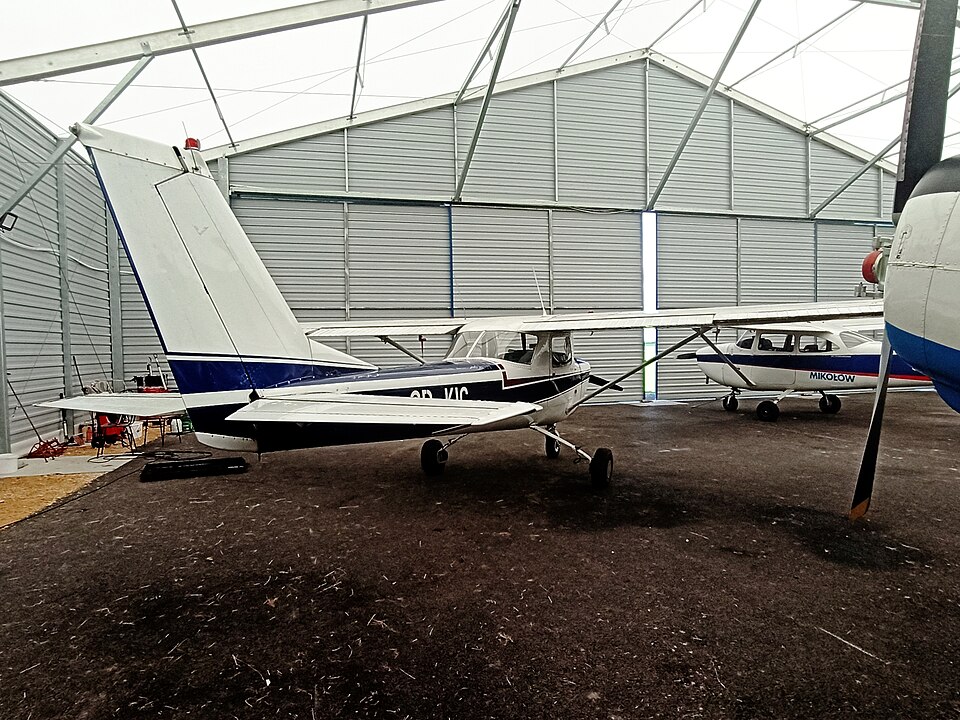
Accident
On 22 July 2018 at 15:18 local time, a Cessna 150J (registration SP-KIC) was damaged during a training landing at Bydgoszcz-Szwederowo Airport (EPBY). The aircraft was conducting circuits and low-level landing maneuvers at 500 ft AGL under visual meteorological conditions. The pilot, a student under the supervision of a ground-based instructor via radio, was performing her second flight of the day.
Aircraft
The Cessna 150J, serial number 15069630, was manufactured in 1969 and powered by a Lycoming O-200A engine. The aircraft had accumulated 5,853.7 hours total time. Its last periodic inspection (50-hour) was performed on 3 June 2018. The aircraft was operated by Ośrodek Szkolenia Lotniczego ATO Grafprom Aviation and owned by Franklin sp. z o.o.
Pilot
The student pilot was a 53-year-old woman training for a PPL(A) license. She had completed 187 flights (32 hours 22 minutes), including 14 solo flights (2 hours 11 minutes). Her training record showed no anomalies. She held a valid Class 2/LAPL medical certificate with VML limitation, valid until 20 April 2020.
Sequence of Events
During the landing on runway 08, the aircraft bounced upon first touchdown. Subsequent touchdowns and bounces occurred with varying amplitude (a "kangaroo" effect). After the fifth touchdown, the nose landing gear collapsed rearward from its engine mount attachment, the axle fractured, and the wheel separated. The propeller struck the runway surface and was destroyed. The aircraft veered right and came to a stop 10 meters from the southern edge of runway 08, about 170 meters west of taxiway C.
The pilot reported the incident to the tower at 15:19, shut down the aircraft, and evacuated unassisted within 2 minutes 50 seconds. Airport fire and rescue services arrived 3 minutes 12 seconds later; fuel leakage was mitigated. The runway was closed until 19:30, causing a 3-hour delay to a scheduled airliner.
Damage
The nose landing gear was torn out, the axle and wheel bearing were destroyed, the engine mount and lower cowling were damaged, exhaust pipes were bent, and the propeller was destroyed. The engine required a post-propeller-strike inspection. No injuries were reported.