History of Flight
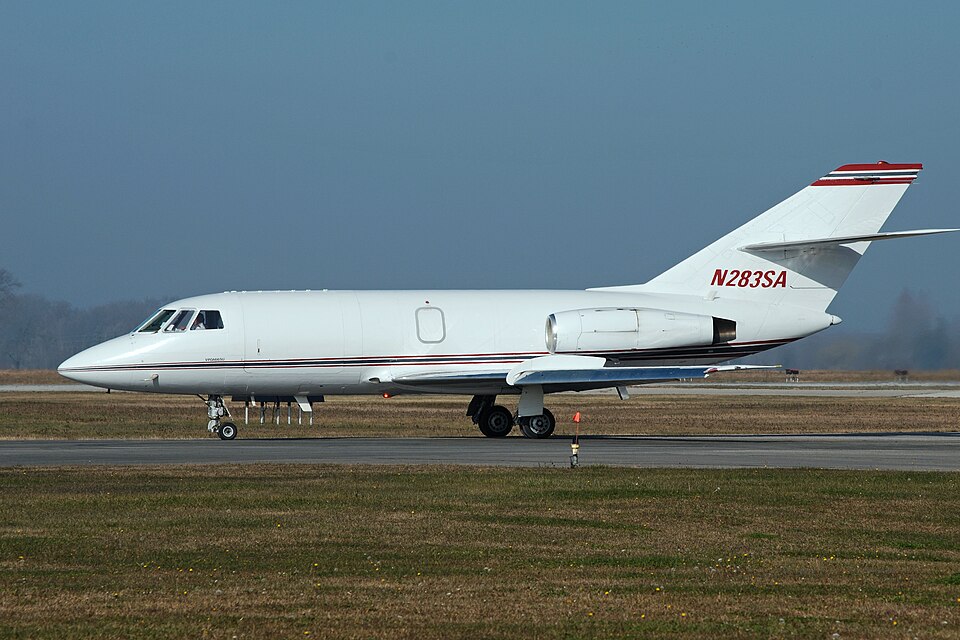
On October 5, 2021, at 0544 eastern daylight time, a Dassault Falcon 20C airplane, registration N283SA, was destroyed when it impacted terrain near the Thomson-McDuffie County Airport (HQU) in Thomson, Georgia. The captain and first officer were fatally injured. The airplane was operated as Pak West Airlines Flight 887 dba Sierra West Airlines, as an on-demand cargo flight under 14 CFR Part 135.
The flight crew initiated the first flight of the night from El Paso International Airport (ELP) to Lubbock Preston Smith International Airport (LBB) at 2132 mountain daylight time. After a delay of about 2 hours 20 minutes, the accident flight departed LBB for HQU.
Air traffic control communications showed the flight was in contact with Atlanta Air Route Traffic Control Center for the final 40 minutes. At 0503, the flight requested NOTAM information for the ILS localizer runway 10 approach. The controller advised of two NOTAMs: the ILS runway 10 glidepath was unserviceable, and the localizer NOTAM was not in effect until after the expected arrival. At 0525, the crew requested the "ILS runway one zero approach." At 0526, they were cleared to CEDAR intersection. At 0537, they were cleared for the ILS localizer approach and instructed to cross CEDAR at or above 3,000 ft. At 0543, near CEDAR, the crew requested to cancel IFR clearance, which was acknowledged.
Surveillance video at HQU showed the airport and runway lights activated at about 0539. About 0542, the airplane's landing lights became visible and were steady for about 2 minutes. About 25 seconds before the lights disappeared, a momentary right turn, followed by a left turn and increased descent rate, was observed. No explosion was seen when the lights disappeared at about 0544.
Cockpit Voice Recorder Information
The CVR captured interactions between the captain and first officer. During the enroute descent through an area of storms, the captain made repeated stern comments about the first officer's performance as the pilot flying, including "fly the airplane" and "I've got the airplane." At 0521, the captain stated "you fly the damn airplane." At 0527, the captain exclaimed "altitude" and shouted "I'll get that, you fly the damn airplane. I don't want you to kill me." At 0532, the captain said he would fly while the first officer loaded a waypoint, then later stated "you got the airplane." Over the next minutes, the captain gave repeated instructions on headings, speed, and altitude.
At 0539:28, the captain said in a frustrated tone "would you fly the airplane... I've been doing everything else." The captain noted airbrakes stowed, flaps set to 40°, and before landing checklist complete. At 0541:15, he stated "follow the glideslope without that" and later said the localizer was alive. At 0542:20, he said "I want you to fly the airplane." At 0543:22, the captain commented they were high and fast, needing to lose 20 kts. At 0543:51, he stated "you're way high" and the first officer responded "no I'm not." The captain said "you're fifteen knots fast we got a short runway." At about 0544, the captain said "use your air brake" and "now you're low." About 6 seconds later, he said "you got trees." Power increased rapidly, the stall warning activated, and impact occurred at 0544:07.
Performance Data
ADS-B data showed the airplane crossed CEDAR at 2,600 ft msl and 500 ft left of the extended runway centerline. After CEDAR, the flight track continued toward the runway, about 600 ft above a 3° visual glide path and further deviating left. At about 3 nautical miles from the threshold, the descent rate increased. Airspeed was about 150 kts. ADS-B coverage ended at 05:43:54, about 3,000 ft short of the first tree strike. Final recorded altitude was 900 ft msl (400 ft agl), calculated airspeed 137 kts.
Personnel Information
The captain satisfactorily completed indoctrination training in September 2019 and was assigned as pilot in command on the DA20. Multiple airman competency checks from 2019 to 2021 were completed satisfactorily, but some required retraining due to unsatisfactory performance, including circling approaches and steep turns. The captain had previously been employed by Ameristar Jetcharter Inc. from June 2017 to August 2019. On December 22, 2017, a proficiency check was disapproved due to distraction leading to a loss of airspeed to a full stall.
The first officer was hired on August 20, 2009, and assigned as second in command on the DA20. He left for 5 years and returned in 2019. A proficiency check on December 30, 2020, was completed with remarks "SIC Only." The operator reported the first officer was designated SIC only due to performance and lack of aeronautical decision making.
Aircraft Information
The airplane's landing reference speed (Vref) for flaps 40°, 20,000 lbs, and no airbrakes was 113 kts. Speed bugs were set to 115 kts (left) and 110 kts (right). The airbrakes are electro-hydraulic devices on the upper wing surfaces. The DA20 AFM stated airbrakes should be checked IN during approach; with flaps extended, airbrakes must be retracted unless anti-ice is on. No evidence of anti-ice usage was found. Aerodynamic stall speed was likely about 91 KIAS (flaps 40°) and 95 KIAS (flaps 25°). The airplane was equipped with a stall warning system that sounds a modulated tone.
Operator Information
Pak West Airlines, dba Sierra West Airlines, held a Part 135 certificate. The accident crew flew together routinely and performed overnight flights. The operator's standard operating procedures required the pilot not flying to announce altitude callouts during visual approaches; none were made by the captain. The General Operations Manual defined a stabilized approach concept and required both pilots to ensure stability before descending below minimum altitudes (500 ft agl for visual approaches). The manual stated that either pilot could call for a go-around, which required immediate execution.
Meteorological Information
An NTSB weather study indicated low clouds, drizzle, rain, and low visibility likely persisted along the approach path. Dark nighttime conditions existed with both sun and moon below the horizon. Surveillance video showed the landing light was steady and continuous, with no indication of entering clouds in the viewable 2 minutes. Inflight advisories were current for thunderstorms west and north of the destination and IFR conditions over the region.
Wreckage and Impact Information
Initial impact was with broken pine tree branches in a forest with trees about 150 ft tall. The debris path was oriented on a heading of about 100°, spanning about 880 ft to the main wreckage. The airplane was heavily fragmented with no evidence of fire. All major components were located. Flight control continuity could not be determined due to fragmentation, but continuity was observed within fragmented areas. The flap selector was in the full flaps 40° position, landing gear handle down. Left and right attitude indicators were damaged with multiple fail flags. The flap surface position was near 25° as found. Landing gear were extended. Left air brake surface partially extended, right nearly fully extended. Both engines exhibited impact damage and ingestion of wood chips and green vegetation.
Additional Information
The NTSB has outstanding recommendations for Part 135 operators to implement Safety Management Systems (SMS) and Flight Data Monitoring (FDM) programs. As of the report's publication, the FAA had no requirement for the operator to implement such programs.