History of Flight
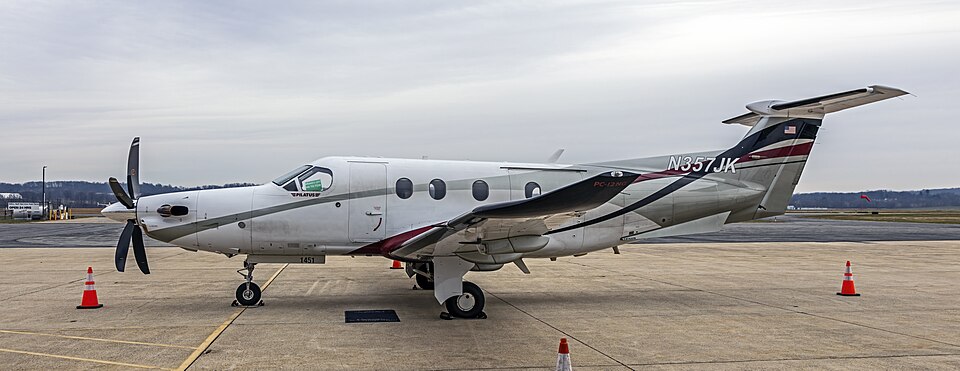
On February 2, 2022, at about 0655 eastern standard time, a Pilatus PC-12/47E, registered as N357JK, was substantially damaged when it struck a parked, unoccupied airplane at Long Island MacArthur Airport (ISP), Ronkonkoma, New York. The commercial pilot and a pilot-rated passenger were not injured. The flight was conducted under Title 14 Code of Federal Regulations Part 91 as a personal flight.
The pilot stated that the ramp where the airplane was parked had spots of snow, slush, and a spot of ice, though he considered it safe. The pilot-rated passenger, who had 252 hours in the airplane, performed the exterior preflight inspection and reported no discrepancies. After boarding and closing the door, the passenger noted no PIREPs or NOTAMs for adverse ramp conditions. The crew used the manufacturer's checklist for engine start. According to the cockpit voice recorder (CVR), some comments resembling checklist reading were heard, and portions of checklists were read aloud. However, no audible comment or challenge-and-response was made regarding the power control lever (PCL) position in the "Cockpit" checklist that preceded the "Before Starting Engine" checklist.
The PCL was specified to be in the idle position for engine start, and the pilot reported it was at idle. However, data from the flight data recorder (FDR) showed the PCL was not at idle for the entire recorded period, though the exact position could not be determined.
The pilot applied toe brakes and the parking brake, engaged the engine starter, and verified oil pressure rising and compressor turbine (Ng) speed reaching 13%. At 13%, he moved the condition lever (CL) to the flight idle position per the cold-start note. He observed Ng increase and felt the airplane lurch forward. Despite pressing harder on the toe brakes, the airplane continued forward as the engine spooled up. FDR data indicated the engine Ng reached 95.1%, propeller speed (Np) peaked at 1,870 rpm for about 6 seconds, and torque reached 43.2 psi. The airplane accelerated to a maximum groundspeed of about 26 knots. The pilot attempted to secure the CL but his thumb slipped off the cut-off guard. He looked down, then back up, and saw the airplane approaching a parked aircraft. Surveillance video showed the right wing separating at the wing root after impacting the nose section of the parked airplane. The passenger helped secure the engine after impact.
Aircraft Information
The airplane was certificated under 14 CFR Part 23, effective February 4, 1991, including Amendments 23-1 through 23-42. Amendment 42 specified that brakes must prevent wheels from rolling on a paved runway with takeoff power on the critical engine but need not prevent movement with wheels locked.
The airplane was equipped with a Pratt & Whitney Canada PT6A-67P engine. According to the Pilot's Operating Handbook and approved Airplane Flight Manual, takeoff engine operating limits were 1,200 shaft horsepower, 44.34 psi torque, 104% Ng, and 1,700 Np, with a maximum transient Np of 1,870 for 20 seconds.
The PCL selects engine power (Ng) and in certain conditions directly controls propeller pitch. At the idle detent, Ng is at idle and the propeller at minimum pitch.
Wreckage and Impact Information
Postaccident examination by an FAA airworthiness inspector revealed the parking brake was engaged, the PCL was forward, the CL was in cut-off, and the manual override lever was off. The left brake and parking brake were operational with no discrepancies. Both main gear tires showed minor scuffing but no flat-spotting. The right brake could not be tested due to wing separation.
The ramp, examined about one hour after the accident, was wet with patches of snow and ice. Alternating skid marks consistent with main landing gear tire width began about 50 ft from the reported parking spot and continued 75 ft toward the impacted airplane's nose.
Inspection of engine controls, throttle friction, cut-off guard, and rigging using the airplane maintenance manual (AMM) revealed no discrepancies. However, the maximum reverse stop at the center console was 0.005–0.015 inch more than specified clearance, and the forward stop was about 0.200 inch more than specified. Rigging of the PCL and CL at the engine was within tolerances.
The engine fuel control unit (FCU) was tested by the manufacturer under NTSB oversight. Although multiple test points in the start and acceleration schedule were out of acceptance limits, the report stated these did not preclude normal operation and did not contribute to the reported engine acceleration.
Maintenance records showed the most recent inspections on January 20, 2022, included adjustments to the overspeed governor and FCU linkage. No maintenance was performed between those inspections and the accident, during which the airplane accrued 16 hours over 10 flights.
Data from a previous uneventful engine start on January 30, 2022, by the same pilot showed maximum Ng of 66.7%, Np of 1,036 rpm, and torque of 7.59 psi with the PCL at idle.
Engine start testing on an exemplar airplane, witnessed by FAA personnel, indicated that with the PCL at idle and the CL moved to ground idle at the appropriate Ng, Np increased to about 963 rpm and the airplane barely moved without brakes. With the CL moved to flight idle, the airplane moved forward slightly.