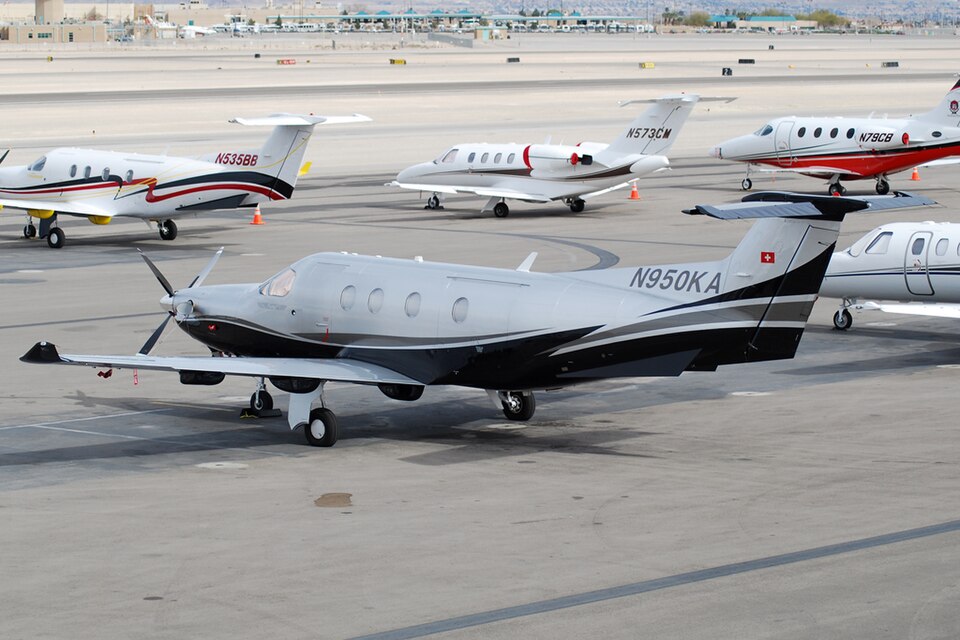
History of Flight
On June 7, 2012, about 1235 eastern daylight time, a Pilatus PC-12/47, registration N950KA, operated by Roadside Ventures, LLC, departed controlled flight and subsequently broke up inflight near Lake Wales, Florida. The airplane was substantially damaged, and the private pilot and five passengers sustained fatal injuries. The flight was conducted under 14 CFR Part 91 as a personal flight from St Lucie County International Airport (FPR), Fort Pierce, Florida, to Freeman Field Airport (3JC), Junction City, Kansas. An instrument flight rules (IFR) flight plan was filed, and instrument meteorological conditions prevailed at the altitude and location of the departure from controlled flight.
The flight departed FPR about 1205. After takeoff, while climbing west-northwesterly, air traffic control communications were transferred to Miami Air Route Traffic Control Center (Miami ARTCC). The pilot communicated with various sectors from 1206:41 until the last transmission at 1233:16.
About six minutes after takeoff, the controller advised the pilot of moderate to heavy precipitation 15 miles ahead, with returns 30 miles in diameter. The pilot asked about circumnavigation, and the controller approved deviations. The flight continued on a heading of about 290 degrees. At 1230:11, while at flight level (FL) 235, the controller cleared the flight to FL260, which the pilot acknowledged. At 1232:26, the central advisory and warning system (CAWS) recorded the pusher system entering "ice mode," indicating the pilot had selected propeller heat and inertial separator open. At that time, the engine information system (EIS) recorded the airplane at 24,668 feet pressure altitude, 110 knots indicated airspeed (KIAS), and an outside air temperature of minus 11 degrees Celsius.
At 1232:36, the controller advised the pilot of a large area of precipitation northwest of Lakeland with moderate, heavy, and extreme echoes, and suggested deviation right of course. The pilot agreed and at 1233:04 requested heading 320 degrees. The controller cleared that heading at 1233:08, and the pilot acknowledged at 1233:16. No further communications were recorded.
Radar data showed that between 1233:08 and 1233:26, the airplane flew at about 290 degrees, climbing from FL250 to FL251 at 109-110 KIAS. Between 1233:26 and 1233:31, it climbed to FL252. At 1233:30, with about 25 degrees of right bank, 109 KIAS, and 25,188 feet, autopilot disengagement occurred, recorded on CAWS three seconds later. Between 1233:30 and 1233:40, the bank angle increased to 50 degrees, and the airplane descended to FL249. From 1233:40 to 1234:00, the bank increased to about 100 degrees, and altitude dropped to FL226. The right descending turn continued, with a change to a southerly heading. At 1234:08, a maximum positive load factor of 4.6 was recorded, and at 1234:14, maximum airspeed of 338 knots was recorded, followed by zero airspeed one second later at about 15,292 feet.
Between 1234:22 and 1234:40, radar showed a direction change to northeast, with descent from 13,300 to 9,900 feet. The airplane continued northeast, descending to 800 feet by the last secondary radar return at 1235:40, located at 27 degrees 49.35 minutes North latitude and 081 degrees 28.6332 minutes West longitude.
At 1235:27, the controller attempted to contact the pilot with no response. Another aircraft pilot reported hearing an emergency locator transmitter (ELT) signal and a mayday call on 121.5 MHz. Witnesses on the ground reported hearing unusual sounds, seeing the airplane descending with missing parts, and observing a spin. The airplane crashed in an open field during daylight conditions, about 100 feet from the last radar return.
Pilot Information
The 45-year-old pilot held a private pilot certificate with single-engine land and instrument ratings, and a third-class medical certificate issued April 6, 2012, with no limitations. He listed 800 total flight hours on his last medical application. His logbook showed a first flight entry on February 3, 1994, and last on May 29, 2012. He had logged flights in various aircraft including the accident airplane. His first turbine engine flight was in 2009 in a Piper PA-46-500TP. He obtained his instrument rating in November 1997. He attended SIMCOM initial Pilatus PC-12 training from May 7 to May 16, 2012, receiving ground and flight instruction. He logged about 38 hours in the accident airplane, with approximately 14 hours after his flight review sign-off on May 16, 2012. His total flight time, corrected for logbook errors and unlogged flights, was about 755 hours, with about 657 hours as pilot-in-command.
Aircraft Information
The Pilatus PC-12/47 is a low-wing, T-tail, single-engine airplane. It was manufactured in 2006, powered by a Pratt & Whitney PT6A-67B engine, and equipped with a Hartzell four-bladed constant-speed propeller. The airplane was certificated for flight into known icing conditions. The maximum operating maneuvering speed is 163 KIAS, maximum operating speed 236 KIAS, and maximum diving speed 290 knots. The airplane was equipped with a Honeywell KFC 325 digital automatic flight control system providing three-axis control. The autopilot system included automatic electric pitch trim and yaw damper functions.