Overview
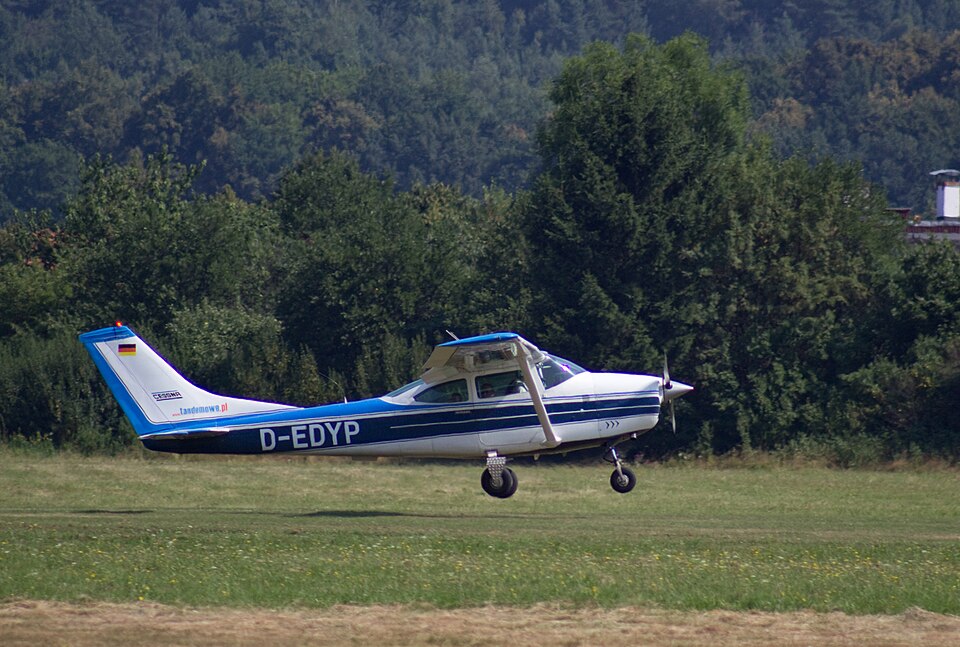
On 25 June 2023, a Cessna C-182L Skylane, registration D-EDYP, was involved in an accident at Jelenia Góra aerodrome (EPJG). The aircraft was performing parachute jumps. The pilot, a 30-year-old male holding a Private Pilot Licence (Aeroplanes) with a Single Engine Piston (Land) rating and a valid Class II medical certificate, had approximately 134 hours total flight time on five aircraft types. He had only one flight as pilot-in-command on the C-182L, a 5-minute circuit 12 days prior. He was not trained or experienced in flights with parachute jumpers.
Sequence of Events
On the day of the accident, the pilot conducted three flights, each time adding 30 litres of car fuel. The pilot reported that before each flight the tanks contained about 20 litres, giving a total of 110 litres available. The recorded aggregate flight time was 1 hour 22 minutes, corresponding to a theoretical fuel consumption of 102.5 litres based on the Flight Manual consumption of 75 litres per hour. The pilot had driven from the coast to Jelenia Góra the night before and was not rested.
During the third flight, parachute jumpers exited at 3000 m above ground level over Góra Szybowcowa. The pilot descended to the north of EPJG, entered the right circuit for Runway 28, and commenced a long, low approach. While configuring for landing, the engine stalled and did not respond to throttle movements. The pilot retracted the flaps to extend glide range and continued toward the aerodrome. Approximately 700 m before the runway threshold, the left wing struck a tree. The aircraft lost forward speed, made an uncontrolled ¾ horizontal turn, struck an earthen embankment vertically, and came to rest in a water reservoir about 1 m deep. The cabin was flooded and the engine submerged. The aircraft was destroyed.
Post-Accident Findings
The pilot egressed unaided, sustaining grazes to his head, arm, and back, and complained of strong spinal pain. He was hospitalized for diagnostic examination. Toxicology tests showed no alcohol or drugs. The wreckage was recovered from the reservoir after concerns about fuel contamination; no contamination occurred. Inspection revealed that the right-wing fuel tank was empty, the left-wing tank contained a residual amount, and the fuel selector was set to the right tank. The propeller damage indicated the engine was not running at impact. The fuel system was intact and tight.
Investigation Findings
- The pilot was not rested before the flights.
- The individual claiming to be the owner/lessee ran a parachuting business without an Air Operator Certificate for specialised operations.
- The aircraft had a valid Certificate of Airworthiness and Airworthiness Review Certificate issued by German authorities, but lacked an Aircraft Flight Manual and other technical documentation. The last airworthiness review entry was dated May 2021. The engine (Continental O-470-R) was installed in 1998, exceeding the recommended Time Between Overhaul of 1700 hours or 12 years. The propeller (McCauley) had an overhaul sticker from 2014, but its TBO is 2400 hours or 72 months.
- The parachute jump organiser did not hold required qualifications or documents for commercial operations.
Probable Cause
The immediate cause of the engine stall was fuel starvation. The accident (collision with obstacles on the ground) was caused by the pilot's unawareness of the engine stall in flight (the propeller was only windmilling) and the incorrectly executed approach (too low, too flat) which prevented reaching the aerodrome in gliding flight.
Contributing Factors
- The pilot's inexperience in flying the Cessna C-182L.
- The pilot's inexperience in flights combined with carrying parachute jumpers, including ignorance of the good practice suggesting execution of the final approach at a height that guarantees reaching the landing site without engine support.
- The pilot's exhaustion after a sleepless night.
- Chaotic organisation of flights for parachute jumps.
Commission Decision
The investigation was discontinued due to the jump organiser lacking an Air Operator Certificate and the aircraft being operated under undocumented rules. The Commission notified the President of the Polish Civil Aviation Authority and submitted the resolution to the District Prosecutor's Office in Jelenia Góra.