History of Flight
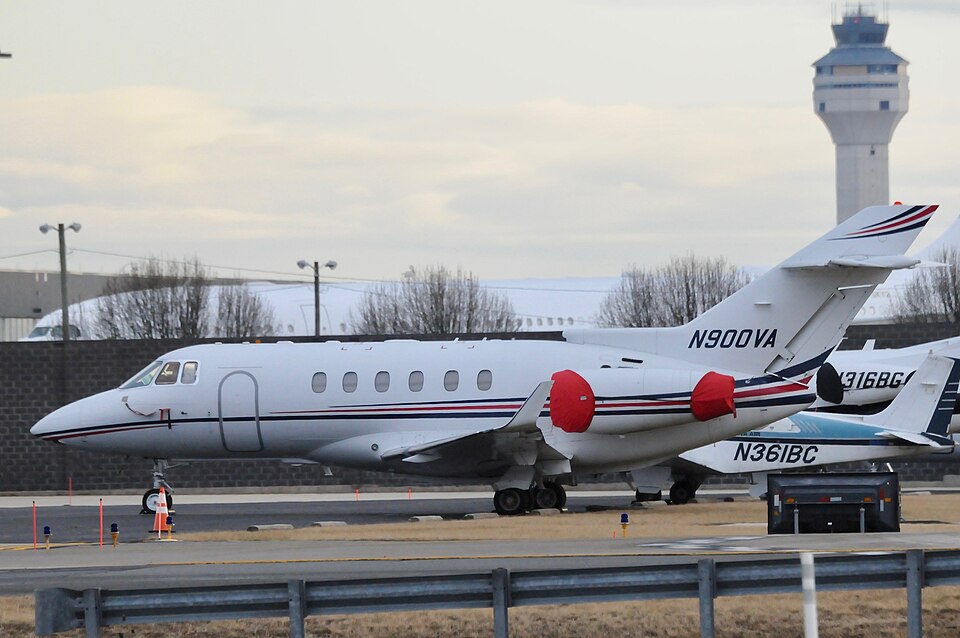
On February 7, 2024, about 1048 mountain standard time, a Hawker 900XP, registration N900VA, was destroyed when it was involved in an accident near Westwater, Utah. The pilot-in-command (PIC) and second-in-command (SIC) were fatally injured. The airplane was operated as a Title 14 Code of Federal Regulations Part 91 positioning flight.
The airplane, owned by Vici Aviation, LLC, and operated by Clay Lacy Aviation, Inc., arrived at West Star Aviation’s facility at Grand Junction Regional Airport (GJT), Grand Junction, Colorado, on December 20, 2023, for routine maintenance. The maintenance included multiple inspections, such as removal of the wing leading edges and de-icing panels to inspect for cracks and corrosion. The airplane was returned to service on February 6, 2024.
The flight crew planned to fly from GJT to Gig Harbor, Washington, while performing a required post-maintenance stall warning and systems check en route.
At 1036:41, the SIC reported to the PIC that anti-ice was off while on the ground before departure. ADS-B and flight data recorder (FDR) data indicated the airplane departed GJT at 1037 and entered a climb on a southeast heading. At 1038:45, the flight crew requested a block of altitude in the “mid-teens for about ten minutes.” Thirty-two seconds later, the SIC again reported “anti-ice is off.” At 1039:54, the PIC stated, “we’ll request a ah altitude once we get above in V-M-C.” The airplane made a right turn northwest while climbing. At 1042:25, the SIC requested a block of altitude from FL180 to FL200, which was approved, and the airplane leveled off at 20,000 ft msl.
The FDR showed that at 1044:00, airspeed began decreasing from 219 kts as pitch attitude and angle of attack (AOA) increased. At 1044:41, the flight crew began discussing the stall test. At 1045:01, the autopilot was disconnected. At 1045:51, a sound consistent with the gear warning horn was heard. At 1046:33, the cockpit area microphone recorded a sound consistent with the stick shaker, and the SIC reported “one nineteen.” The airplane’s pitch attitude continued increasing while decelerating until 1046:37. While decelerating from 118 kts, at an AOA of 0.91% and 0.93% for the right and left, and a pitch attitude of 15.12°, Stall Valve A opened. At 1046:37, a rattling sound accompanied the stick shaker.
At 1046:47, flight track data showed the airplane began a rapid descent in a corkscrew pattern, completing multiple circular rotations before ending at 1047:44.
Personnel Information
The PIC and SIC completed their most recent training at a commercial simulator training facility. According to an instructor, a demonstration of the stick pusher is performed in a simulator at high altitude, with the autopilot on, to show that the autopilot disconnects when the stick shaker activates. No proficiency is required for that demonstration, and the facility does not teach full stalls.
The PIC completed recurrent training in a Hawker 800XPi simulator in October 2023, about 9 months before the accident, receiving satisfactory ratings in all categories including stall prevention.
The SIC completed initial training in the Hawker 800XPi 4 months before the accident, also receiving a satisfactory rating. However, in one simulator session on October 24, 2023, the SIC received a rating of “1” (insufficient progress) in the stall prevention category and six other areas. The next day, the SIC repeated the session and achieved a “3” (proficient). During the checkout on October 28, 2023, the SIC received a grade of “S” (satisfactory) for all events.
The operator’s records indicated that the PIC had conducted an inflight stall test once before, on December 7, 2019, as the second-in-command on that flight. There was no record that the SIC had conducted an inflight stall test before the accident flight.
Aircraft Information
The Hawker 900XP was launched in 2006 by Raytheon Aircraft Company. The type certificate was transferred to Hawker Beechcraft Corporation, then Beechcraft Corporation, and on October 12, 2016, to Textron Aviation, Inc., the holder at the time of the accident.
Stall Test Requirement
The recent maintenance required a stall test per the structural repair manual (SRM) due to removal of the wing leading edges every 4 years to access de-icing panels for inspection (SRM task code No. 570026). According to the SRM, a test flight is required if the leading edge assembly was removed as a whole, or if two or more TKS wing distribution panels on one side were removed or installed. The SRM references the Pilot’s Operating Manual (POM) for the stall test procedure.
Stall Test Procedure from POM
The POM specifies required conditions: altitude above 10,000 ft AGL, 10,000 ft above clouds, and below 18,000 ft MSL; day visual meteorological conditions with a good visual horizon; autopilot disengaged; operative stall identification system; external surfaces free of ice; ventral tank empty; weather radar on standby. The technique requires wings level flight, thrust set and maintained, trim to 1.4 Vs1, airspeed reduced at no more than 1 kt/second, and avoidance of rapid or violent control movements, especially below stick shaker activation.
Accident Flight Stall Test
According to FDR data, the flight had an empty ventral tank, the autopilot was switched off before the stall test, and the stall identification system was operative. The flight was in VMC conditions about 5,000 ft above clouds and about 2,000 ft above the maximum prescribed altitude of 18,000 ft msl. The flight crew’s visual horizon and weather radar status are unknown. The crew decelerated at 1 kt/second while maintaining level flight, with no rapid movements observed in FDR data until the stall break.
Stall Characteristics
The POM notes that a moderate roll is acceptable if ailerons limit the roll angle to no more than 20°. It warns of possible “aileron snatch,” which should not be considered acceptable. In case of aileron snatch, the POM advises moving the elevator forward to decrease AOA and restore normal aileron control. The POM caution states: “PILOTS CONDUCTING STALL CHECKS SHOULD HAVE PRIOR EXPERIENCE IN PERFORMING STALLS IN THE HAWKER AND MUST BE PREPARED FOR UNACCEPTABLE STALL BEHAVIOR AT ANY POINT LEADING UP TO AND THROUGHOUT THE MANEUVER.” The POM also warns there is no natural stall warning or aerodynamic buffet before the stall.
The type certificate holder defined aileron snatch as roll upset caused by airflow separation inducing self-deflection of the ailerons, possibly beyond the pilot’s physical capability to overcome.
The operator’s Standard Operator Procedures Manual provided guidance on stall and stick pusher recovery: reduction of AOA is required, and for aircraft with a stick pusher, training allows the pusher to reduce AOA. Deliberate activation of the pusher is not an evaluated maneuver.
Stall Warning and Identification System
The airplane was equipped with a two-channel stick shaker (warning) and stick pusher (identification) system. The stall warning arms during takeoff when no weight-on-wheels is recognized; the identification portion arms 6 seconds after takeoff. The stick shaker provides a physical warning. AOA is derived from two heated vanes. The stick pusher is hydraulic, controlled by two independent stall valves (A and B), both must open to activate. The signal summing unit calculates the stall point using vane and flap angle inputs. If AOA continues increasing after the shaker, the stick pusher activates automatically when both SSUs agree the airplane is at the stall point.
De-Icing System
The airplane had an airframe fluid ice protection system for wing and horizontal stabilizer leading edges. A timer switch controls an electrically-operated pump. When selected, the first minute is high flow, then normal flow. If icing persists, the timer should be reset before reaching zero to avoid high flow restart. When the timer reaches zero, a warning chime sounds. The system distributes fluid through distributor panels with micro-porous plastic and titanium outer skin. An ice detector is not connected to the system. Ice detection spotlights illuminate wing leading edges for night visual inspection. The AFM includes procedures for flight into icing conditions, including selecting engine ignition and anti-ice on, and priming the airframe system.
Meteorological Information
High-Resolution Rapid Refresh (HRRR) model data showed broken or overcast cloud layers between about 8,200 ft and 15,000 ft msl at the accident site. The freezing level was about 6,500 ft msl, with potential for light or moderate clear, rime, or mixed icing between 7,800 ft and 15,300 ft msl. Satellite data indicated cloud top heights of about 17,500 ft msl. A Graphical-Airmen’s Meteorological Information (G-Airmet) was issued for moderate icing between the freezing level and 22,000 ft msl at 0800, and between the freezing level and 20,000 ft msl at 1100, both valid for the accident site. A Graphical Forecast for Aviation (GFA) icing probability analysis for 18,000 ft msl at 1045 showed a zero percent probability. The GFA cloud cover showed broken clouds at 8,000 ft with tops to 28,000 ft. The National Center for Atmospheric Research modeled ice accretion of less than 1 mm.
Video of the departure showed low-altitude clouds. A witness reported precipitation and sleet during the preflight and asked the PIC about finding an opening in the storm clouds; the PIC replied, “we’ll just get above them.” A mechanic also observed precipitation and sleet during the preflight.