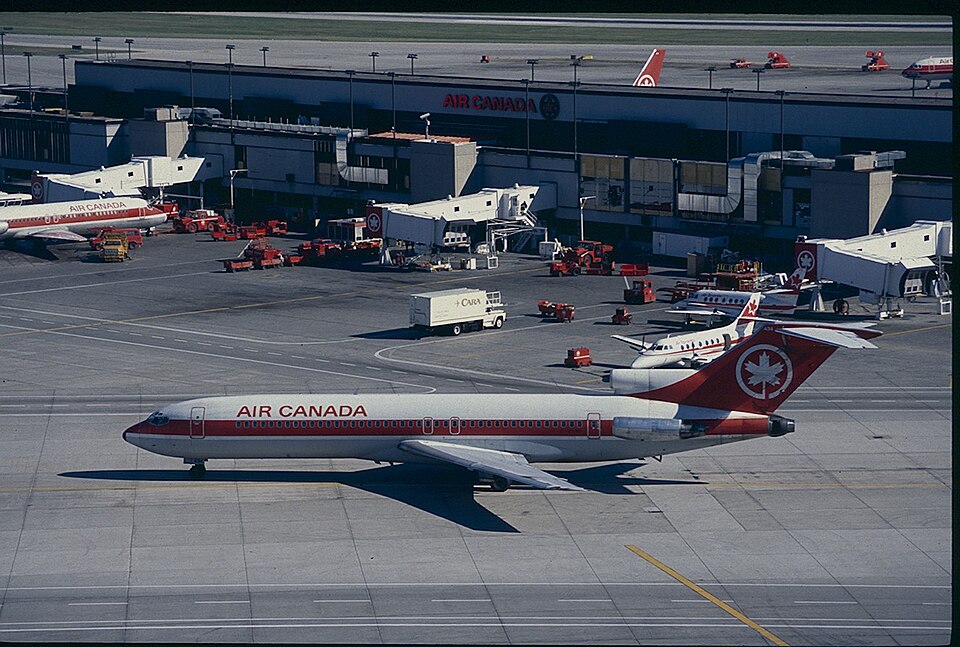
On May 28, 2004, a Boeing 727-225 C-GCJB operated by Cargojet Airways Limited was involved in an aviation accident near Greater Moncton International Airport, CA. This summary draws on records from the Transportation Safety Board of Canada (TSB); 11 related events involving the same aircraft type or operator are linked below.
A Cargojet Boeing 727-225 (C-GCJB) scraped its left wing during a rejected landing at Moncton after two missed approaches in deteriorating weather. No injuries occurred, but the aircraft sustained damage.
Incident Overview and Aircraft Damage Cargojet Airways Flight 620, a Boeing 727-225 freighter registered as C-GCJB, was operating a night cargo flight from Hamilton, Ontario, to Moncton, New Brunswick. The first officer was the pilot flying, while the captain was conducting a line check. After two unsuccessful approaches in darkness and poor weather, the crew landed on the third attempt. A post-flight inspection revealed visible damage to the left wing, specifically abrasion on the tip of the left outboard leading edge flap and the outboard trailing edge flap “canoe.” The damage was consistent with slight contact with the runway, which occurred at 0241 Atlantic daylight time during the rejected landing after the second approach. At the time of contact, the aircraft was at a pitch angle of five degrees nose up, 14 degrees of left bank, and approximately 26 feet above the ground. No injuries were reported. ## Weather Reporting and Observations Weather observations at Moncton were conducted by ADGA Group Consultants Incorporated under contract with NAV CANADA. According to the Manual of Surface Weather Observations (MANOBS), observers are required to maintain a continuous watch on the weather and take check observations between regular hourly reports to ensure significant changes are not left unreported. A check observation is also required when a pilot report (PIREP) indicates conditions differ significantly from current observations. However, the weather observer was not advised that conditions were significantly lower than reported until after Flight 620 had missed two approaches. An observation released at 0249 reported a visibility of 1½ statute miles, but the crew did not receive this report as they were already under vectors for the third approach. The observers lacked access to area forecasts, satellite information, radar data, or observations from other airports. Additionally, the equipment used to determine the ceiling at night, a ceiling projector and alidade, was time-consuming to use and not ideally located due to interference from high-intensity ramp lighting and adjacent buildings. ## Approach Sequence and Fuel Status The first approach was a straight-in, localizer back-course approach to Runway 11. The aircraft remained in cloud at the minimum descent altitude of 270 feet above ground level, leading to a missed approach at 0231. The crew was then radar vectored for an instrument landing system (ILS) approach to Runway 29. During this approach, the autopilot’s altitude hold function malfunctioned, prompting the first officer to manually fly the approach. The aircraft was configured for a flap-30 landing. At decision height of 200 feet, the crew saw the approach lights. The aircraft was slightly right of the extended centerline. At about 150 feet, the first officer banked right to acquire the runway centerline, positioning the aircraft near the right edge of the runway at about 40 feet. A further correction toward the centerline was made, and at about 20 feet above the runway, with 14 degrees of left bank, the first officer reduced power to land. The captain then took control, applied power, and increased pitch to five degrees nose up to reject the landing. Before the wings were leveled, the left-wing leading-edge slat and trailing-edge flap scraped the runway. The crew was unaware of the contact at the time. The aircraft was vectored for another Runway 29 ILS approach, and the captain landed at 0253. ## Crew, Fuel, and Operational Factors The captain had 40,000 total flight hours, including 9,000 on the type, while the first officer had 5,000 total hours, including 600 on the type. Both were well-rested, and fatigue was not a factor. During the third approach, the fuel remaining was below the minimum required diversion fuel of 8,680 pounds. At shut down, 6,400 pounds remained. The company’s Flight Operations Manual requires that upon reaching minimum diversion fuel, the flight must proceed immediately to the alternate airport unless an imminent landing is reasonably assured. The Moncton weather forecast called for a marked decrease in ceiling and visibility starting at 0300, but the transition was already underway during the first approach. The crew, expecting weather well above minimums based on the 0200 ATIS report, did not update the weather for the filed alternate, Greenwood. Had the reported weather reflected the actual conditions, the crew would likely have planned for a diversion and conducted an ILS approach to Runway 29 as their first approach, which would have increased the chances of a successful landing and avoided the low fuel state.