Flight History
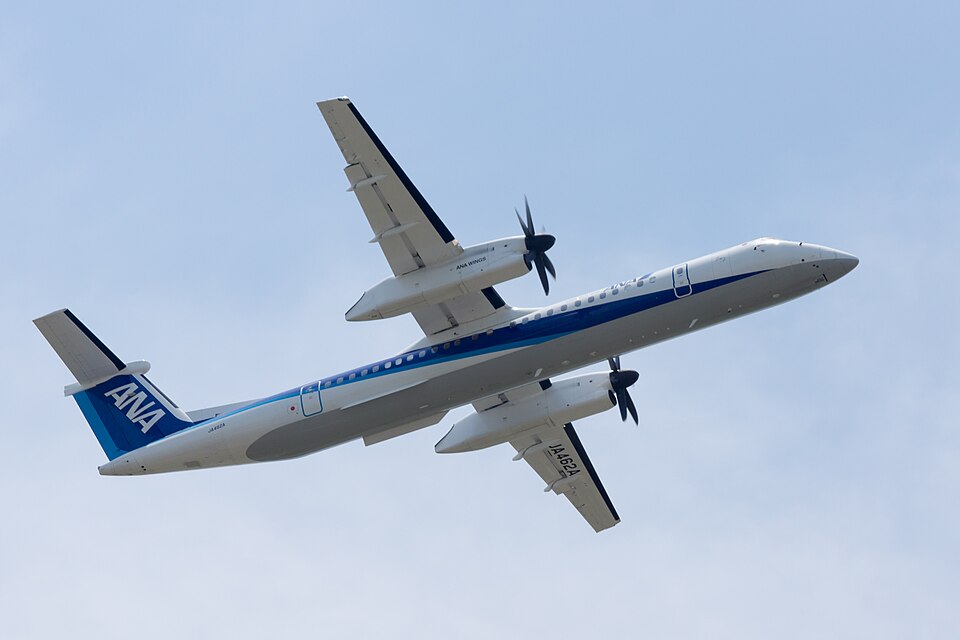
On November 29, 2013, at 09:03 Japan Standard Time, a Bombardier DHC-8-402, registered JA462A and operated by ANA Wings Co., Ltd., departed Fukuoka Airport as flight 4915 bound for Fukue Airport. The aircraft carried the pilot in command (PIC), first officer (FO), four other crew members, and 36 passengers, totaling 41 people on board.
During pre-flight weather checks, the PIC and FO noted a wintry pressure pattern with a trough passing through western Japan, but no specific information indicated lightning on the planned route. The PIC served as pilot flying (PF) and the FO as pilot monitoring (PM).
While cruising at 12,000 ft toward Fukue, the crew observed white clouds with a top height of 11,000 ft on their course. As the aircraft began descent around 09:24, those clouds appeared on the weather radar as a green area (weakest rainfall). At approximately 09:30, while descending through clouds, the PIC and FO saw a bright flash from the left front of the cockpit and heard a loud bang.
After the event, the crew performed checks and found no abnormalities except a wind noise from the nose. The aircraft continued its approach, exited clouds, and landed at Fukue Airport at 09:37. Post-landing inspections by the crew and a mechanic revealed damage.
Damage to Aircraft
The aircraft sustained substantial damage, including:
- Five dents on the aft side outer skin of the upper left nose access panel, each 1–3 mm deep and deformed inward.
- Six burned rivet heads on the upper left access panel.
- Burn marks on the aft latch of the upper right access panel and both latches of the upper left access panel; these latches were found open.
- Deformations in the internal structure supporting the damaged outer skin.
- Paint flaking (approximately 1 mm diameter) on the radome.
- Burned static dischargers on the left wing tip and right elevator tip.
- Burned part of the APU silencer.
Despite the open latches, the panels were prevented from fully releasing by other mechanisms. Pitot tubes located near the panels functioned normally, as confirmed by flight data recorder (FDR) records and crew statements.
Meteorological Conditions
The Aviation Special Weather Report for Fukue Airport at 09:28 indicated wind from 280° at 12 kt, visibility 10 km or more, sleet, and multiple cloud layers with bases from 1,500 to 3,000 ft. The broader weather pattern featured a wintry pressure setup with a high to the west and a low to the east, along with a cold pressure trough causing instability. Lightning observation data from Franklin Japan recorded one strike at 09:30:12 near the aircraft's route.
Investigation Findings
The Japan Transport Safety Board determined that the aircraft was struck by lightning at approximately 09:30 at an altitude of about 5,300 ft, roughly 20 km northeast of Fukue Airport. The lightning strike originated from low-altitude cumulus clouds distributed over a wide area, typical of winter conditions on the Sea of Japan side, rather than from summer cumulonimbus. The analysis noted that the crew had visually observed these clouds and seen them as a weak rainfall area on radar, but predicting the lightning was difficult.