Introduction
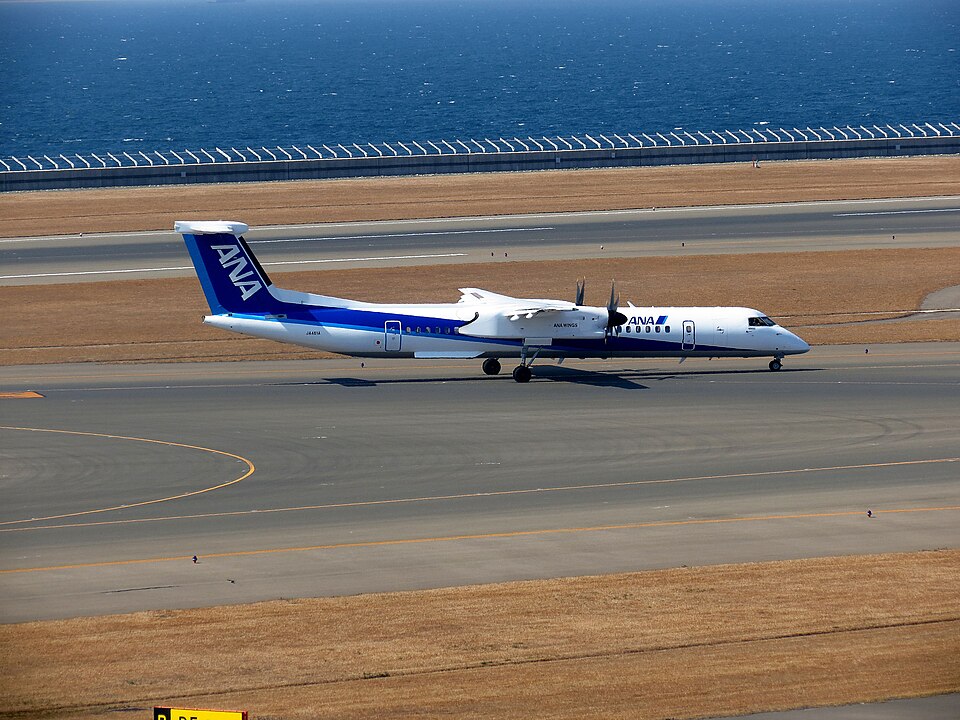
On January 19, 2017, a Bombardier DHC-8-402, registration JA461A, operated by ANA Wings Co., Ltd., overran the end of Runway 01R at New Chitose Airport in Hokkaido, Japan, and came to a halt on snow-covered grassland. The aircraft was operating as All Nippon Airways Flight 1831 from Akita Airport.
Flight History
The aircraft departed Akita Airport with a delay of 15 minutes due to one of two runways at New Chitose Airport being closed for snow removal. The pilot in command (PIC) had checked snow conditions at New Chitose prior to departure. After holding at a waypoint, the aircraft was vectored for an ILS approach to Runway 01R. The runway 01L/19R was closed for snow removal. The PIC set flaps to 15° and approached at VREF plus 10 knots.
At 11:56:34 JST, the aircraft touched down near the touchdown zone marking, approximately 300 m from the threshold, at an airspeed of about 122 kt (CAS) and groundspeed of about 107 kt. Ground spoilers deployed automatically after main gear touchdown. The power lever remained at about 45° PLA until touchdown, then moved to the Flight Idle position at about 42° PLA and stayed for about 50 seconds.
The PIC intended to vacate the runway via Taxiway B2 and delayed braking, expecting the aircraft to stop based on reported braking action of Good. The co-pilot observed that the propeller ground range advisory light was not on and thought the PIC was delaying braking. Normal post-touchdown procedure includes setting PL to Flight Idle, then to Disc, and applying brakes. According to FDR data, the PL moved slowly to Flight Idle position for five seconds from 11:57:23 at about 56 kt GS near Taxiway B3. The co-pilot was monitoring instruments and heading and did not have a clear memory of the PL position.
The PIC began applying brake pressure from near Taxiway B4, but braking pressure started rising as the aircraft passed Taxiway B3. The PIC did not feel deceleration and applied maximum braking pressure (3,000 psi) at about 35 kt GS, about 200 m before the runway end. The co-pilot felt braking and did not assist. The PIC attempted to steer left to avoid overrun zone edge lights. The aircraft decelerated gradually but passed the runway end at about 20 kt GS and stopped at 11:58:07 on snow-covered grassland. The right main landing gear stopped about 72 m from the runway end. No impact was felt on stopping. After a crew conversation, the PL moved to Disc position at 11:58:37. The PIC reported to the tower that the aircraft could not taxi, stopped the engine, and confirmed no injuries.
Aircraft Information
The aircraft was a Bombardier DHC-8-402, serial number 4430, manufactured December 17, 2012. It had a total flight time of 8,833 hours 53 minutes. Post-incident function tests of the anti-skid system were normal, though detailed inspection revealed that the wheel speed transducer of the left inner main wheel did not output an electrical signal. No other abnormalities were found.
Personnel Information
The PIC, age 52, held an airline transport pilot certificate and type rating for the DHC-8, with 15,510 total flight hours and 880 hours on type. The co-pilot, age 38, held a commercial pilot certificate and type rating, with 2,880 total flight hours and 2,541 hours on type.
Meteorological Information
At 11:30, wind was 340° at 15 kt, visibility 10 km or more, light shower snow, temperature –3°C, dew point –4°C, QNH 30.02 inHg. At 12:00, wind was 350° at 13 kt, similar conditions.
Additional Information
Runway condition assessment for snow-ice was last performed at 08:52 prior to landing. The braking action was reported as Good. The PIC did not use reverse pitch to avoid lateral slip on the snow-ice runway. The co-pilot concurred that reverse pitch should not be used on a slippery runway.