History of the Flight
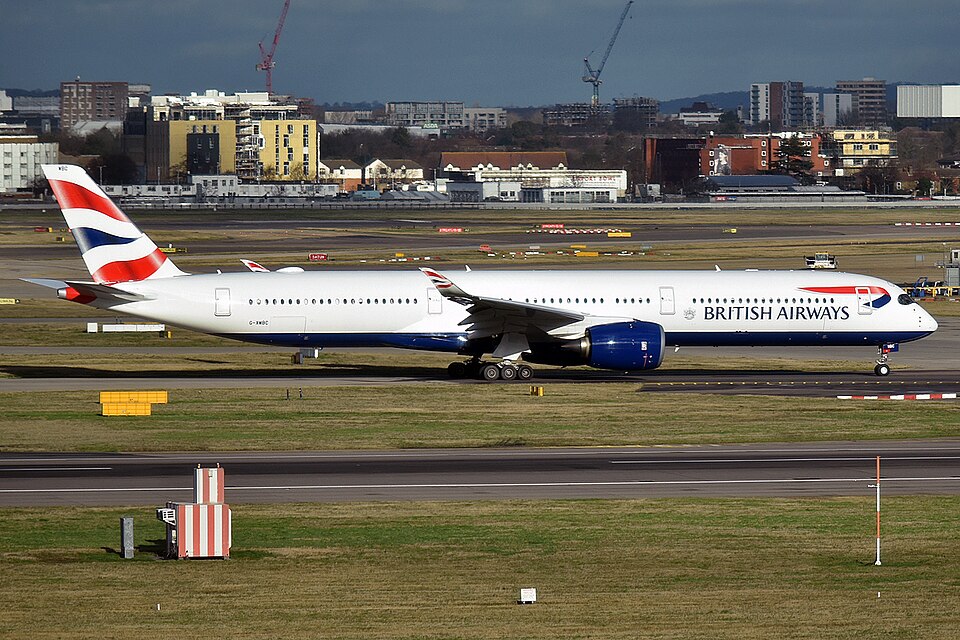
The aircraft, an Airbus A350-1041 (registration G-XWBC), was operating a commercial passenger flight from Dubai International Airport to London Heathrow Airport on 2 January 2022. The flight crew had completed a rest period in Dubai and reported feeling normally rested. Departure preparations were routine, and the only technical log entry concerned a flight deck touch screen on the commander’s side. The aircraft departed Dubai at 0620 hrs.
The flight to Heathrow was uneventful. The crew briefed an approach to Runway 27L, with forecast gusts up to 30 kt. They discussed implications and calculated landing performance for both Flap 3 and Flap Full configurations. The runway surface was wet, so they assumed medium to poor braking action and no reverse thrust for landing distance calculations. They selected the N6 exit using the Brake to Vacate autobrake system.
The operator uses a monitored approach philosophy: the commander was pilot flying (PF) for initial stages, then handed control to the co-pilot for final approach and landing. The crew accepted a shorter arrival routing from ATC, causing the aircraft to be higher than intended. The commander used speedbrakes to increase descent rate, and the aircraft was in landing configuration by 2,000 ft agl. The co-pilot took over PF at approximately 1,000 ft agl.
Another aircraft landing ahead planned to vacate at N6, so the co-pilot continued the ILS approach with autopilot engaged until that aircraft cleared the runway. He disengaged the autopilot at approximately 400 ft agl for a manual landing. He made corrections due to wind conditions but described the approach as normal. The ATIS reported wind 210° at 11 kt gusting 22 kt.
The co-pilot manually reduced thrust at approximately 50 ft agl and flared. The radio altimeter sounded at 5 ft, after which the aircraft “floated.” Height increased to 9 ft then decreased to 5 ft with a second call. The commander considered the aircraft would land beyond the touchdown zone (TDZ) and called for a go-around per the operator’s Safe Landing Policy.
The co-pilot initiated the go-around, selecting TOGA on the thrust levers and applying pitch-up control, briefly reaching full aft movement. Engine spool-up took several seconds; the aircraft briefly touched down with increasing pitch attitude reaching 15° nose-up. The pilots described the touchdown as firm but not a heavy landing. With the aircraft on the ground, the aural configuration warning sounded due to TOGA thrust with landing flap setting.
The aircraft became airborne and climbed normally. The crew retracted landing gear and reduced flap to Flap 1. At 400 ft agl, the ECAM displayed a tailstrike warning. ATC informed the crew of a tailstrike. The crew completed ECAM actions, then after takeoff checklist. They decided to continue an approach to Runway 27R. The co-pilot continued as PF until the commander took control for landing. After landing, airport RFFS inspected for damage, and the aircraft taxied to a parking stand.
Damage
Initial damage assessment found two areas of skin damage on the tail lower fuselage, one at each end of the toilet waste panel aft of the tailstrike sensor. The rearmost area was surface finish damage; the forward area penetrated through paint, copper mesh lightning protection, and up to five carbon fibre reinforced plastic layers. The toilet waste panel’s leading and trailing edges and rivets were abraded by the runway surface, but considered repairable. The tailstrike sensor fractured on impact as designed.
Recorded Information
The FDR and CVR recorded the event. The FDR data showed the approach from 100 ft radio altitude. At approximately 55 ft, the aircraft was flared and thrust reduced to idle. Over three seconds, nose-up sidestick increased to 3/5 deflection, pitch attitude reached 6° nose-up, and the aircraft floated at 5 ft without touchdown. Four seconds later, the aircraft began to climb, pitch increased, then a sharp nose-down input occurred. The aircraft descended, pitch reduced towards 5°, and nose-up sidestick reached full travel, elevators reaching 4/5 nose-up travel. At that point, having used 900 m of runway and at the end of the TDZ, the go-around was initiated. Thrust levers moved to TOGA, sidestick reduced but still nose-up. Pitch attitude rose rapidly to 10° nose-up, airspeed decreased, and before engine spool-up the aircraft touched down briefly. Then as it became airborne again, airspeed reached a minimum of 135 kt and the tailstrike occurred. Despite nose-down inputs, pitch attitude continued to increase to a maximum of 16° nose-up before elevators reduced it. After that, the flight path stabilised.