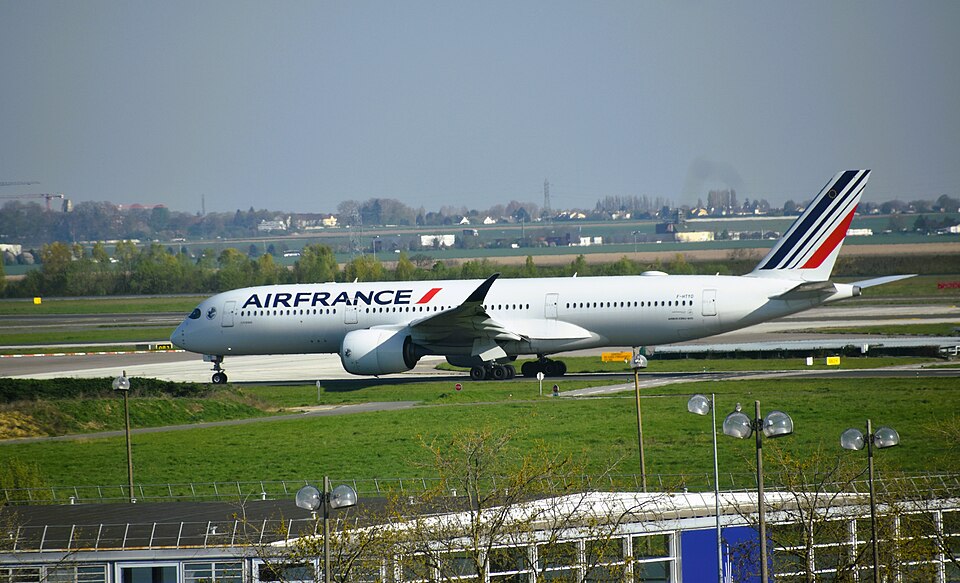
History of the Flight
On 28 May 2023, the Airbus A350-900 registered F-HTYO, operated by Air France, was conducting flight AF291 from Kansai International Airport (Osaka, Japan) to Paris-Charles de Gaulle Airport (France). The flight crew consisted of a captain and three co-pilots, with 10 cabin crew members and 309 passengers on board.
During the climb, the crew received weather radar fault indications (WXR fault). In response, they decided to execute an in-flight turn-around. While descending through Flight Level 300, the radome collapsed on itself.
The structural failure of the radome caused airflow disturbances that affected the pressure measurements of the airspeed indicator probes located at the front of the aircraft. This resulted in discrepancies in the airspeed indications displayed on the primary flight displays. The discrepancies varied throughout the flight depending on the aircraft's angle of attack. During the approach, when the slats and flaps were extended to Configuration 1, the pilots observed prolonged fluctuations in airspeed indications and subsequently disconnected the autopilot and autothrust.
The crew performed an overweight landing without any incident.
Damage and Consequences
The incident resulted in damage to the radome and the weather radar antenna. The airspeed indicator probes were also affected by the airflow disturbances. No injuries were reported among the occupants, and no other damage occurred.
Investigation and Safety Measures
Following notification from Air France, the BEA (French Civil Aviation Safety Investigation Authority) opened a safety investigation. The Japan Transport Safety Board (JTSB) declined to investigate as the occurrence did not meet the criteria for a serious incident or accident under ICAO Annex 13.
The investigation identified that the damage to the radome was not detected during maintenance. As a result, Airbus updated the maintenance tasks related to radome inspection and the handling of weather radar faults. Additionally, Airbus revised the A350 Flight Crew Operating Manual (FCOM) and Flight Crew Techniques Manual (FCTM). Air France implemented measures to alert pilots about the New Air and Inertia Automatic Data Switching (NAIADS) system and to remind maintenance technicians of the risks associated with radome composite structure damage.