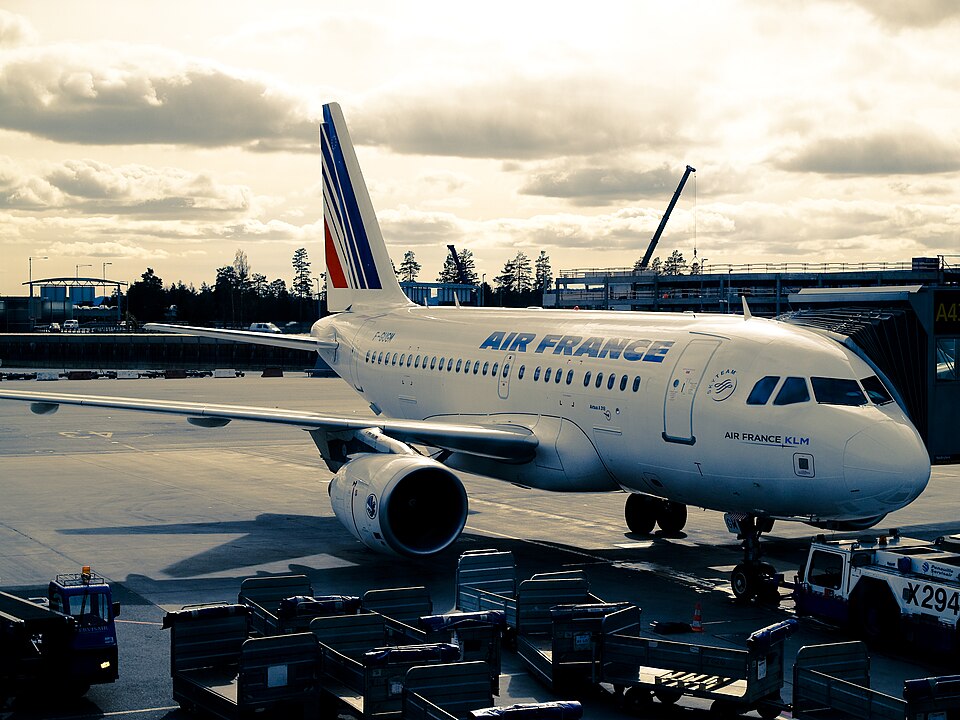
Incident Overview
On 12 September 2020, an Airbus A318-100 registered F-GUGM and operated by Air France was involved in an incident during approach to Paris-Orly Airport (Val-de-Marne). The aircraft was performing a scheduled passenger flight from Biarritz-Bayonne-Anglet Airport. The crew consisted of one captain (pilot flying), one co-pilot (pilot monitoring), three cabin crew members, and 81 passengers. No injuries occurred.
Flight History
The aircraft was descending to flight level 110 en route to waypoint ODILO for an ILS approach to runway 25. At approximately 15:50 UTC, the approach controller proposed a shortened route, which the crew accepted. The controller directed the aircraft to fly direct to the CLM VOR and descend to 3,000 ft QNH. Autopilot 1 was engaged in DES/NAV mode with an indicated airspeed of 250 kt.
As the aircraft descended, the crew engaged OPEN DES mode and later used speed brakes. At around 8,700 ft, the controller suggested a short circuit and asked the crew to call back when ready for the base leg. The co-pilot reported readiness, and the controller provided an initial interception heading north, then a heading of 290° upon request. Lateral guidance was in HDG mode, and the crew was cleared for the ILS approach to runway 25. At that time, the altitude was 5,900 ft and indicated airspeed 247 kt. APP mode and autopilot 2 were engaged, with auto-thrust in SPEED mode.
At 4,900 ft, LOC* mode engaged, but the aircraft was approximately two dots above the glide slope, descending at 2,200 ft/min. Speed brakes were retracted. At 3,500 ft (9.1 NM from threshold), the aircraft was 600 ft above the glide slope at 249 kt. The controller instructed the crew to contact tower and gave a 'free speed' clearance. ALT* mode engaged at the selected altitude of 3,000 ft, causing engine N1 to increase. The crew disengaged both autopilots, selected a vertical speed of -3,000 ft/min, and set an altitude of 3,600 ft. V/S mode engaged, then G/S*. The crew then selected 2,000 ft, the missed approach altitude.
At 2,700 ft (7.4 NM from threshold), LOC mode engaged. The aircraft was in clean configuration at 250 kt. 'Managed' speed was selected, target speed decreased to green dot speed, and engine N1 decreased. Both autopilots were re-engaged. Shortly before GS mode, the vertical speed was around -2,200 ft/min at 250 kt.
At 2,287 ft (2,000 ft above aerodrome level), 6 NM from threshold, the aircraft was established on localizer and glide slope. The autopilots were disengaged, and nose-up input was recorded on the captain's sidestick. Calibrated airspeed decreased to 237 kt, and glide slope deviation increased to +0.8 dots. Landing gear was extended. Configuration 1 was selected. The captain, having the runway in sight, made a nose-down input, increasing vertical speed to -2,750 ft/min, and glide slope deviation decreased to -1.6 dots.
At 1,287 ft (1,000 ft AAL), 3.7 NM from threshold, the aircraft was in configuration 1, on localizer, 1.48 dots below glide slope, vertical speed -1,328 ft/min, airspeed 204 kt (VAPP+78 kt), engine N1 near idle at 28%.
Warnings and Controller Intervention
At 1,250 ft (about 960 ft AAL), 3.6 NM from threshold, the co-pilot changed the landing configuration from 'flaps full' to 'flaps 3' in the FMS, causing a VAPP increase. Simultaneously, the GPWS Glideslope alert activated on board, and the MSAW activated in the control tower. The LOC controller informed the crew of a terrain alert and instructed them to check altitude. The co-pilot replied they were maintaining altitude. The captain made a nose-up input, and the aircraft pitch changed from -2.7° to +7°, returning to the glide slope.
Shortly after, at 1,225 ft (about 940 ft AAL), 3.2 NM from threshold, the co-pilot selected configuration 2. The controller asked if they were on the glide slope; the co-pilot confirmed. Nine seconds later, configuration 3 was selected at 1,185 ft (about 900 ft AAL), with indicated airspeed 172 kt (VAPP+46 kt).
At 787 ft (500 ft AAL), the stabilization altitude, the aircraft was established on localizer and glide slope in landing configuration (configuration 3). Indicated airspeed was VAPP+26 (152 kt), vertical speed 624 ft/min, engine N1 near idle at 27%. These conditions exceeded the operator's non-stabilized approach detection thresholds.
The indicated airspeed reached VAPP 180 m after the threshold at a height of 10 ft. Thrust levers were set to IDLE at 6 ft. The aircraft landed on the runway at 380 m from the threshold at 123 kt.
Airport and Meteorological Information
Paris-Orly runway 25 is 3,320 m long and 45 m wide. Air France A320 crews regularly perform ILS approaches to this runway. The airport is equipped with MSAW since 1 March 2001. The weather was calm and sunny, with a light northwesterly wind. The 15:03 ATIS indicated ILS 25 approach, wind 300° 6 kt, CAVOK, temperature 23°C, QNH 1022.
Controller and Crew Actions
The initial approach controller stated that traffic was light and he proposed shortening the route. He considered the crew's request to turn premature but gave headings. He did not find the aircraft's altitude particularly high. The tower controller stated he usually sees aircraft at 180-200 kt and had not observed early warning signs. He saw the MSAW at 4 NM and noted the pilot reacted immediately. The controller added that MSAWs are rare.
The approach vectors were given in accordance with French air traffic regulations. No specific causal link is established in the source.