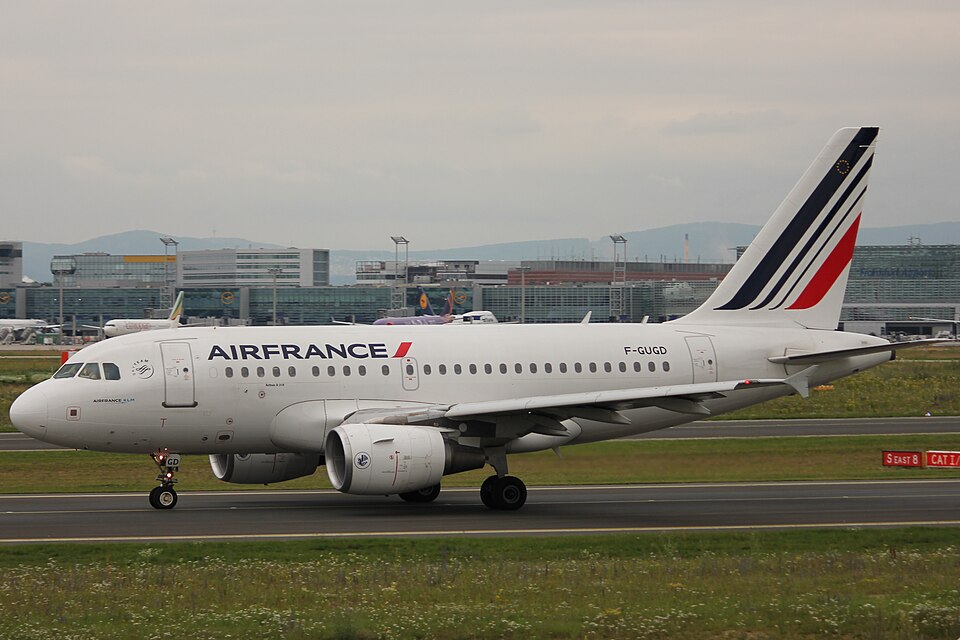
History of the Flight
The flight departed from Paris-Orly airport bound for Hyères-Le Palyvestre airport. The crew passed the JULEE waypoint of the approach procedure at flight level 110 in descent. They were in contact with Toulon approach, cleared to descend to 1,900 ft. The controller informed them that runway 23 was in use with wind 150° at 12 to 19 kt and that weather conditions might be tight for runway 23. During a left turn to join the Initial Approach Fix (IAF) PALME, the tailwind component increased from 0 to 50 kt in about 40 s and remained above 40 kt during the descent to roughly 3,000 ft.
The crew asked the controller if they could use runway 05 after checking landing performance. The controller accepted. At that time, the aircraft was in clean configuration, about 16 NM from the runway threshold at approximately 6,500 ft in a -2,000 ft/min descent, indicated airspeed 250 kt, speedbrakes extended, autopilot and autothrust engaged in OP DES/NAV and THR IDLE modes.
About one minute later, the crew passed the IAF. The controller asked if they wanted a direct approach or a holding pattern. The crew chose a direct approach for runway 05. The controller cleared them, and the APPR mode and AP 1 were engaged. The aircraft was 12 NM from the threshold at 5,170 ft, approximately 1,350 ft above a 3° glide slope, airspeed 237 kt decreasing, ground speed 307 kt.
A few seconds later, airspeed reached 220 kt, landing gear extended, and the aircraft established on the localizer. Slats and flaps set to configuration 1. Thirty seconds later, at 6.4 NM from the threshold, the autopilot changed to ALT* mode and started acquiring the selected altitude of 1,900 ft. The crew did not detect this mode change.
At 09:15:07, the crew passed the Final Approach Fix (FAF) at 5.3 NM from the threshold, altitude 2,200 ft and decreasing (500 ft above the published altitude of 1,700 ft). The glide index on the PFD indicated the aircraft was above the glide slope.
On reaching 1,900 ft, the AP changed to ALT mode and the aircraft stabilized in level flight, taking it further from the nominal 3° glide slope. The crew did not realize the aircraft was level and did not have sight of the runway due to cloud cover. In the following 20 s, they set slats and flaps to configuration 2, 3, then FULL. The landing checklist was carried out. Ground speed was 175 kt and decreasing.
The aircraft reached the 9° slope of the secondary lobe, and the AP G/S* mode engaged. The aircraft flew through the 9° slope in level flight and then was positioned above it. The AP ordered a nose-up movement because in the secondary lobe the glide signal is inversed: when above the 9° slope, the aircraft sees itself below the nominal slope and the AP commands nose-up.
Pitch attitude increased from 1° to 30° nose-up in about 20 s. The crew stated the increase was barely perceptible. The air traffic controller instructed a missed approach, but the crew did not read back. The pitch increase raised angle of attack and decreased speed. The A/THR increased thrust. When angle of attack triggered the low energy alert, the aural alert "SPEED SPEED SPEED" sounded. Two seconds later, at 09:16:22, ALPHA PROT activated. The PF put the thrust levers in the TOGA detent without calling out. The crew disconnected both APs, and ALPHA FLOOR activated. The PF saw TOGA LK on the FMA, moved levers to IDLE to disconnect A/THR and cancel TOGA LK, then returned levers to TOGA.
When pitch reached 30°, angle of attack reached 16° (exceeding Alpha Max of 15° for one second) before decreasing due to ALPHA PROT and nose-down inputs. Indicated airspeed decreased to a minimum of 96 kt, 20 kt below VLS and 2 kt above VS1G.
The PF then climbed on the runway centreline at about 1,000 ft/min, initially holding 15° pitch consistent with FD command bars in SRS mode. Angle of attack remained near 12° (ALPHA PROT threshold triggered again for ten seconds), and airspeed stayed below VLS. The crew selected flap retraction to position 3. Speed passed above VLS at 09:17:08 after 46 s below.
At 4,000 ft, the crew set 4,000 ft on FCU and thrust levers to CLIMB. They retracted flaps to position 2, stabilized at 4,000 ft, engaged AP 2 and A/THR. The controller proposed radar vectors to ILS 05. The second approach and landing were without incident.
Additional Information
ILS Glide Signal and Secondary Lobes
The ILS glide signal is generated by antennas near the runway threshold. The main lobe is centred on 3°. An unwanted secondary lobe at about 9° has an inversed signal: an aircraft above the 9° slope sees itself below the nominal slope, causing the autopilot to command nose-up.
Autopilot Glide Slope Acquisition Mode (G/S*)
The G/S* mode engages when glide path deviation passes below the lower threshold of two dots. The system does not check consistency with other information. In this incident, the aircraft approached the 9° slope from below; G/S* engaged shortly before reaching it. The initial nose-down orders lasted three seconds, insufficient to modify the flight path. Once above the 9° slope, the AP generated nose-up orders, causing the excessive pitch increase. The A318 did not have the anti-pitch up excursion protection available on other Airbus types.