Event Summary
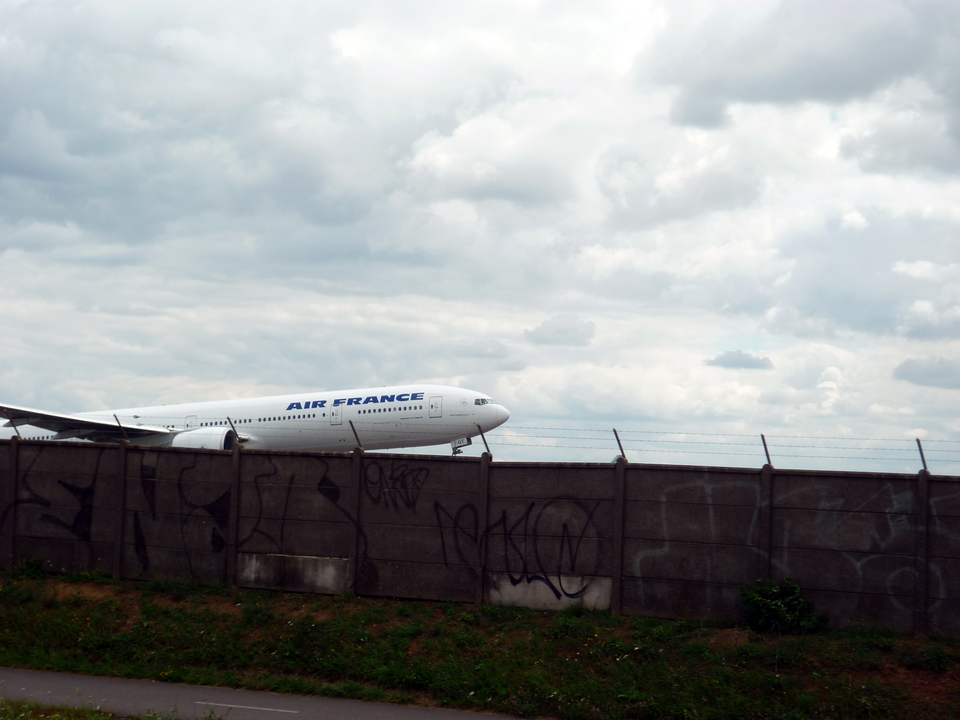
On Wednesday 30 August 2023 at around 13:30 local time, a ground collision occurred between an Air France Boeing 777-300 (registered F-GSQT) and a Delta Air Lines Airbus A330-900 (registered N411DX) at Paris-Charles de Gaulle airport. The Airbus A330-900 was taxiing on taxiway T when its right wingtip contacted the tail of the stationary Boeing 777-300, which was holding on taxiway UT3.
Aircraft and Personnel
The Boeing 777-300 was operating a passenger flight from Lima, Peru. The flight crew consisted of a captain (pilot monitoring), a co-pilot (pilot flying), and a relief pilot, along with 12 cabin crew and 473 passengers. The captain, aged 60, had approximately 16,000 total flight hours (4,000 on type); the co-pilot, aged 51, had approximately 12,000 hours (2,500 on type); and the relief pilot, aged 37, had approximately 7,000 hours (2,000 on type).
The Airbus A330-900 was operating a passenger flight from Seattle, USA. Its crew comprised a captain (pilot flying), a co-pilot (pilot monitoring), and a relief pilot, with 10 cabin crew and 282 passengers. The captain, aged 62, had approximately 20,000 total flight hours (6,900 on type); the co-pilot, aged 42, had approximately 5,000 hours (1,400 on type); and the relief pilot, aged 43, had approximately 10,000 hours (5,000 on type).
Sequence of Events
The Boeing 777-300 landed on runway 26L at about 13:15, vacated via ramp V3, crossed runway 26R on taxiway S3, and taxied on taxiway T6. The controller instructed the crew to turn left onto taxiway T and then right onto UT3 to hold on the de-icing pads, advising a 20- to 30-minute wait due to an unavailable parking stand. The aircraft taxied on T at approximately 8 kt, passing behind a Boeing 777-200 holding on UT4. At about 13:22, the crew shut down both engines, started the APU, and requested a five-minute warning before proceeding to the parking stand.
The Airbus A330-900 landed on runway 26L at about 13:25, vacated via ramp V2, crossed runway 26R on taxiway S3, and taxied on T6. The controller directed it to turn left onto T and then right onto UT2 to hold. The aircraft taxied on T at around 12 kt, slowed to about 8 kt as it passed behind the Boeing 777-200 and then the Boeing 777-300 on UT3. At 13:31:30, the right wingtip of the A330 struck the tail of the B777. The A330 stopped a few metres beyond.
Damages
The Boeing 777-300 sustained damage to its APU access hatches and both right-hand and left-hand elevators. The Airbus A330-900 suffered damage to its right winglet.
Context and Observations
The UT taxiways (UT1-UT4) are located on the south-west side of the airport and can be used as de-icing pads (designated SW1-SW4 when used for de-icing). A limitation in the Aeronautical Information Publication (AIP) restricts use of taxiway T between T1 and T2 to aircraft with a wingspan no greater than 36 metres when an aircraft is waiting on de-icing bays SW1-SW4. Both involved aircraft have a wingspan of about 60 metres. This restriction was documented in crew navigation charts and air traffic controller materials.
The Boeing 777-300 crew reported good weather but noted the flight had been long and tiring. They stated that there were no ground markings for north-facing use on UT3, and they positioned the aircraft level with the Boeing 777-200 on UT4, leaving space ahead. The Airbus A330-900 crew indicated that they saw the tail of the second Boeing possibly protruding beyond markings and slowed to a walking pace; they asked for a close watch but believed sufficient margin existed.
The controller, a 38-year-old with a GND rating, stated that workload was normal. She knew of the taxiway T limitation but associated it only with de-icing vehicle movement, not with aircraft taxiing. She had directed both aircraft to hold on UT3 and UT2 because other parking stands were occupied.