Aircraft and Flight Details
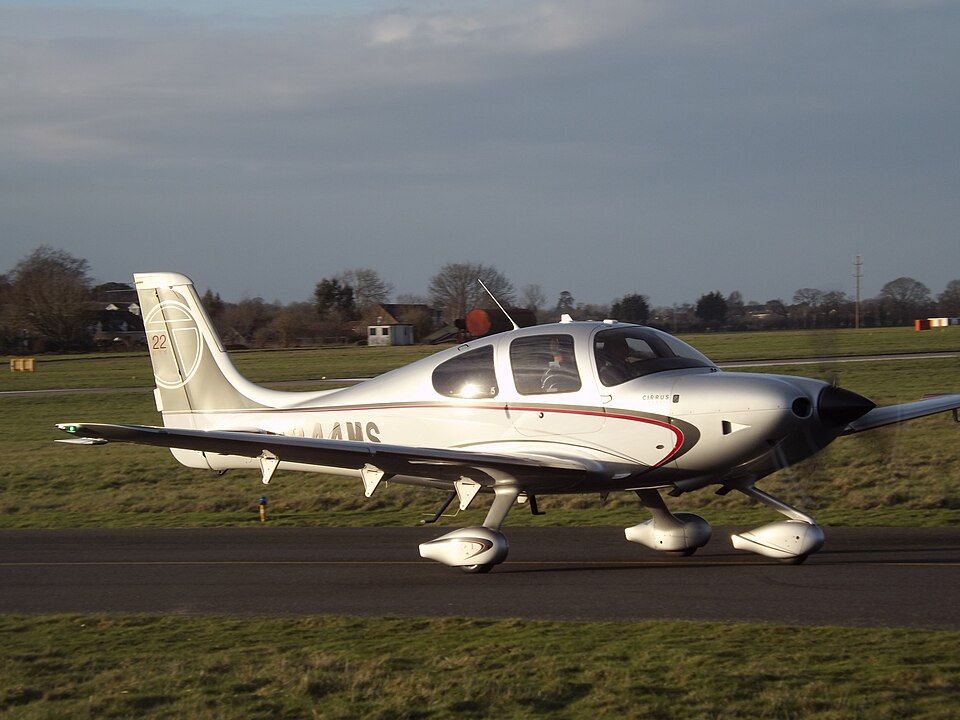
The aircraft involved, a Cirrus SR22 registered as N844MS, was manufactured in 2013 and powered by a single Continental Motors TS10-550-K piston engine. It was privately owned and operated by a syndicate of pilots. The pilot on the accident leg held a Private Pilot's Licence, was 60 years old, and had logged 1,348 hours total flying time, with 271 hours on type. In the preceding 90 days, he flew 14 hours; in the 28 days before the accident, 7 hours.
History of Flight
On 25 November 2017, two syndicate members flew the aircraft from Oxford to Leeds East Airport. After an uneventful flight, they decided to continue to Sherburn-in-Elmet Airfield for lunch before returning to Oxford. The pilot who flew from Oxford handed control to the other member for the leg to Sherburn-in-Elmet. The weather was good, with a westerly wind of about 11 kt, scattered cloud at 3,000 ft, and visibility exceeding 10 km.
The aircraft departed Leeds East at 1134 UTC and climbed to approximately 2,000 ft above airfield level (aal). The pilot made a radio call to the Sherburn-in-Elmet air ground station but could not recall the information exchanged, particularly regarding other aircraft in the circuit.
Accident Sequence
The pilot positioned the aircraft onto the downwind leg at about 1,000 ft aal and an airspeed of 100 kt. He noticed an aircraft ahead in the circuit and began reducing speed. Turning onto final approach for Runway 28 at 700 ft aal and 90 kt, he further reduced speed to 77 kt but determined the separation was insufficient to land safely. He leveled the aircraft at 500 ft aal and initiated a left orbit.
Approximately a quarter of the way through the turn, the pilot became aware of another aircraft on the downwind leg. To avoid it, he increased the bank angle. Data from the Garmin G1000 system recorded a maximum bank of 47° at an airspeed of 74 kt and a height of 460 ft aal. The left wing then dropped suddenly. The pilot performed a stall recovery, descending 300 to 400 ft before regaining control momentarily. Shortly after, the right wing dropped. Another recovery attempt allowed only enough height to level the wings before the aircraft struck the ground. The undercarriage collapsed, and the aircraft slid approximately 75 m before coming to rest.
Injuries and Damage
Both occupants sustained serious injuries. The aircraft was damaged beyond economic repair.
Pilot's Assessment
The pilot attributed the accident to the aircraft stalling, resulting from a combination of low airspeed and an increased stall speed during the turn. Recorded data were consistent with an accelerated stall. The pilot believed he may have become unaware of the decreasing airspeed due to the distraction of maintaining separation from other aircraft. He did not consider deploying the aircraft's ballistic parachute recovery system because events unfolded rapidly and the altitude was too low for the system to operate effectively.