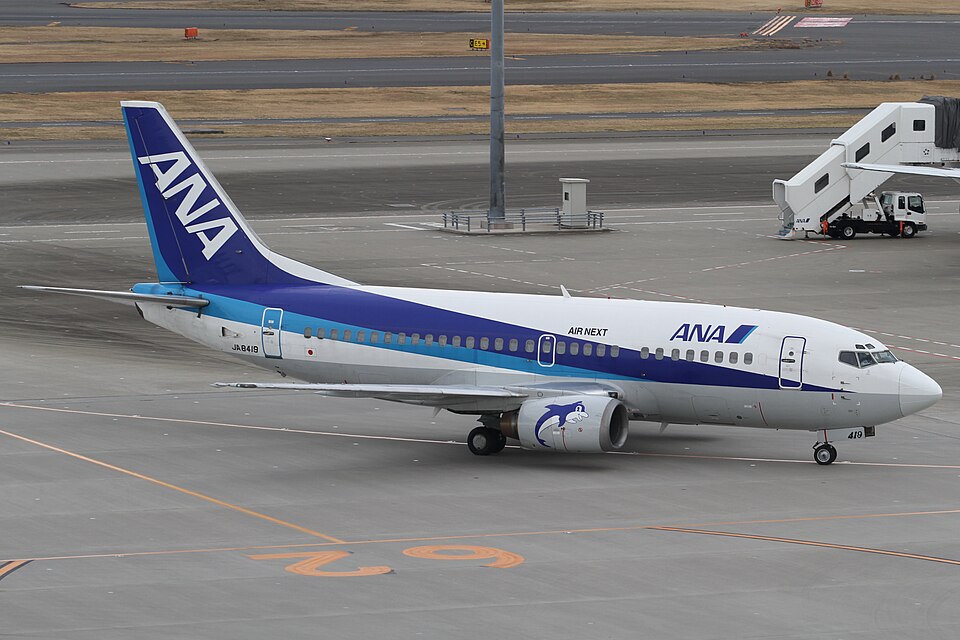
Overview
On July 5, 2006, a Boeing 737-500, registration JA8419, operated by Air Nippon Co., Ltd., was operating as All Nippon Airways scheduled flight 2142 from Fukuoka Airport to Narita International Airport. The aircraft departed Fukuoka at 07:24 JST with 46 persons on board: the pilot in command (PIC), four other crew members, and 41 passengers.
Flight Timeline
According to digital flight data recorder (DFDR), cockpit voice recorder (CVR), and air traffic control (ATC) radio communications records:
- At 07:42, the aircraft reached Flight Level (FL) 370 (approximately 37,000 ft).
- At 08:09, the throttle levers were retarded.
- At 08:10:05, the master caution light and AIR COND system annunciator illuminated.
- At 08:10:21, the crew requested descent to FL290 due to a cabin pressurization problem.
- At 08:10:31, Tokyo Control cleared the descent.
- At 08:10:40, the aircraft began descending.
- At 08:10:44, the cabin altitude warning horn sounded.
- At 08:10:50, the crew requested an emergency descent.
- At 08:10:56, Tokyo Control cleared the emergency descent.
- At 08:13:27, oxygen masks in the cabin deployed automatically.
- At 08:17:30, the aircraft reached 10,000 ft.
The aircraft landed at Chubu International Airport at 09:09. No injuries were reported.
Crew Statements
The PIC reported that during cruise, the cabin air temperature seemed to respond slowly to adjustments. After the master caution and AIR COND light illuminated, both BLEED TRIP OFF lights were observed, indicating that bleed air from both engines had stopped. The duct pressure dropped to about 5 psi. The cabin altitude rose to about 9,000 ft initially. The crew donned oxygen masks and initiated an emergency descent. The PIC noted that they were not using the wing anti-ice system. The cabin altitude warning horn sounded as altitude exceeded 10,000 ft, and the pre-recorded emergency announcement began automatically with mask deployment. After reaching 10,000 ft, the crew completed checklists, determined there were no hypoxic symptoms among passengers, and diverted to Chubu International Airport.
The First Officer's statement corroborated the timeline but provided no additional factual details relevant to the depressurization cause.
Investigation
The Aircraft and Railway Accidents Investigation Commission (ARAIC) investigated the serious incident. The United States, as the state of design and manufacture, participated. Investigators conducted interviews, teardown examinations, and analyses of deposits and detergent solutions in pneumatic system components. However, the report does not state a probable cause for the depressurization.