History of the Flight
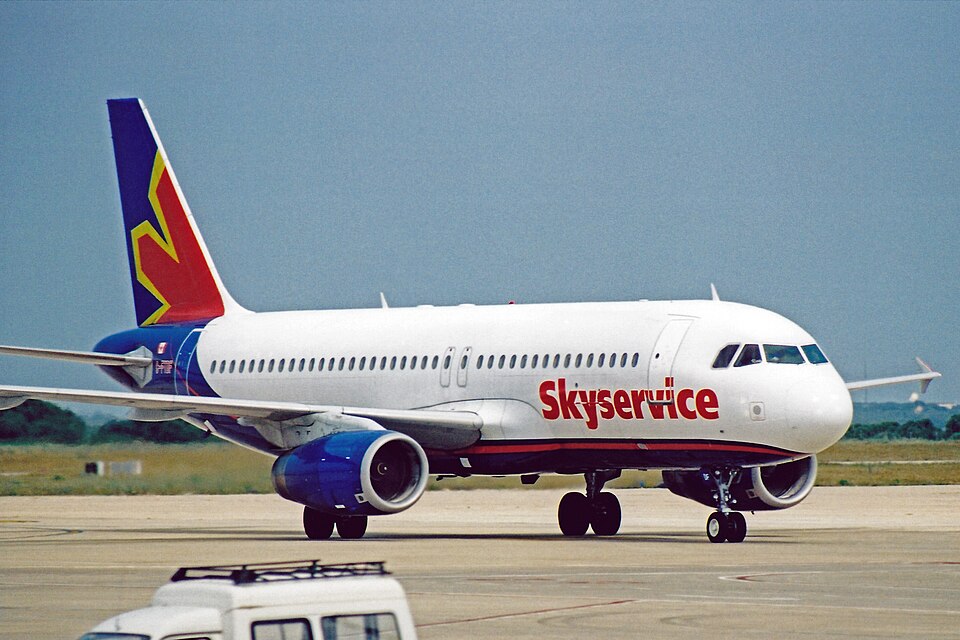
The aircraft, an Airbus A320-200 registered C-FTDF, was operating a public transport passenger flight from Tenerife to Cardiff International Airport. The crew had been on duty for approximately 10 hours. The approach was an ILS to Runway 30, with light winds, no cloud, good visibility, and a dry runway. The crew selected LOW autobrake and briefed for idle reverse thrust per noise abatement procedures.
At about 1,000 feet on final approach, the ECAM displayed a STEERING caption on the WHEEL page, and the approach status degraded from CAT III DUAL to CAT III SINGLE. The crew cycled the A/SKID & N/W STRNG switch; the indications returned to normal and the approach status returned to CAT III DUAL. The commander could not later recall if autobrake was re-armed after this action.
The aircraft landed normally and idle reverse thrust was selected. However, deceleration was not normal. The first officer announced "Manual Braking" as the autobrake panel showed it was not functioning. The commander pressed the brake pedals progressively to full deflection without effect. He then selected maximum reverse thrust and instructed the co-pilot to cycle the A/SKID & N/W STRNG switch again. After cycling, the commander again tried pedal braking with no response, and ordered the switch to OFF to obtain alternate braking from the hydraulic accumulator. He then applied sufficient wheel braking to stop the aircraft on the paved surface, about 40 metres from the end of the runway. This braking caused three mainwheel tyres to burst and a fourth to be badly scuffed. No fire occurred.
After stopping, the commander advised the cabin crew to remain seated and contacted the control tower for emergency crews to check for smoke. No evacuation was needed; crew and passengers deplaned 15 minutes later via normal doors. The aircraft remained on the runway for about 3 hours for wheel and tyre replacement.
Systems Description
The A320 wheel brakes use two independent systems: normal (green hydraulic) and alternate (yellow hydraulic with accumulator). Anti-skid and autobrake are controlled by a two-channel Brake and Steering Control Unit (BSCU). The A/SKID & N/W STRNG switch has ON and OFF positions; when OFF, anti-skid is disabled and pilots must limit brake pressure to 1,000 psi to avoid wheel locking. Braking modes include normal, alternate with anti-skid, alternate without anti-skid, and parking brake.
Technical Examination
The BSCU from C-FTDF was tested extensively by the manufacturer but could not reproduce the fault codes recorded in flight. However, a 'micro-cut' test (brief power interruption) revealed a problem in the separate power supplies for both BSCU channels, which was likely related to the recorded faults.
Flight Recorder Analysis
The cockpit voice recorder had overrun and did not capture the approach or landing. Flight data recorder analysis confirmed the pilots' sequence. Data loss from the BSCU occurred 53 seconds before touchdown, corresponding to the first cycling of the switch at about 1,000 feet. This resulted in a change of active BSCU channel and loss of autobrake arming.
After touchdown, spoilers extended in about 2 seconds, and idle reverse thrust was initiated. Deceleration reached 0.18g due to spoilers and idle reverse, but then decreased. The commander's pedal braking began 8 seconds after touchdown but was ineffective. Maximum reverse thrust at 19 seconds after touchdown gave 0.19g deceleration. Effective pedal braking was evident 28 seconds after touchdown (5 seconds after the switch was turned off), with rapid deceleration to about 0.4g and three sharp spikes corresponding to tyre bursts. The aircraft stopped 50 seconds after touchdown.
The AAIB calculated that the initial 10 seconds of ineffective pedal braking covered about 590 metres of runway. Full reverse thrust combined with earlier pedal braking would have reduced this distance. The switch cycling covered about 120 metres.
Procedures and Commander's Comments
The operator's FCOM specifies memory items for loss of braking: press brake pedals if autobrake selected; if no braking, select MAX reverse, release pedals, turn A/SKID & N/W STRG OFF, then press pedals with max brake pressure 1,000 psi. The commander noted that had the first cycling not cleared the STEERING caption, he would have executed a missed approach. He was uncertain if autobrake was re-armed after cycling.
Safety Recommendations
The AAIB made two safety recommendations to the aircraft manufacturer regarding improved warnings and crew procedures, though details are not provided in this source.