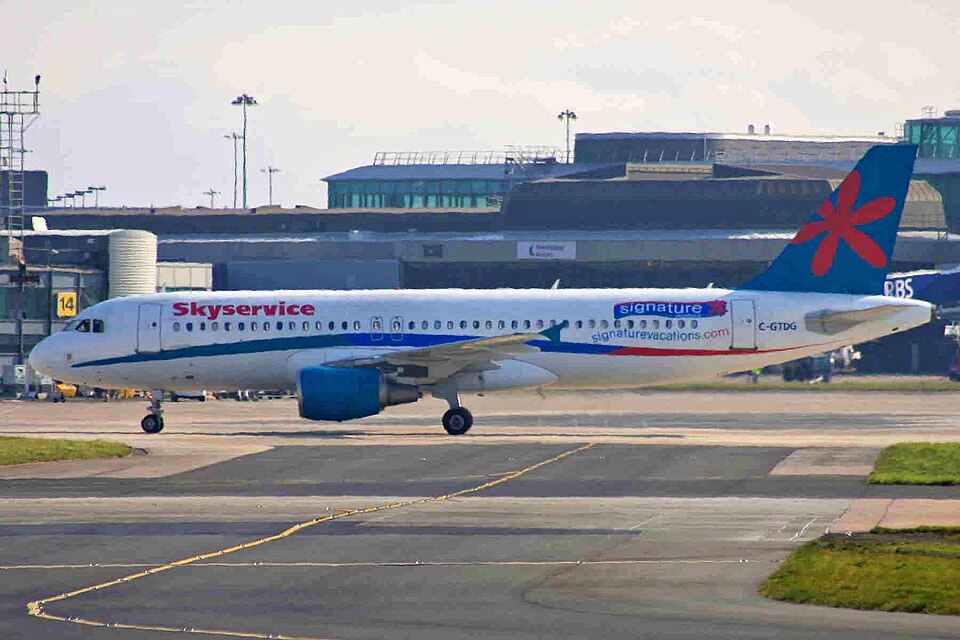
History of the Flight
The Airbus A320, registration C-GTDG, was being taxied onto Stand 9 at Cardiff Airport to board passengers for a flight. The commander, seated in the left seat, utilized the Visual Docking Guidance System (VDGS) to position the aircraft accurately. However, he did not observe a small baggage tug with a set of steps attached behind it parked on the left side of the stand. As the aircraft approached the stop line, the left engine fan cowl struck the tug, causing damage to both the fan cowl and the tug. The aircraft was brought to a stop, and the crew disembarked without further incident.
Some eyewitnesses noted that the aircraft was taxied at a higher than normal taxi speed, but the commander reported no undue pressure of time on the operation.
Background Information
Prior to the incident, a Boeing 737 had been parked on Stand 9 for boarding, with steps positioned at the front passenger door. After embarkation, a tug was used to reverse the steps away from the aircraft. The driver found he could not move the combination completely clear of the stand area due to a van blocking his path. Unable to locate the van's owner, he left the tug and steps where they were, intending to move them once the Boeing 737 departed. Subsequently, the Boeing 737 departed.
The duty ramp controller, observing by CCTV that Stand 9 had become vacant, allocated it to the incoming Airbus A320.
The airport authority reported that extensive construction work was underway on the ramp, leading to vehicles being parked in unassigned locations. Parking arrangements had been in a state of flux and were not effectively policed. Until changes were made after the incident, the VDGS devices on each stand were permanently illuminated, allowing pilots to taxi onto stands without reference to ground personnel.
Airport Authority Safety Actions
The airport authority investigated the incident and implemented several changes:
- Switches for VDGS systems were installed on each stand, and ground crew were instructed to conduct safety checks of stand areas before activating the equipment.
- Improved parking arrangements for equipment were introduced and policed.
- Consideration was given to relocating the duty ramp controller's working position to the operations tower for a better view of the parking stands.
- Risk assessments of aircraft marshalling and docking procedures were to be reviewed.
Conclusion
The AAIB investigation was unable to determine why the aircraft commander did not see the tug and steps. It was considered probable that his attention was focused on the VDGS system and the need to stop the aircraft accurately during the final stages of manoeuvring onto the stand. The AAIB forwarded copies of the report to ICAO for consideration of clear international standards regarding VDGS activation.