Background
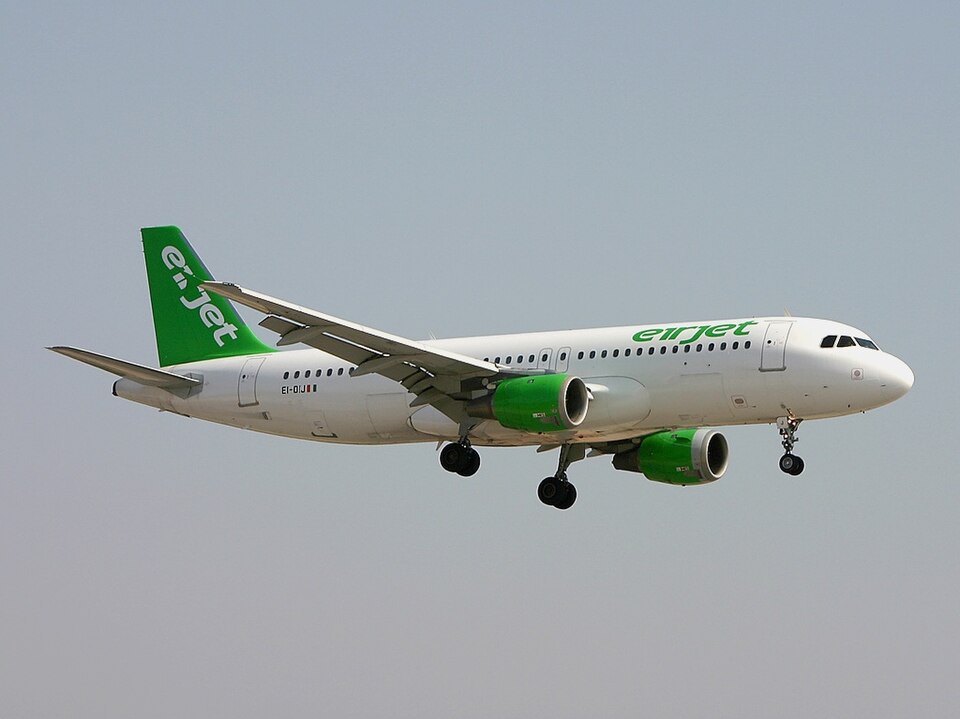
On 29 March 2006, an Airbus A320 (EI-DIJ), powered by two CFM 56-3A3 turbofan engines and manufactured in 1992, was operating a scheduled passenger flight from Liverpool (John Lennon) Airport to Londonderry/Eglinton Airport in Northern Ireland. The crew consisted of 6 and there were 39 passengers on board. No injuries were reported and no damage occurred. The commander, aged 57, held an Airline Transport Pilot's Licence and had accumulated 14,000 flying hours, including 1,800 hours on type.
Flight History
The crew reported for duty at 0455 hrs for a four-sector day. The third sector was from Liverpool to Londonderry, with the commander as Pilot Flying (PF) and the co-pilot as Pilot Not Flying (PNF). Due to the short runway at Londonderry, the operating company required commanders to perform both landing and takeoff at that airport. A single-track railway line crossing the Runway 26 extended centreline near the threshold required sequencing to avoid trains.
The flight to Londonderry was uneventful until the crew was handed over from Scottish Area Control to Eglinton Approach. At that time, a Beech 200 (callsign CALIBRATOR) had just finished calibrating the ILS and was routing outbound. An Army Gazelle helicopter was also on frequency, routing from Coleraine to Londonderry City via Ballykelly Airfield (BKL). The Gazelle pilot was advised to stay below 1,500 ft amsl and remain south of the ILS centreline.
Approach and Landing
At 1320 hrs, the A320 crew contacted Eglinton Approach and were instructed to descend to 3,500 ft amsl and report established on the ILS localizer at COLRE, a holding fix 15 nm on the Runway 26 extended centreline. The crew was advised of the Beech 200 holding 10 nm east of COLRE not above 3,000 ft amsl. At 1322 hrs, the helicopter pilot reported 3 nm north-east of Bellarena, and ATC asked him to stay below 500 ft agl for the last 3 nm to Ballykelly due to the A320 on the ILS.
Two minutes later, the A320 crew reported established on the localizer. ATC cleared them for an ILS/DME approach to Runway 26 and asked them to report passing 4 DME. The crew was also advised of the helicopter passing through Ballykelly overhead from north to south not above 500 ft. The Beech 200 requested to extend outbound to 30 nm before turning inbound, which was approved.
At 1326 hrs, when 8 nm from Londonderry, the crew transmitted that the ILS was not providing decent glideslope information and requested a visual approach. ATC cleared the visual approach and instructed them to report on a 4-mile final. The commander disengaged the autopilot and increased descent rate. The crew then asked about joining a visual circuit downwind if a missed approach was needed. They initiated a go-around and joined right-hand downwind, keeping it tight as ATC mentioned a train due in eight minutes. Without pressing go-around buttons or changing configuration, and after re-engaging the autopilot, the crew performed a descending 360° turn onto right base for Runway 26.
The crew requested a QNH check, confirmed the ILS was off, and lost the signal. ATC confirmed the ILS indications in the tower were normal, and the Beech 200 pilot reported the ILS appeared turned off. Ground crew subsequently confirmed both ILS transmitters were functioning. As the A320 turned onto right base, ATC instructed them to continue and call on final. At 1330 hrs, ATC, visual with the aircraft, cleared it to land. Shortly before touchdown, the Enhanced Ground Proximity Warning System (EGPWS) issued a Mode 5 'Glideslope' alert followed by a 'Terrain Ahead' warning. The co-pilot attempted to silence it by pressing the TERR OFF button. About 50 seconds later, ATC asked for DME, and the crew replied they had touched down. ATC informed them they had landed at Ballykelly Airfield, 5 nm east-north-east of Londonderry.
After landing, the aircraft turned around at the end of the runway. ATC instructed the crew to shut down engines and await ground handling from Londonderry. Passengers and baggage were transported by road to Londonderry. The aircraft later departed Ballykelly from Runway 02 at 1925 hrs with a different operating crew, after the runway was measured and inspected for debris.
Flight Recorders
The Cockpit Voice Recorder (CVR) was unserviceable, having failed approximately 16 days before the incident, undetected despite daily test requirements. The Flight Data Recorder (FDR), Quick Access Recorder (QAR), and EGPWS provided useful data. After departure, the aircraft climbed to FL220 and headed north-west. For most of the 40-minute flight, the ILS frequency for Londonderry Runway 26 was selected. The autopilots acquired the ILS localizer and glideslope and tracked them for about 2.5 nm before both autopilots were disengaged. The aircraft was then flown manually left of the Londonderry Runway 26 extended centreline, more in line with Ballykelly Runway 26, and descended below the glideslope. A descending right orbit further deviated below the glideslope. The first half of the orbit used the left autopilot in HDG/FPA modes; the second half and landing were manual.
A Mode 5 'soft' EGPWS 'glideslope' alert triggered just before the orbit was complete at about 592 ft agl, with glideslope deviation greater than five dots. Ten seconds later, at 509 ft agl, an EGPWS 'terrain ahead, pull up' warning triggered and would have repeated. The commander had terrain displayed on his Navigation Display (ND); the co-pilot did not, but the alert would have caused that page to appear. Ten seconds later, at 384 ft agl, the EGPWS look-ahead functions were inhibited using the TERR OFF selection, preventing further alerts. The aircraft touched down at Ballykelly 34 seconds later. The Flight Management System position indicated the aircraft was within 175 m of the runway intersection.
Airport Information
Londonderry's main runway 26/08 has a Landing Distance Available (LDA) of 1,817 m. A single-track railway line crosses the undershoot area, with up to 14 train movements per day. Railway personnel are required to notify the ATCO of train movements. The UK AIP warns that aircraft will not be permitted to land on Runway 26 or depart Runway 08 from 5 minutes before a train passage until the train is past.