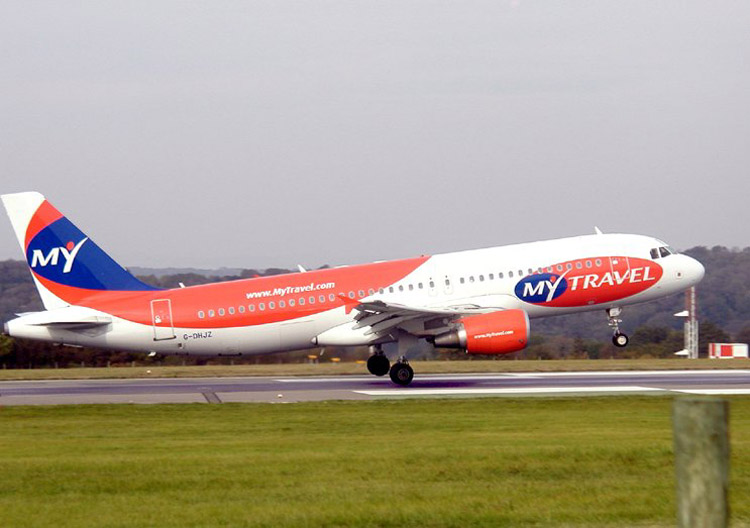
History of the Flight
The flight crew, consisting of a line training captain (commander) and a cadet co-pilot undergoing line training on the A320/321, reported for duty at 0500 hrs to operate a return non-scheduled passenger service from London Gatwick Airport to Kos, Greece. The co-pilot was to act as Pilot Flying (PF) for the sector to Kos to fulfill an outstanding training requirement for a managed approach. The commander had previously flown with the co-pilot and had been notified that the co-pilot's landing technique had been a cause for concern, though recent training records were favorable.
The aircraft departed LGW at 0610 hrs. During climb, an ECAM message indicated an engine bleed fault, leading to a status message of MAX FLT LVL 100. The crew held near the south coast to resolve the issue with company maintenance, determining the status message irrelevant after a 45-minute delay. The aircraft then climbed to FL310 and proceeded en-route. Due to reduced fuel reserves, a diversion to Thessaloniki was made, where the co-pilot performed a manual landing without incident. After refueling, departed for Kos at 1100 hrs with the co-pilot still PF.
Approach and Landing
As the aircraft neared Kos, the crew obtained ATIS indicating wind 300°/10 kt, visibility 10 km or more, temperature 34°C, and QNH 1005 mb. Runway 32 was in use, and the crew briefed for a VOR/DME approach using autopilot. Approach speed was 137 kt. CVR analysis showed a relaxed flight deck atmosphere.
At three minutes before touchdown, the aircraft started final approach in visual contact. At 5 DME and 1,870 ft, the aircraft was on profile and configured for landing with full flap. At 1,400 ft, the co-pilot disconnected the autopilot and adjusted track to follow the extended runway centerline. Autothrottle remained engaged; approach speed stabilized between 132-138 kt. Shortly after disengaging the autopilot, the co-pilot applied two aft sidestick inputs, causing a slight deviation above the glide path.
At about 2 DME (830 ft aal), the crew sighted the PAPIs. The commander initially reported three white lights, then four, indicating a high approach, and advised the co-pilot to increase descent rate to about 1,000 ft/min. The co-pilot complied and deselected flight directors. Descent rate and groundspeed stabilized at 1,000 ft/min and 138 kt, equating to a descent path of about 4°. At 500 ft, the commander deemed the approach stable. The co-pilot maintained 1,000 ft/min, stating he did not want to increase it.
Eleven seconds before touchdown, at about 160 ft aal, the commander confirmed "THREE WHITES AND ONE RED AND CORRECTING" and noted a left crosswind of seven knots. During the final flare, wind data indicated a change to a tailwind of 3-4 kt.
The commander was coaching the co-pilot but stopped mid-sentence at the automatic FIFTY callout. The subsequent FORTY, THIRTY, and TWENTY callouts occurred rapidly, with touchdown almost immediately after TWENTY. At about 35 ft aal, three seconds before main gear touchdown, the co-pilot retarded thrust levers and started the flare, moving his sidestick aft about two-thirds of full travel. Almost simultaneously, the commander applied nearly full aft sidestick. The aircraft's pitch attitude increased to about 6° before touching down with a descent rate of 900 ft/min. Normal acceleration recorded at 3.15g as both main gears touched down almost simultaneously, followed by a bounce.
The commander took control, initiating a TOGA 10 manoeuvre by advancing thrust levers to TOGA and attempting to stabilize pitch at 10° nose up. The co-pilot's sidestick returned to neutral. A takeoff configuration warning sounded, and the commander retarded thrust levers. The aircraft momentarily became airborne before touching down a second time with a normal acceleration of 2.75g. During the bounce, pitch attitude reached 11.6° (tail strike angle is 11.7° with gear compressed). The aircraft bounced twice more before settling. Heavy braking was applied. Spoilers deployed automatically; thrust reversers unlocked at 70 kt but no reverse thrust was selected. No standard callouts were made during the landing roll. Aircraft gross weight at touchdown was 63,900 kg.
The initial touchdown was about 225 m beyond the threshold. By the time brakes were applied, the aircraft was 1,400 m from the runway end. Groundspeed reduced to 40 kt with 850 m of runway remaining.
Aftermath
After clearing the runway, the crew noticed brake HOT indications. The commander remarked, "THE FLARE WAS RATHER LATE THERE……BUT THEN I SHOULD HAVE TAKEN OVER." The aircraft taxied to stand, passengers disembarked normally. The ACMS printed a report classifying the landing as 'heavy'. The commander reported to the company, and the aircraft was declared unserviceable. Two cabin crew reported physical discomfort and obtained over-the-counter medication.
Aircraft examination by the operator's maintenance staff found both main landing gear oleos deflated with fluid leakage from charging points. Severe damage to the main landing gear was noted. The operator subsequently withdrew the TOGA 10 manoeuvre from its Operations Manual and recommended the manufacturer's revised balked landing recovery technique.