History of the Flight
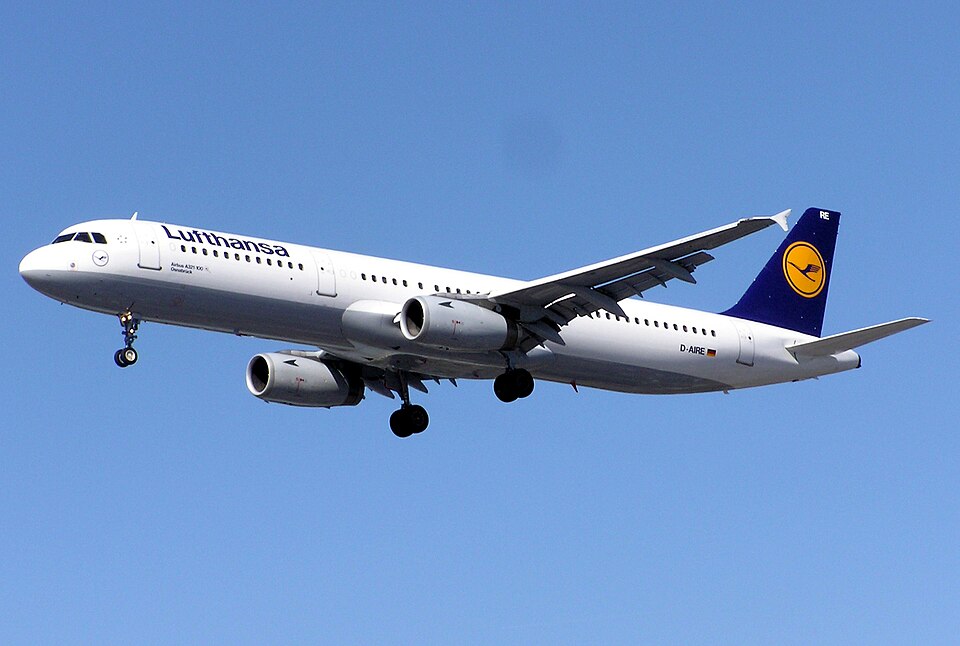
The crew were on the second day of their rostered cycle. The commander and First Officer (FO) had first flown together the previous day. On 9 October 2000, they flew an A320 from Stuttgart to Frankfurt, then changed to an A321 for the flight to London. The approach to Runway 27 Left at London Heathrow was conducted with the FO flying. The weather included a surface wind of 180°/13 gusting 27 kt, rain, and a wet runway. The aircraft had a landing weight of 72,999 kg.
During the approach, the FO disconnected the autopilot at approximately 570 feet agl. At around 500 feet, the commander noted the aircraft was below the glide path. The FO increased pitch slightly. At about 300 feet, the commander saw three white lights and one red light on the VASI and noticed a high rate of descent. He called 'sink rate', and the GPWS sounded a Mode 1 'sink rate' alert. The commander applied full aft sidestick to cushion the landing. The aircraft bounced and touched down a second time. The commander applied aft sidestick again to lower the nose gear gently. The PFD showed a nose-up attitude of about 10°. Neither pilot recalled the height calls or the 'RETARD' call.
After landing, the commander inspected the tail and discovered damage.
Engineering Investigation
Examination at London Heathrow revealed severe abrasion of the aircraft's skin longitudinally from forward of frame 64 to aft of frame 68, and laterally over the lowermost four stringers and drain mast. No apparent damage to fuselage frames was found. The damage was biased slightly to the right, indicating a slight right roll at contact. Geometrical considerations showed the damage occurred over a pitch attitude range of 9.65° to 10.65°. Data from the manufacturer indicated tail scrape would occur between 9.7° (oleos fully compressed) and 11.4° (oleos uncompressed but tyres in ground contact).
During inspection, slight leaks from two fuel couplings in the wing root area were noted, a known problem after a firm landing. The defect was deferred and later rectified.
Flight Recorders
Data from the Flight Data Recorder (FDR) and Cockpit Voice Recorder (CVR) were analyzed. The approach was stable until about 500 feet, when the aircraft went low on the glideslope. Power levers remained constant after that. At 100 feet, the aircraft was 1.8 dots high with a vertical speed of 900 ft/min. Forward sidestick increased descent rate to 1,000 ft/min. At 62 feet, the flare began with aft sidestick. At 21 feet, descent rate was 1,200 ft/min and GPWS Mode 1 activated. The aircraft touched down at 7.4° nose up and 1.4° right wing low, with a normal acceleration of 2.08g. The aircraft bounced, reaching a pitch of 5° nose up, then pitched up again to 10.5° nose up at the second touchdown. A normal acceleration spike of 1.3g likely indicated tail contact. The aircraft then slowed with reverse thrust.
Weather
ATIS at 1529 hrs gave wind 180°/16 kt gusting 26 kt, visibility 5 km in moderate rain, clouds FEW 1,100 ft, BKN 1,300 ft, OVC 1,800 ft, temperature +12°C, dew point +11°C, QNH 992 mb. ATC passed wind 180°/13 gusting 27 kt.
Sidestick Authority
Each pilot has a sidestick for manual control in pitch and roll. The sidesticks are not mechanically linked and are spring-loaded to neutral. When one pilot operates the sidestick, it sends signals to flight control computers. If both move simultaneously, inputs are summed.