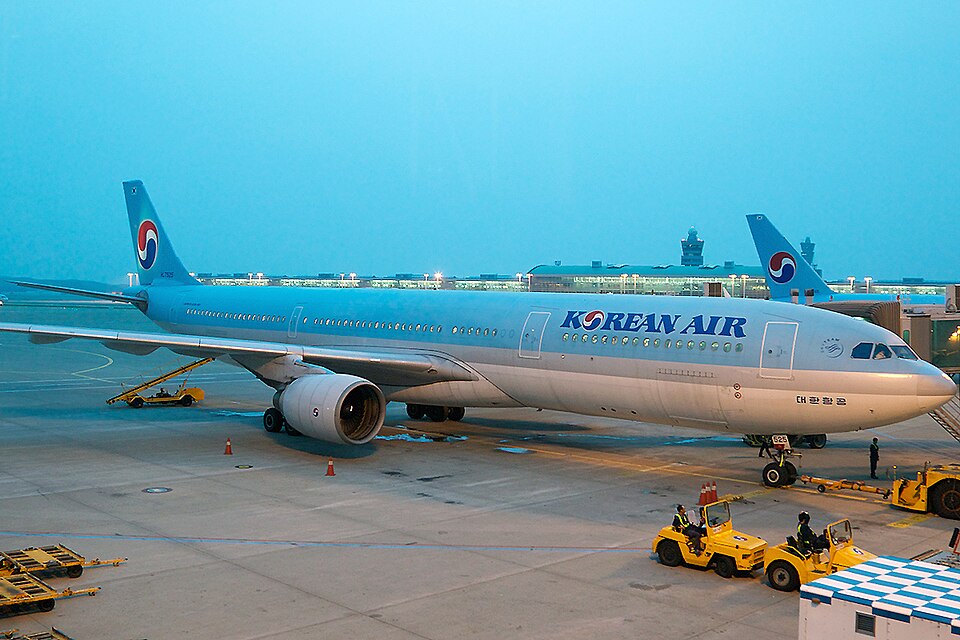
Accident Sequence
On the night of October 23, 2022, at approximately 2310 local time (1510 UTC), Korean Air flight operated by an Airbus A330-322, registration HL7525, experienced a runway overrun during the landing roll on runway 22 at Mactan-Cebu International Airport (RPVM), Lapu-Lapu City, Cebu, Philippines. The flight had originated from Incheon International Airport (RKSI), Incheon, Korea. Instrument meteorological conditions prevailed at the time.
The captain was the pilot flying. The crew initially planned an approach to runway 04, but changed to runway 22 due to shifting wind. During the first approach, after descending below minima, the crew encountered heavy rain and executed a go-around after losing visual contact with the runway. A second approach was flown, resulting in another go-around at 14:26:23 UTC due to a sudden increase in vertical speed accompanied by an aural “Sink rate” warning. During the go-around, the aircraft’s landing gear contacted the ground. The crew received Electronic Centralized Aircraft Monitor (ECAM) messages indicating faults in landing gear control interface units (LGCIU) 1 and 2. After reporting the go-around to air traffic control (ATC), the crew requested to hold over the ALMAR reporting point and performed ECAM actions.
Technical Issues
While executing ECAM procedures for the LGCIU faults, a BRAKES ANTI SKID FAULT message appeared. Both messages were displayed to the flight crew only at 1,500 ft radio altitude—32 seconds after touchdown—as they were inhibited below that altitude. The crew decided to attempt a third approach. During this approach, the crew performed a normal landing gear down procedure per ECAM actions for the LGCIU faults at 14:44:29 UTC, but the right main landing gear down-lock indicator did not illuminate on the landing gear indicator panel. The crew canceled the approach clearance and again held over ALMAR at 14:45:30 UTC to address the technical issue.
After executing the Quick Reference Handbook (QRH) procedure for landing with abnormal landing gear, a HYD B RSVR LO LVL (Hydraulic B Reservoir Low Level) message appeared. The crew performed another ECAM action before continuing the approach to RPVM.
Final Approach and Runway Overrun
During the fourth approach, the aircraft landed but failed to stop, overrunning the end of runway 22. It collided with the localizer antenna and runway approach lighting system, coming to a complete stop on a grassy area approximately 235 meters from the runway end at coordinates 10°17'41.8" N 123°57'59.9" E, with a final heading of 245°. Passengers and crew evacuated using the L2 and R2 cabin door slide rafts. Shuttle buses transported them to the terminal. The Mactan Cebu International Airport Authority (MCIAA) Rescue and Firefighting Services responded; no fire occurred.
Injuries and Damage
One flight crew member, four cabin crew members, and 15 passengers sustained minor injuries. The aircraft sustained substantial damage and was subsequently destroyed.
Probable Cause
The official probable cause identifies primary and contributory factors:
Primary Cause Factors: a. The increase in vertical speed indicator (VSI) was attributed to forward pitch control from the captain, resulting in ground contact before the runway. b. An increase in vertical wind factor during the aircraft’s descent on the second approach. c. The right main landing gear struck a 15-centimeter step on the cemented edge of runway 22, causing multiple damages and faults to the landing gear, resulting in loss of most deceleration means—specifically aircraft braking failure—leading to the runway overrun.
Contributory Cause Factors: a. Loss of spoilers and thrust reversers. b. Aircraft brake system dormant failure. c. Deficiency in Airbus’s crew operating procedures and alerting in relation to the A330 blue hydraulic low-level fault.