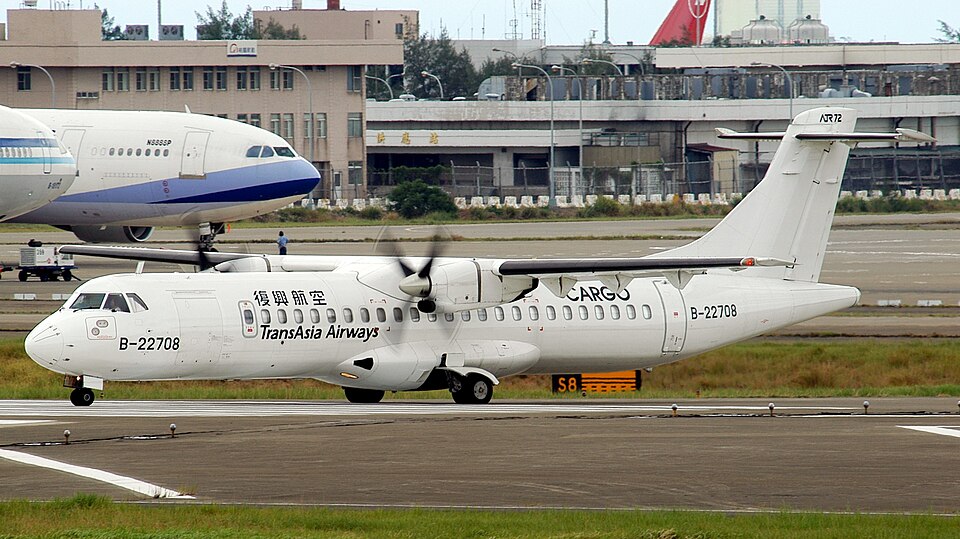
Accident
At 01:05 local time, a cargo aircraft departed Taipei-Chiang Kai Shek Airport on a flight to Macau. The aircraft carried two pilots and a load of leather parts and electronic materials. While cruising at 18,000 feet off the Penghu Islands, the crew contacted air traffic control and was cleared to descend to 16,000 feet due to icing conditions. At 01:52, at an altitude of 17,853 feet, the stall warning sounded and the stick shaker activated. The crew disconnected the autopilot and attempted to maintain control. Sixteen seconds later, the aircraft entered an uncontrolled descent, reaching 320 knots with a descent rate of 603 feet per second (over 36,000 feet per minute). It crashed into the sea 17 kilometers southwest of Magong. Few debris were found floating. Both pilots were killed.
Investigation
The official investigation identified multiple findings regarding the accident. The flight encountered severe icing conditions, with liquid water content and maximum droplet size exceeding the icing certification envelope of FAR/JAR 25 appendix C. The operator's training and rating of severe icing for the pilots was not effective, and the pilots lacked familiarity with relevant warnings and procedures in the Flight Crew Operating Manual and Airplane Flight Manual. After detecting icing and activating the de-icing system twice, the crew did not consult the handbook and failed to recognize severe icing indicators such as an unexpected decrease in airspeed. The crew was slow to detect severe icing and did not change altitude or follow the Severe Icing Emergency Procedures. The aircraft experienced unusual rolling and pitching and entered a stall. Recovery maneuvering did not comply with operating procedures for unusual attitudes, and the aircraft's performance and controllability were seriously degraded. During the first 25 minutes, extra drag increased by about 100 counts, reducing speed by about 10 knots. When the de-icing system was intermittently switched off, residual ice likely accumulated on the wings. Four minutes before autopilot disengagement, extra drag increased by about 500 counts, airspeed decayed to 158 knots, and lift-drag ratio decreased by 64%. In the 10 seconds before the roll upset, severe ice accumulation modified longitudinal and lateral stability, causing flow separation. Before autopilot disengagement, aerodynamic performance (lift/drag) was degraded by about 40%.
Probable Cause
The official findings identified the following causes: the flight encountered severe icing conditions beyond the certification envelope; the operator's training on severe icing was ineffective; the crew failed to follow procedures and detect severe icing promptly; recovery maneuvering did not comply with operating procedures.