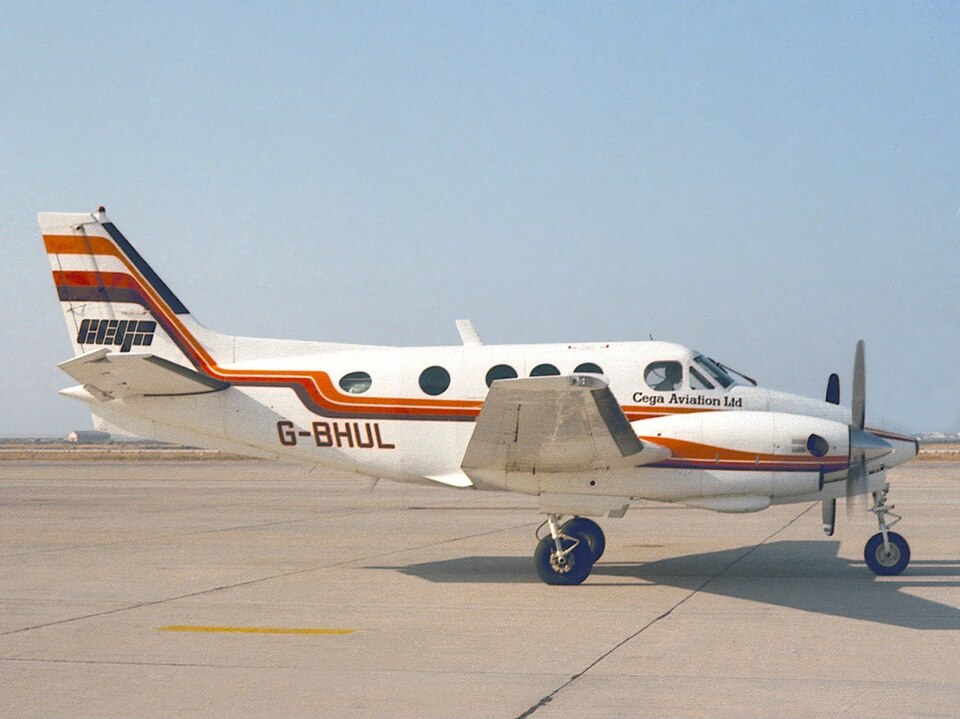
Overview
A training flight involving simulated engine failures resulted in an accident with serious injuries to both pilots. The aircraft was engaged in a sequence of exercises including simulated engine failures, an NDB approach, and a single-engine go-around before entering an uncontrolled descent.
Sequence of Events
The flight began with a takeoff from grass runway 06. The pilot under supervision (P U/S) was handling. Visibility was good with high cloud cover, and wind was recorded from 060° to 080° at 20 to 30 knots, gusting to 35 knots. During the initial climb, a pilot (PI) simulated an engine failure. After touch drills and climb out, power was restored. The climb continued to 2,500 feet, and another engine failure was simulated before executing an NDB approach to runway 33.
P U/S then performed a single-engine missed approach and entered the runway 06 circuit pattern. At the downwind position, he called 'downwind full stop'. On final approach, the simulated failed engine was set to a zero thrust setting of 120 feet lb torque and 1800 rpm. P U/S reported difficulty stabilizing the approach and controlling airspeed in gusty conditions. At approximately 300 feet AGL, he initiated a single-engine go-around, raising gear and flaps.
At some later stage, PI took control and pushed both throttle and rpm levers fully forward. P U/S recalled the aircraft entering a spiral descent to the left. Both pilots remember evacuating the aircraft but have no recollection of airspeed, height, which engine was 'failed' on either occasion, or what prompted PI to take control.
Wreckage and Injuries
The aircraft was observed overflying the airfield in a northeasterly direction with gear and flaps raised, at a height estimated between 100 and 300 feet AGL. Just outside the airfield boundary, it rolled to the right, then rolled or yawed left, entering a spiral descent into an open field. The left wing tip struck the ground at a 30° angle. The aircraft yawed left through 90°, slid and rolled 45 yards, coming to rest almost inverted on its right side. The left wing was detached and lay alongside the right wing stub. Both pilots sustained serious injuries.
Investigation Findings
The wreckage was examined at the AIB facility at Farnborough. Inspection of controls, control runs, engines, and propellers revealed no significant fault or failure. The airspeed indicators were calibrated and found to be accurate.