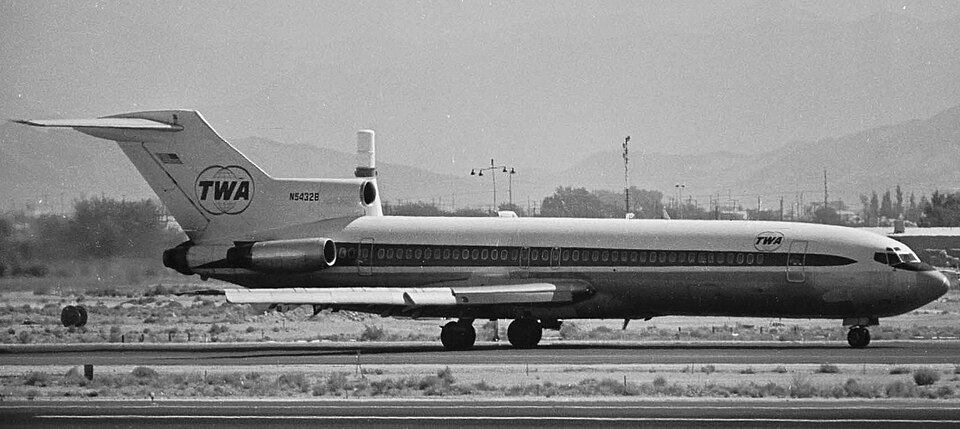
On December 1, 1974, a Boeing 727-200 (registration N54328) operated by Trans World Airlines - TWA was involved in an aviation accident near Mt Weather, United States of America during landing or approach. 92 people were killed. Investigators recorded the probable cause as: The National Transportation Safety Board determines that the probable cause of the accident was the crew's decision to descend to 1,800 feet before the aircraft had reached the approach segment where that minimum altitude applied result of inadequacies and… This summary draws on records from the Bureau of Aircraft Accidents Archives (B3A); 10 related events involving the same aircraft type or operator are linked below.
TWA Flight 514, a Boeing 727, crashed into Mount Weather, Virginia, while approaching Dulles International Airport. All 92 occupants were killed in the accident.
Flight Details and Diversion to Dulles International Airport (IAD) Trans World Airlines Flight 514 was a regularly scheduled service from Indianapolis, Indiana (IND), to Washington-National Airport, District of Columbia (DCA), with an intermediate stop at Columbus-Port Columbus International Airport, Ohio (CMH). The Boeing 727 departed Indianapolis at 08:53 EST and arrived in Columbus at 09:32. The aircraft departed Columbus at 10:24, eleven minutes behind schedule, carrying 85 passengers and 7 flight crew members. At 10:36, the Cleveland Air Route Traffic Control Center (ARTCC) informed the crew that no landings were being made at Washington National Airport due to high crosswinds, and that flights destined for that airport were either being held or diverted to Dulles International Airport (IAD). The captain communicated this information to the dispatcher in New York at 10:38. With the captain's concurrence, the dispatcher amended the flight's release to allow the aircraft to proceed to Dulles. At 10:42, Cleveland ARTCC cleared Flight 514 to Dulles via the Front Royal VOR at flight level 290. One minute later, the controller cleared the flight to descend to flight level 230 and cross a point 40 miles west of Front Royal at that altitude. Control was then transferred to the Washington ARTCC, with communications established at 10:48. During this time, the flight crew discussed the instrument approach to runway 12, the navigational aids, and the runways at Dulles, and the captain turned the flight controls over to the first officer. The Washington ARTCC controller affirmed that he knew the flight was proceeding to Dulles. The crew then discussed the various routings they might receive to conduct a VOR/DME approach to runway 12. At 10:51, the controller requested the flight's heading. After being told the flight was on a heading of 100 degrees, the controller cleared the crew to change to a heading of 090°, intercept the 300° radial of the Armel VOR, and cross a point 25 miles northwest of Armel to maintain 8,000 feet. The controller noted that the 300° radial would be for a VOR approach to runway 12 at Dulles and provided an altimeter setting of 29.74. The crew acknowledged the clearance and discussed the VOR/DME approach again. At 10:55, the landing preliminary checklist was read by the flight engineer, and the other crew members responded to the calls. A reference speed of 127 knots was calculated and set on the airspeed indicator reference pointers. The altimeters were set at 29.74. The crew discussed items on the instrument approach chart, including the Round Hill intersection, the final approach fix, the visual approach slope indicator, runway lights, and the airport diagram. At 10:59, the captain commented that the flight was descending from 11,000 feet to 8,000 feet. He asked the controller if there were any weather obstructions between the flight and the airport. The controller replied that he did not see any significant weather along the route. The captain replied that the crew also did not see any weather on the aircraft weather radar. At 11:01, the controller cleared the flight to descend to and maintain 7,000 feet and to contact Dulles approach control. Twenty-six seconds later, the captain initiated a conversation with Dulles approach control and reported that the aircraft was descending from 10,000 feet to maintain 7,000 feet. He also reported having received information “Charlie” transmitted on the ATIS broadcast. The controller replied with a clearance to proceed inbound to Armel and to expect a VOR/DME approach to runway 12. The controller then informed the crew that ATIS information Delta was current and read the data to them. The crew determined that the difference between information Charlie and Delta was the altimeter setting, which was given in Delta as 29.70. There was no information on the cockpit voice recorder (CVR) to indicate that the pilots reset their altimeters from 29.74. At 11:04, the flight reported it was level at 7,000 feet. Five seconds after receiving that report, the controller said, “TWA 514, you're cleared for a VOR/DME approach to runway 12.” This clearance was acknowledged by the captain. The CVR recorded the sound of the landing gear warning horn followed by a comment from the captain that “Eighteen hundred is the bottom.” The first officer then said, “Start down.” The flight engineer said, “We're out here quite a ways. I better turn the heat down.” At 11:05:06, the captain reviewed the field elevation, the minimum descent altitude, and the final approach fix and discussed the reason that no time to the missed approach point was published. At 11:06:15, the first officer commented that, “I hate the altitude jumping around. Then he commented that the instrument panel was bouncing around. At 11:06:15, the captain said, “We have a discrepancy in our VOR's, a little but not much.” He continued, “Fly yours, not mine.” At 11:06:27, the captain discussed the last reported ceiling and minimum descent altitude and concluded, “...should break out.” At 11:06:42, the first officer said, “Gives you a headache after a while, watching this jumping around like that.” At 11:07:27, he said, “...you can feel that wind down here now.” A few seconds later, the captain said, “You know, according to this dumb sheet it says thirtyfour hundred to Round Hill --- is our minimum altitude.” The flight engineer then asked where the captain saw that and the captain replied, “Well, here. Round Hill is eleven and a half DME.” The first officer said, “Well, but ---” and the captain replied, “When he clears you, that means you can go to your ---” An unidentified voice said, “Initial approach, and another unidentified voice said, “Yeah!” Then the captain said “Initial approach altitude.” The flight engineer then said, “We're out a --- twenty-eight for eighteen.” An unidentified voice said, “Right, and someone said, “One to go.” At 11:08:14, the flight engineer said, “Dark in here,” and the first officer stated, “And bumpy too.” At 11:08:25, the sound of an altitude alert horn was recorded. The captain said, “I had ground contact a minute ago,” and the first officer replied, “Yeah, I did too.” At 11:08:29, the first officer said, “...power on this....” The captain said “Yeah --- you got a high sink rate.” “Yeah,” the first officer replied. An unidentified voice said, “We're going uphill,” and the flight engineer replied, “We're right there, we're on course.” Two voices responded, “Yeah!” The captain then said, “You ought to see ground outside in just a minute -- Hang in there boy.” The flight engineer said, “We're getting seasick.” At 11:08:57, the altitude alert sounded. Then the first officer said, “Boy, it was --- wanted to go right down through there, man,” to which an unidentified voice replied, “Yeah!” Then the first officer said, “Must have had a # of a downdraft.” At 11:09:14, the radio altimeter warning horn sounded and stopped. The first officer said, “Boy!” At 11:09:20, the captain said, “Get some power on.” The radio altimeter warning horn sounded again and stopped. At 11:09:22, the sound of impact was recorded. After the aircraft left 7,000 feet, the descent was continuous with little rate variation until the indicated altitude was about 1,750 feet. The altitude increased about 150 feet over a 15-second period and then decreased about 200 feet during a 20-second period. The recorded altitude remained about 1,750 feet until the airplane impacted the west slope of Mount Weather, Virginia, about 25 nautical miles from Dulles, at an elevation of about 1,670 feet (509 m). The aircraft was totally destroyed by impact forces and a post-crash fire, and all 92 occupants were killed.