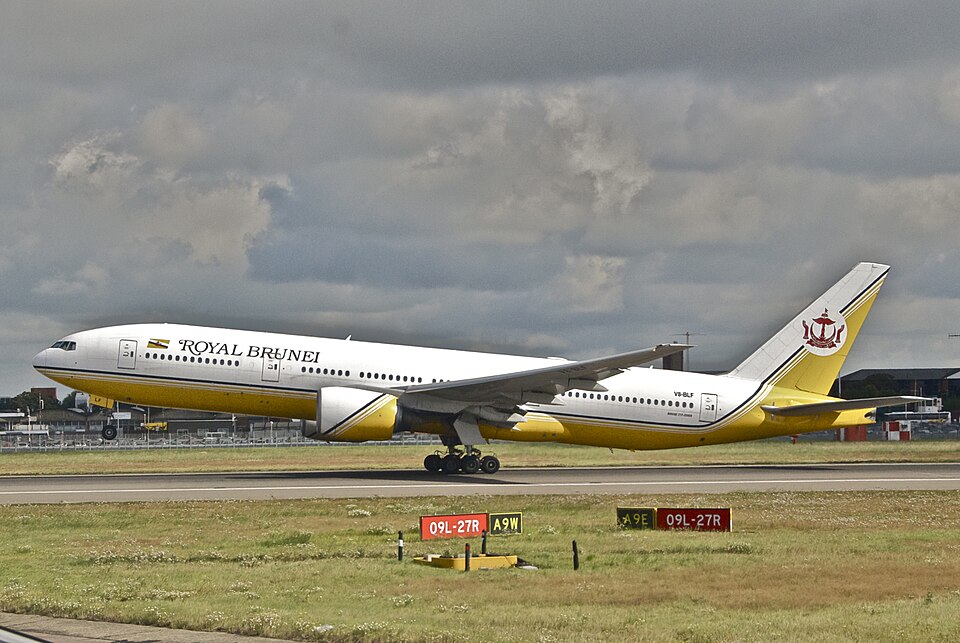
History of the Flight
On 27 December 2012, a Boeing 777-200 (registration V8-BLF) departed from Heathrow Airport Runway 27L, destined for Dubai. While climbing through Flight Level 150, the flight crew heard a loud rumbling noise, felt a small amount of vibration, and observed an exhaust gas temperature exceedence on the right engine. The crew performed all appropriate memory and emergency checklist items, and a review of engine parameters indicated both engines were within normal limits. Nevertheless, the commander decided to return to Heathrow as a precaution. The approach and landing on Runway 27L were uneventful, carried out with two engines operating. An emergency services Local Standby was initiated at the airport due to the overweight landing.
Damage Inspection
Post-flight inspection revealed that a large amount of material was missing from the inner wall of the right engine inboard thrust reverser half. Consequently, the exhaust nozzle had been damaged and was loosely attached. A considerable amount of the missing composite structure was recovered later that day from a property in Broxbourne, Hertfordshire. All parts, including the damaged reverser half, were sent to the aircraft manufacturer for further examination.
Thrust Reverser Breakup History
This incident was the fifteenth similar occurrence of Boeing 777 Trent engine thrust reverser breakup known to the manufacturer (the design and manufacture of the reverser is the airframe manufacturer's responsibility). Approximately half of these events involved fracture and liberation of a portion of the reverser inner wall, which can also cause consequential damage to the exhaust nozzle. In June 2010, a similar incident to a British-operated Boeing 777-236, registration G-YMMP, prompted an AAIB Field Investigation reported in AAIB Bulletin 10/2011. Various service bulletins had been issued, culminating in SB 777‑78-0071 in late 2009, which introduced a new thermal protection system for the insulation blanket. At the time of the V8-BLF incident, more than 60% of the affected fleet had been modified, and over 50% had incorporated an associated engine manufacturer's modification to a bleed vent. A further case of inner wall collapse on a similar aircraft in the Far East occurred on 7 January 2013, but details are not known.
Engineering Investigation
V8-BLF was fitted with the later standard of insulation and was up-to-date with required inspections. However, it was found that one of the four compression rods which carry hoop stresses in the inner wall was not correctly engaging the receptor cups when the thrust reverser was closed. This misalignment had caused the compression rod end to damage the insulation blanket in that area, though no evidence of associated heat distress was found. Wear was also found on the hanger brackets. The manufacturer reported that the cause for the misalignment and subsequent incorrect engagement has not been determined, but investigation continues. The manufacturer has advised that replacement of the thrust reverser inner wall will be required, and may be mandated, for all affected aircraft. Additional inspections for evidence of disconnection or wear in the compression rods have been required, and the manufacturer has devised a programme of thrust reverser inner wall replacement because existing non-destructive test techniques may not reliably detect previous thermal damage. They further advise that the Federal Aviation Administration may mandate inner wall replacement on all Rolls-Royce powered Boeing 777 aircraft.