Summary
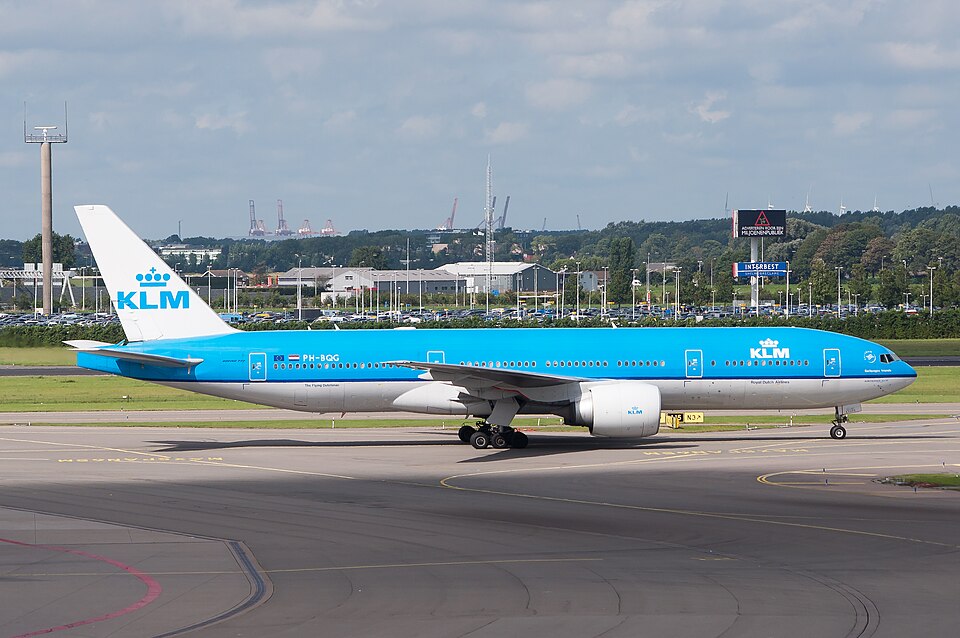
On September 23, 2017, at approximately 10:57 Japan Standard Time, a right aft wing-to-body fairing panel (Panel 198AR) detached from a Boeing 777-200, registration PH-BQC, operated by KLM Royal Dutch Airlines. The panel fell over Osaka City, Japan, and collided with a vehicle driving on National Route 1 in Kita-ku. The aircraft was operating scheduled flight KL868 from Kansai International Airport to Amsterdam Schiphol International Airport with 321 people on board. No injuries were reported.
Flight History
The aircraft took off from Kansai International Airport at about 10:39. While climbing and accelerating over Osaka city, the panel detached. At around 12:55, the operator's Kansai Airport branch received photographic information of the fallen panel from police and forwarded it to the head office. At about 14:27, the Operations Control Center informed the crew via ACARS that a fuselage panel may have fallen. The captain contacted OCC and, after checking cabin pressurization, flight controls, fuel systems, and checking for abnormal noise or vibrations, decided to continue the flight. The aircraft landed at Amsterdam Schiphol at about 21:38, where a mechanic confirmed the panel was missing.
Injuries and Damage
No injuries to persons were reported. The aircraft sustained slight damage: Panel 198AR was detached and missing, the bracket fixing the panel was cracked, bolt and screw holes were damaged, and mounting screws were broken. The vehicle suffered a dented roof and a broken right-side rear window.
Panel and Attachment Details
The panel, part number 149W5242-2, was a honeycomb sandwich structure made of glass-fiber-reinforced plastic, located at the wing-to-body fairing of the right wing. It was secured by seven screws and thirty bolts. Examination revealed that five improper bolts (BACB30XD3K5) were used where proper bolts (BACB30LH3-4) should have been. The improper bolts have a longer grip length, shorter thread length, and smaller head diameter. This created a gap of up to 0.7 mm between the panel and the bracket, preventing full securement. The improper bolts were not used at the damaged forward upper bracket but were used at positions just below it. Marks remained where bolts had been torqued at the end of the thread.
Meteorological Conditions
At the nearby Osaka District Meteorological Observatory, at 10:00 the wind was southwesterly at 1.7 m/s, temperature 24.1°C; at 11:00 the wind was west-southwesterly at 2.5 m/s, temperature 24.0°C.