Incident Summary
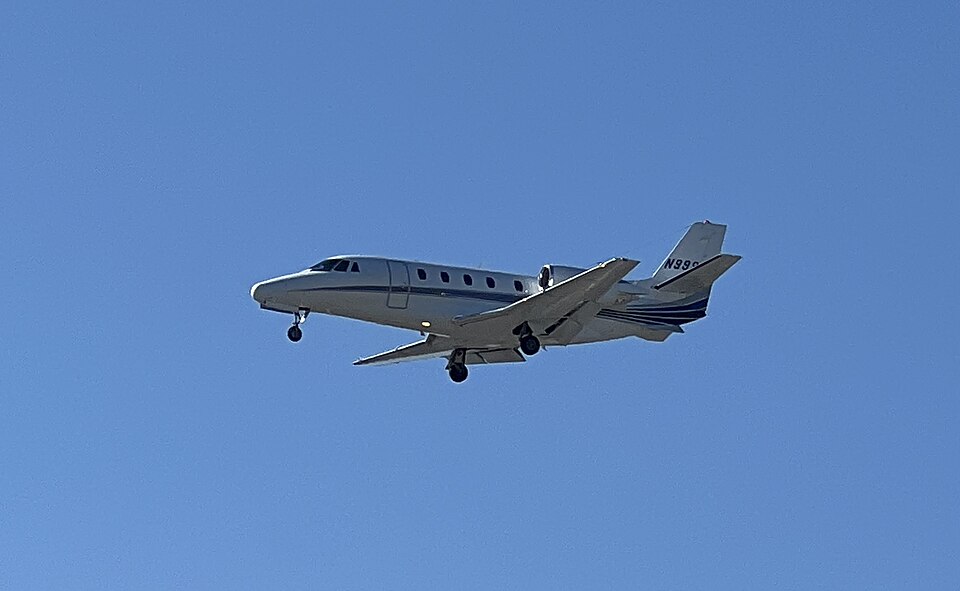
On 29 July 2000, at approximately 0955 UTC, a Cessna Citation X 750, registration N999CX, was being marshalled into a parking space at London Heathrow Airport's business jet parking area. The left wing-tip navigation light lens housing was broken after contacting the vanes of a blast wall. The two crew members on board were uninjured.
Sequence of Events
The parking manoeuvre required a 230° right turn from a heading of north to face south-west. The turn was planned to be completed in stages, with the left wing-tip in close proximity to a blast wall during the final 140° of turn. The marshaller initially positioned himself at the aircraft's final parking position and guided the aircraft northwards along the taxiway. As the aircraft approached the required turning point, the marshaller signalled it to turn to the east and repositioned himself close to the blast wall to monitor wing tip clearance during subsequent turns toward the south. After turning the aircraft to a south-easterly heading and confirming sufficient clearance, the marshaller moved away from the wall and signalled the aircraft to continue turning south. During this turn, the left wing-tip contacted the vanes of the blast wall, damaging the navigation light housing. The commander felt the contact from the cockpit, immediately brought the aircraft to a halt, and shut down the engines.
Aircraft Information
The Cessna Citation X 750 is a swept-wing business jet with a wing sweep of 37° and a wingspan of 19.38 metres (63 feet 7 inches). According to the Aircraft Flight Manual, when making ground turns using only nosewheel steering, the aircraft pivots around either the left or right main wheels, depending on the turn direction. For small turns, the wing tip describes an arc that extends 0.86 metres (2 feet 10 inches) beyond its straight-line track. For a 180° turn, the wing tip traces a semi-circle with a diameter of 24.64 metres (80 feet 10 inches), which is 5.25 metres (17 feet 3 inches) greater than the aircraft's wingspan.
Personnel Information
The commander held an FAA Airline Transport Pilot Licence, was 43 years old, and had accumulated 3,714 total flying hours, including 550 hours on type. In the last 90 days, he had flown 115 hours, and in the last 28 days, 23 hours.