Accident
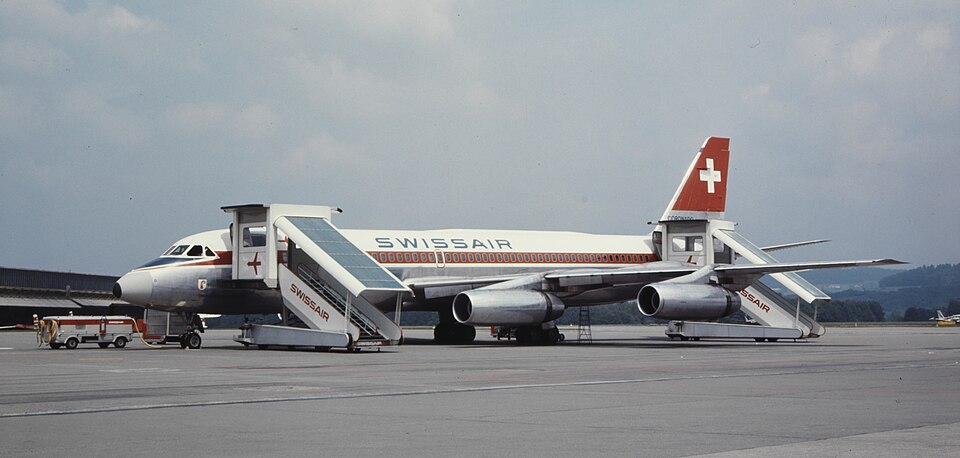
An airplane departed Zurich-Kloten Airport runway 28 at 1314 local time bound for Tel Aviv with 38 passengers and nine crew members on board. Seven minutes later, while climbing to an altitude of 14,000 feet approximately 41 km south of the airport, the captain contacted air traffic control and declared an emergency. He reported a detonation in the cargo compartment and a drop in cabin pressure, requesting an immediate return to Zurich. During the subsequent minutes, the captain reported smoke spreading in the cabin and cockpit, unserviceable instruments, and failure of the electrical system. The copilot stated, 'Smoke on board, I don't see anything', and the captain said, 'We are falling, goodbye everyone'. The aircraft then completed a 180-degree turn, nosed down, and crashed in a wooded area near the village of Würenlingen, some 22 km northwest of runway 14 threshold. The airplane totally disintegrated on impact, and all 47 occupants were killed.
At impact, the aircraft was in a nose-down attitude of 12 degrees, at a speed of 422 knots, and in a slight left bank. Weather conditions at the time were marginal with rain, a cloud base at 300 meters, overcast to 600 meters, visibility up to 5 km, and wind 15–20 knots. Among the passengers were 15 Israelis, nine Germans, five Americans, two Canadians, two Mexicans, one Belgian, one French, one British, one Thai, and 10 Swiss citizens. The nine crew members were all Swiss.
Probable Cause
Investigation determined that the tragedy was the consequence of the detonation of an explosive device (bomb) placed in the cargo hold. The bomb was connected to an altimeter and exploded when the aircraft reached 14,000 feet, causing severe damage to the fuselage and control systems and spreading smoke in the cabin. The act of sabotage was later claimed by the Palestinian group Abu Jihad, who justified it by the presence of several senior Israeli officials on board. No human error and no technical discrepancy were reported during investigations. The fire that followed the explosion damaged some generators, creating electrical short circuits that made continued operation of the aircraft impossible.