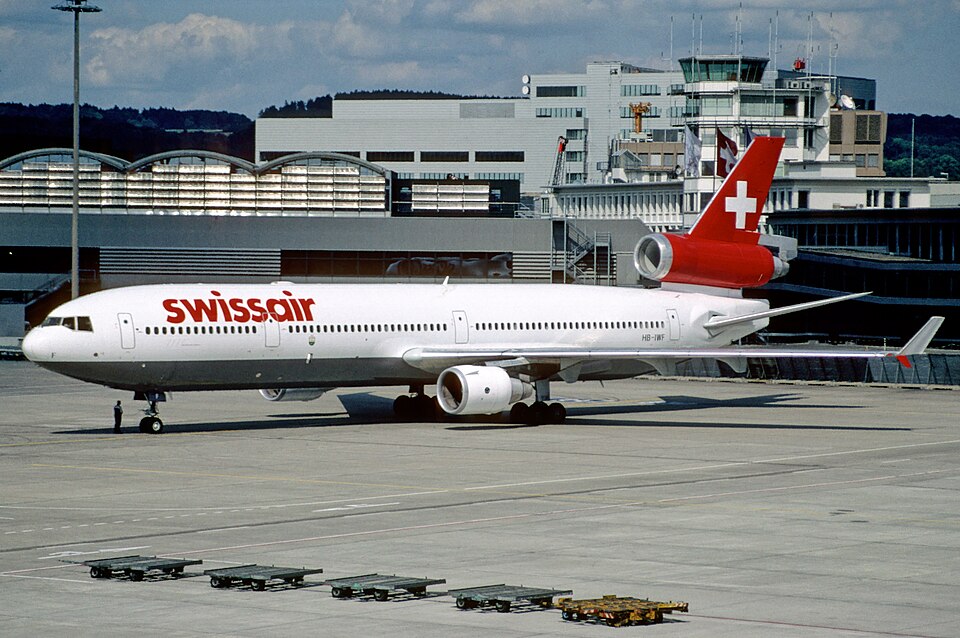
Overview
On 2 September 1998, Swissair Flight 111, a scheduled flight from New York, United States, to Geneva, Switzerland, departed at 2018 eastern daylight savings time with 215 passengers and 14 crew members. About 53 minutes after departure, while cruising at flight level 330, the flight crew detected an abnormal odor in the cockpit. They investigated and initially perceived an anomaly behind and above them, later identifying it as smoke. They decided to divert, initially toward Boston, but changed to Halifax International Airport after air traffic services mentioned Halifax.
Fire and Systems Failures
While preparing for landing, the crew was unaware of a fire spreading above the ceiling in the front area of the aircraft. About 13 minutes after the odor detection, the flight data recorder recorded a rapid succession of system failures. The crew declared an emergency and requested immediate landing. About one minute later, radio and radar contact were lost, and recorders stopped. About 5.5 minutes later, the aircraft crashed into the ocean about 5 nautical miles southwest of Peggy’s Cove, Nova Scotia, Canada. The aircraft was destroyed; there were no survivors.
Probable Cause Findings
The official investigation identified multiple causes and contributing factors. The fire most likely started from a wire arcing event. Flammable thermal acoustic insulation cover materials, particularly metallized polyethylene terephthalate (MPET) and metallized polyvinyl fluoride, ignited and propagated the fire. Other materials such as silicone elastomeric end caps, hook-and-loop fasteners, foams, and adhesives contributed to fire propagation. The lack of built-in smoke and fire detection and suppression devices in the area delayed identification. The crew misidentified the initial odor and smoke as originating from an air conditioning source. No integrated in-flight firefighting plan existed, and the crew concentrated on diversion preparations. Additionally, circuit breakers were not capable of protecting against all wire arcing events. Fire-induced failure of silicone elastomeric end caps on air conditioning ducts added conditioned air, intensifying the fire. In the last minutes, loss of primary flight displays and outside visual references forced reliance on standby instruments, complicating spatial orientation.
Findings as to Risk
Additional risk factors were noted: lack of ready access to areas dependent on human detection, loss of electronic navigation and communications radios, no requirement for immediate de-powering of non-essential systems, lengthy checklists, and missing emphasis on immediate landing preparations in smoke checklists. Wiring discrepancies were also found in several MD-11 aircraft.