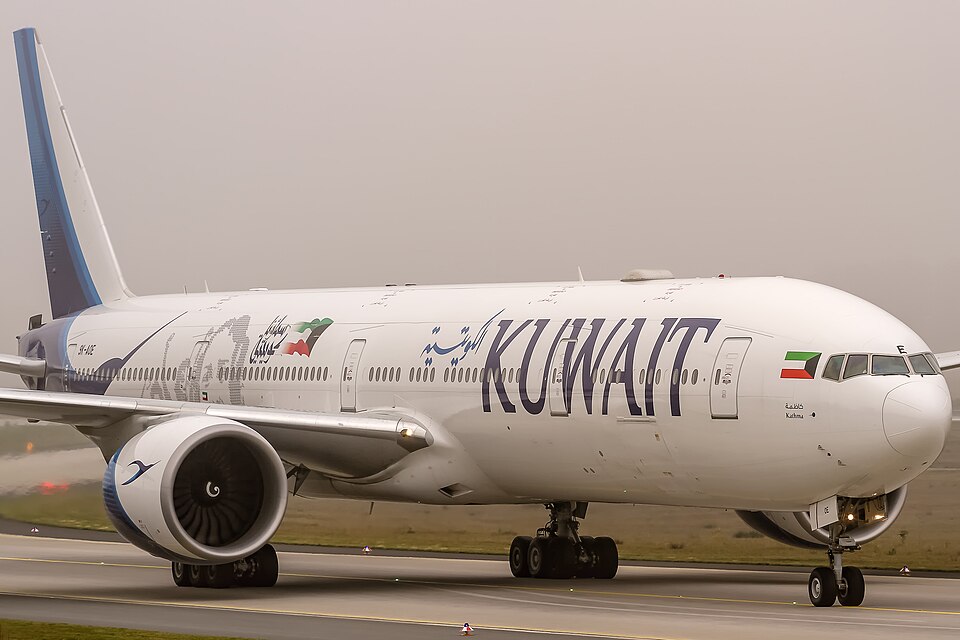
Incident Overview
On 4 February 2018, a Kuwait Airways (KAC) Boeing 777-300ER, registration 9K-AOE, operating flight KU 788 from Jeddah (JED) to Kuwait International Airport (KWI), arrived at Gate 5 at approximately 15:00 local time. The aircraft was scheduled to depart as flight KU 203 to Dhaka (DAC). During catering preparations for the next flight, three catering trucks from Kuwait Aviation Services Company (KASCO) were deployed.
At around 15:10 local time, the driver of catering truck with registration plate DGCA-1053 and KAC identification 163/VNC struck the aircraft, significantly damaging the fuselage skin on the right-hand side below the crew/passenger R4 door. The damage was classified as serious, with multiple punctures and structural deformation. The aircraft was subsequently grounded for repair by the KAC sheet metal shop.
Aircraft Damage
External damage included four locations on aircraft section 46:
- Puncture between STA 1476 and STA 1497.
- Puncture with substructure damage between STA 1497 and STA 1522.
- Puncture with substructure damage between STA 1546.5 and STA 1567.
- Dents and scratches at STA 1513.5 between STGR 40 and STGR 43.
Internal structural damage consisted of:
- Stringer #36 sheared off.
- Stringer #37 sheared off.
- Stringer #38 deformed.
- Reinforcement support web cracked.
- Slant cargo side panel support structure damaged.
Driver and Procedures
The catering truck driver was examined by paramedics and found medically fit, with no illness at the time of the occurrence. According to KASCO instructions, each catering truck driver must position the truck with the assistance of a marshaller and never alone. However, the driver that day was alone and did not wait for the marshaller, who was busy positioning another truck on the same aircraft. When questioned, the driver stated he was fully aware of the company's procedures.
Investigation Findings
The investigation concluded that the driver acted recklessly and neglected company procedures by not waiting for marshaller guidance. Additional findings included:
- KASCO did not strictly enforce the requirement for a driver and marshaller for each catering truck.
- No proper training program for KASCO drivers existed.
- No health records were kept for KASCO drivers; some drivers were found to suffer from high blood pressure, asthma, and diabetes.
- No shift-in-charge or handling group coordinator was available during PM and night shifts to monitor catering truck operations.
- The company lacked an effective quality assurance and control system.
Recommendations
The report recommended that KASCO establish a quality assurance and control section with qualified personnel, provide a suitable working environment and incentives to attract skilled staff, revise recruitment policies to consider education, health, and fitness, implement annual medical checkups for all staff, provide appropriate training on equipment operation including human factors and SMS, encourage reporting of unsafe conditions through a voluntary system, and replace old equipment with modern trucks equipped with effective safety features.