Incident
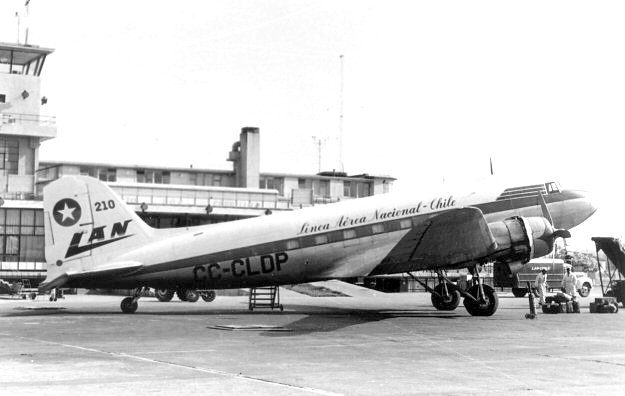
On a domestic passenger flight from Castro to Santiago with intermediate stops, LAN Chile flight 621, a Douglas DC-3C, departed Temuco at 18:30 hours local time for the final leg. The flight was cleared to follow Airways 45 and 40 at an altitude of 8,500 feet, with an estimated flying time of 2 hours and 30 minutes. En route, the flight was instructed to climb to 9,500 feet due to other traffic at 8,500 feet. At 19:10, the crew requested a descent to 9,000 feet because of ice formation on the wings. The controller denied the descent due to conflicting traffic (LAN flight 205) on Airway 4. Subsequently, the controller cleared the flight to turn back on Airway 45, descend to 6,500 feet on that airway, pass over Curico, and continue on Airway 40 to the Santo Domingo beacon. No further radio contact was established.
Search and Wreckage
After seven days of search operations, the wreckage was located on April 10. The aircraft had struck Cerro La Gotera, a mountain in the Sierra de las Ánimas sector, east-northeast of a hill named Lástimas del Pejerrey. The airplane was flying in a south-westerly direction and impacted 50 meters below the summit at an elevation of approximately 3,500 meters (11,480 feet). The wreckage slid about 14 meters downslope before coming to rest. The aircraft was destroyed and burned out. Among the occupants were eight players and the trainer of the Green Cross football team.
Investigation
The official investigation determined from the wreckage's position that the flight was on a south-west heading. Due to the aircraft's complete destruction and burning, it was not possible to ascertain its speed, altitude, or whether the left engine had failed. At impact, the right engine appeared to be functioning normally. Examination of navigation instruments and the wreckage did not allow for a determination of the accident's cause.