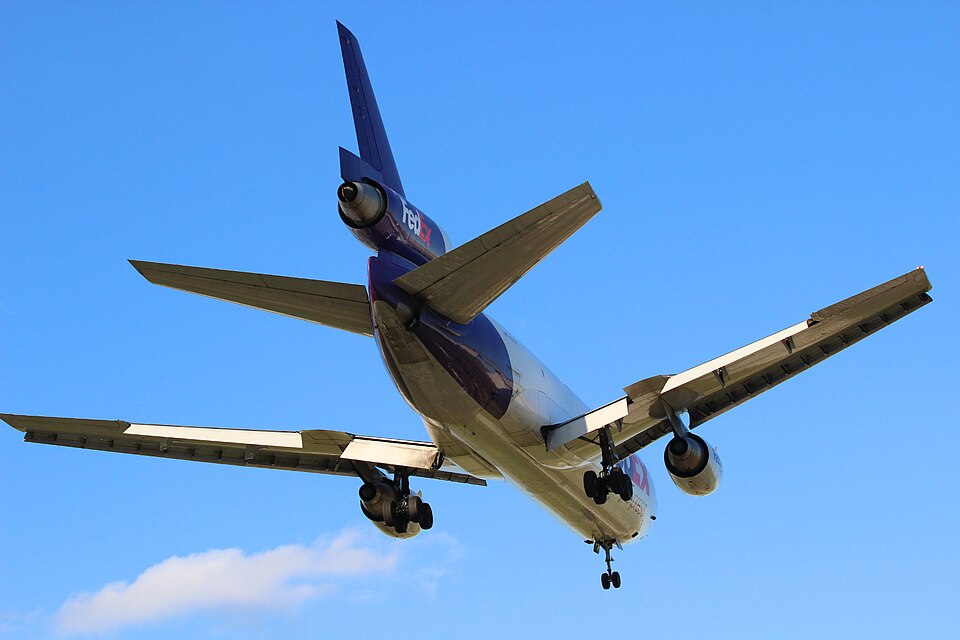
Incident Overview
On October 28, 2016, about 1751 eastern daylight time, FedEx Express flight 910, a McDonnell Douglas MD-10-10F (registration N370FE), experienced a collapse of the left main landing gear (MLG) after landing on runway 10L at Fort Lauderdale–Hollywood International Airport (KFLL), Fort Lauderdale, Florida. Subsequently, the left wing caught fire. The airplane came to rest off the left side of the runway.
Flight Crew and Injuries
The two flight crew members evacuated the airplane. The captain reported a minor cut and abrasions from the evacuation, while the first officer was not injured.
Flight Details
The cargo flight operated under Title 14 Code of Federal Regulation Part 121 and originated from Memphis International Airport (KMEM), Memphis, Tennessee. The first officer was the pilot flying, and the captain was the pilot monitoring. Both crew members stated that the departure and en route portions were normal.
Approach and Landing Sequence
About 1745, air traffic control cleared the flight for an instrument landing system approach to runway 10L. Recorder data showed the first officer set flaps to 35° at about 1746 when the airplane was 3,000 ft above ground level (agl). The autopilot was disconnected at about 1749 at 1,000 ft agl. Both crew members reported the approach was stable at 500 ft agl. At 200 ft agl, the first officer began airspeed corrections for crosswind. At about 1750, the autothrottles were disconnected at 100 ft agl as briefed. The flare was initiated at 50 ft agl.
The left MLG touched down at about 1750:31 in the touchdown zone, left of the runway centerline. The spoilers deployed at 1750:34, and the nose gear touched down 3 seconds later. Thrust reversers deployed at 1750:40. The captain instructed the first officer to begin braking at about 1750:39; the airplane was not equipped with autobrakes. Flight data recorder data indicated an increase in brake pedal position and longitudinal deceleration (braking) at about 1750:41.
Gear Collapse and Fire
In post-accident interviews, the flight crew reported hearing a "bang" as the first officer applied brakes, and the airplane yawed left. The cockpit voice recorder recorded multiple thuds, consistent with gear collapse. At about 1750:48, the captain stated, "I have the airplane," and the first officer replied, "you got the airplane." The captain applied full right rudder without effect while the first officer continued braking. At about 1750:53, the captain instructed the first officer to call the tower about the emergency.
Airport video showed that after the left MLG collapse, the No. 1 engine initially supported the airplane, then a fire began near the left-wing tip. The airplane stopped off the left side of runway 10L, at about 30° to 40° off the runway heading. At about 1751, the crew began the evacuation checklist. As they prepared to evacuate, they heard an explosion, and video showed a fireball at the No. 1 engine. The captain attempted to discharge a fire bottle for the No. 1 engine, but it did not discharge. The crew evacuated through the right cockpit window.
Probable Cause
The failure of the left main landing gear due to fatigue cracking that initiated at a corrosion pit. The pit formed in the absence of a required protective cadmium coating, the cause of which could not be determined from available evidence. Contributing to the failure of the left MLG was the operator's overhaul limit, which exceeded that recommended by the airplane manufacturer without sufficient data and analysis to ensure crack detection before it progressed to failure.