Background
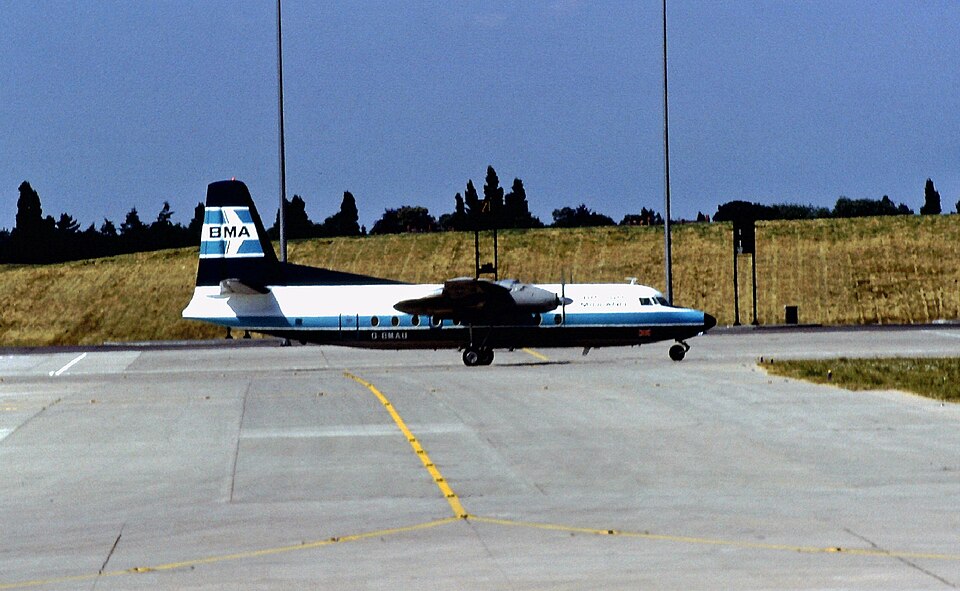
The aircraft was a BMA Fokker F-27 engaged in crew training at East Midlands Airport (EMA). The commander, an experienced training captain, occupied the right pilot's seat. A first officer training for captaincy sat in the left seat as handling pilot. Another captain refreshing on type sat on the jump seat, intending to move to the left seat after the first officer's training period. Weather conditions: wind 150° at 7 kts, visibility 4 km, cloud 7 oktas stratus at 1000 ft, surface temperature 2 °C, QNH 1030.
Flight Sequence
The training began with a practice abandoned takeoff. The aircraft took off at 13:08 and performed three practice ILS approaches with touch-and-go landings on runway 09, climbing to 2000 ft amsl after each takeoff. The runway was then changed, and a simulated asymmetric ILS approach to runway 27 was flown, followed by a missed approach with the left engine throttled back. Another change of runway preceded an ILS approach to runway 09 with the left engine still throttled back. This approach ended with a touch-and-go landing, during which both engines were brought to full power. Shortly after becoming airborne, the training captain again simulated left engine failure, and the aircraft climbed to 2000 ft amsl. After leveling off, the handling pilot commented on the large rudder input required. The training captain explained he was adding extra drag on the left side to simulate the climb performance of a passenger-loaded aircraft, noting that if the handling pilot could cope with that, the actual failed engine with auto-feather would require less rudder force.
The crew then began a procedural NDB approach to runway 09, with instrument screens fitted in front of the handling pilot. The intention was to land after the approach and swap pilots. Decision altitude was 740 ft, touchdown altitude 305 ft. Company practice was to identify beacon passage by radio compass needle movement. As the aircraft passed approximately one-third mile north of the marker beacon inbound, descending through roughly 1300 ft amsl, the handling pilot said "Over the beacon now." No audio signal from the marker beacon was heard on the cockpit voice recorder. Over the following 20 seconds, the landing checklist was completed, confirming undercarriage down, fuel heaters off, propeller lights illuminated, and fuel trimmed.
Accident
Forty-eight seconds after beacon passage, the aircraft reached decision altitude. The training captain asked the handling pilot "How long and where is it?" The handling pilot replied, "Got about a minute and ten seconds to go - should be straight in front." Twenty-two seconds later, about 36 seconds before impact, the training captain said "Why are we at 650 feet?" and noted that the handling pilot had descended below decision altitude while still in IMC for training purposes. The handling pilot said "Intend going around then" or similar. The training captain responded, "Yes, well I'll let you see it now. There it is." As he spoke, an engine power increase was heard on the CVR. About 25 seconds before impact, one engine's rpm increased to 14,800, 200 rpm below maximum continuous power. Ten seconds later, the training captain said "Hang on, that's the - that's the field there. See it?" The handling pilot said "Hold tight." About 13 seconds before impact, the CVR recorded the other engine increasing to 14,800 rpm. Moments later, the handling pilot said "Haven't got it," and the training captain said "I've got it." The F-27 yawed left before banking steeply to the right. The aircraft struck the ground on the northern side of the Castle Donington motor racing circuit in a nose-down attitude, banked left, with considerable left sideslip.
After the accident, an accumulation of mixed rime and glaze ice was found on the leading edges of the wings and tail surfaces, forming rough-surfaced horns one inch high above and below the airflow stagnation point. No ice was found on the flaps or landing gear.
Probable Cause
The probable cause, as stated in official findings, was that the aircraft became uncontrollable at an airspeed well above its stalling speed and minimum control speed because its flying and handling characteristics were degraded by an accumulation of ice. The decision by the training captain not to operate the airframe de-icing system was an underlying cause, though he could not have been expected to foresee this at the time. A contributory factor was that the operating crew allowed the airspeed to fall below the normal approach speed during the latter stages of the approach.