History of the Flight
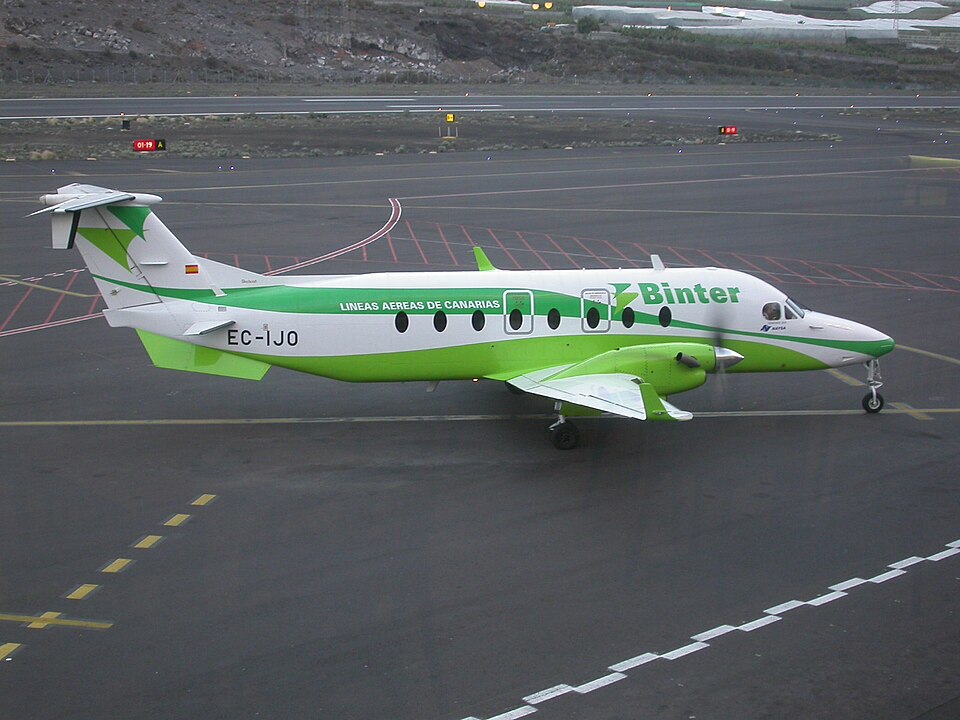
On Friday, 2 February 2007, at 19:43 local time, a Beechcraft 1900D, registration EC-IJO, was en route from Lanzarote Airport to Tenerife South Airport. The flight was the sixth of eight scheduled flights that day between the Canary Islands. The first officer was the pilot flying. Weather conditions were Visual Meteorological Conditions (VMC) with sunset before takeoff at 19:00.
The aircraft departed runway 03 using the TENERIFE SUR DOS MIKE (TFS2M) standard departure. After passing the Fuerteventura (FTV) VOR, air traffic control cleared the crew to proceed directly to the Las Palmas (LPC) VOR and then to MERAN, cruising at flight level FL100.
While over the coast of Gran Canaria, the crew felt a strong explosion and the aircraft yawed uncommanded to the right. The first officer observed flames from the exhaust nozzle of the number 2 engine and informed the captain. The captain noted the Inter Turbine Temperature (ITT) rose to 720 °C. The crew initiated the "ENGINE FIRE OR FAILURE IN FLIGHT" emergency procedure, shutting down the number 2 engine. The captain performed the first two memory items: Condition Lever to FUEL CUTOFF and Propeller Lever to FEATHER. The first officer declared an emergency to ATC (Tenerife South) and requested diversion to Gran Canaria, which was granted. The captain then took over as pilot flying (PF), while the first officer handled communications and continued the procedure as pilot not flying (PNF).
The remaining memory items were completed: Firewall Fuel Valve PULL CLOSED, Fire Extinguisher (not actuated as there was no engine fire warning or visible fire signs), Eng AutoIgnition OFF, Autofeather OFF, Prop Sync OFF, Generator OFF, Electrical Load ensured within limits, and Bleed Air Valve set to INST & ENVIR OFF. The crew decided not to attempt an in-flight restart as they concluded the engine was damaged.
The aircraft proceeded to Las Palmas de Gran Canaria Airport, requesting a visual approach. The crew asked several times for preceding traffic (a B-757) to be diverted. ATC maintained the approach sequence. Before landing on runway 03L, an A-320 was cleared to take off from runway 03R. After landing, the aircraft exited via taxiway S3 and notified ATC of the emergency end. The crew shut down the left engine and secured the aircraft, vacating normally.
Injuries and Damage
There were no injuries among the 2 crew and 13 passengers. A preliminary ground check revealed the right engine did not rotate; no other damage was noted.
Aircraft and Engine Information
The Beechcraft 1900D is a 19-seat, pressurized, twin-engine turboprop. The right engine, a Pratt & Whitney PT6A-67D (serial number 114109), had 18,239 total hours and 29,180 cycles. The aircraft held a valid airworthiness certificate and was maintained per the approved program. The PT6A-67D is a free-turbine engine with a two-stage reduction gearbox, lubricated by a system including pressure, scavenge, and breather components. Periodic oil level checks were required daily or preflight, and oil filter inspections every 100 hours (extendable to 200 hours based on previous results).
Crew Information
The 33-year-old captain held a commercial pilot license, had 6,000 total flight hours (2,591 on type), and was certified as captain on 18 February 2006. His last proficiency check was 22 October 2006. The 26-year-old first officer also held a commercial pilot license with 660 total hours (456 on type). Both had completed CRM training four days after the incident. The company did not use flight simulators for training on certain emergencies.
Final Outcome
The aircraft landed safely with no injuries. The right engine was damaged but no other damage occurred.