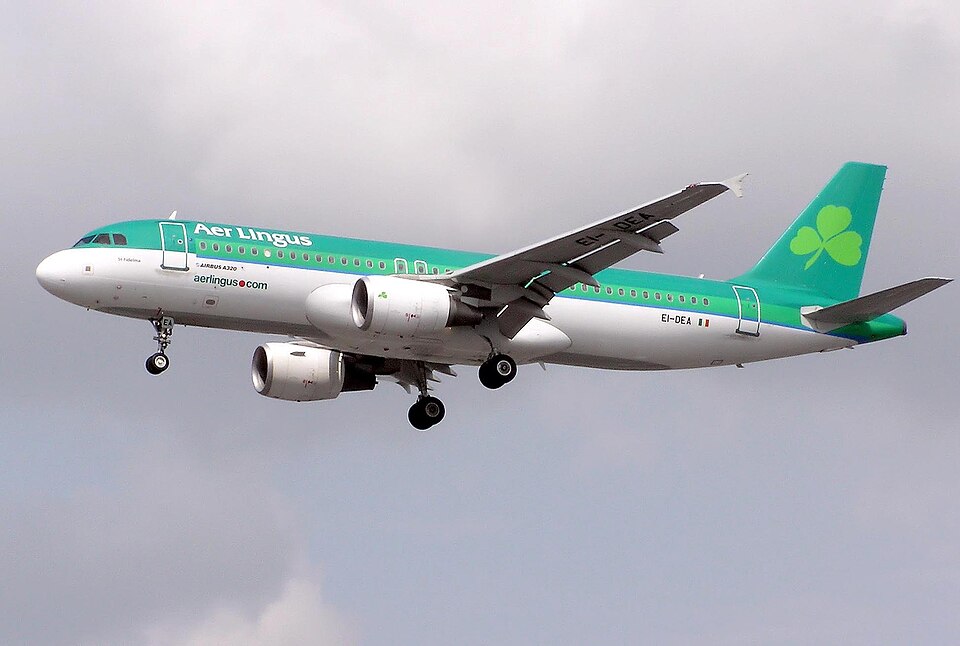
History of the Flight
On 14 March 2012, an Airbus A320-200, registration EI-DEA, operated by Aer Lingus as flight EIN868 from Cork, Ireland, entered a holding pattern above the Calella VOR at 19:34 UTC. The runway visual range (RVR) for runway 25R at Barcelona El Prat Airport was below the authorized minimum of 400 m for Category II approaches. The crew requested a change to another runway with lower minimums (Category III), but ATC denied the request.
After holding for 30 minutes with no improvement in visibility, the crew decided to divert to Valencia. En route, ATC informed them that the RVR at runway 25R had increased marginally above minimums, so they turned back to attempt a landing. During final approach, they informed the tower that in the event of a go-around, they would divert to Girona, which had lower fuel requirements per their operational flight plan.
Seconds later, the RVR again dropped below minimums. The crew aborted the approach and requested vectors to Girona. ATC then informed them that Girona had no parking available due to numerous diversions. The crew declared a PAN PAN (urgency) due to insufficient fuel, after which ATC cleared them to land on runway 25L, which they did without incident.
Personnel Information
The tower supervisor was qualified in October 2008 and named temporary chief supervisor in October 2011 after an online course. In 2011, he received training on special and emergency situations and low visibility procedures. On the incident day, he worked the afternoon shift (13:30 to 21:00) after six days off. Coworkers described him as a good professional. The control area supervisor had over 25 years of experience.
Aircraft Information
The aircraft was authorized for Category IIIB approaches (no decision height, RVR 75 m) as per its AOC. The A320 falls within ICAO category C for approach speed.
Meteorological Information
Forecasts issued at 11:00 and 15:16 predicted fog reducing visibility to 400 m from 16:00 to 21:00. Observations confirmed visibility drops starting at 15:00, with fog banks at 16:30. At 17:06, a SPECI reported visibility 500 m and RVR 1000 m for runway 25R. Fog settled, lowering visibility to 100 m and RVR at the 25R threshold to 200 m at 21:00. Aerodrome reports at 19:30 and 20:30 gave RVR values of 325 m and 300 m, respectively, for 25R. Girona and Valencia airports had CAVOK conditions.
Communications
The crew maintained contact with Barcelona TMA and tower without problems. Coordination occurred between the Barcelona TMA control center, Barcelona tower, and Girona tower. Parking availability at Girona was relayed from its coordination center (CECOA) to its tower.
Detailed communications show that at 19:22, EIN868 was informed of low visibility procedures in effect. The crew requested RVR for 25R and noted their minimum was 400 m, asking why 25L (Category III) was not available. Other aircraft reported similar issues. The tower supervisor stated that procedure required maintaining parallel runway configuration while RVR exceeded 300 m, and that changing configuration was not justified. He emphasized that crews could divert if they could not land. At 19:52, the approach controller relayed that Girona had no parking, leading to the PAN PAN declaration.
Injuries and Damage
No injuries were reported among the 6 crew and 56 passengers. No damage to the aircraft or third parties occurred.