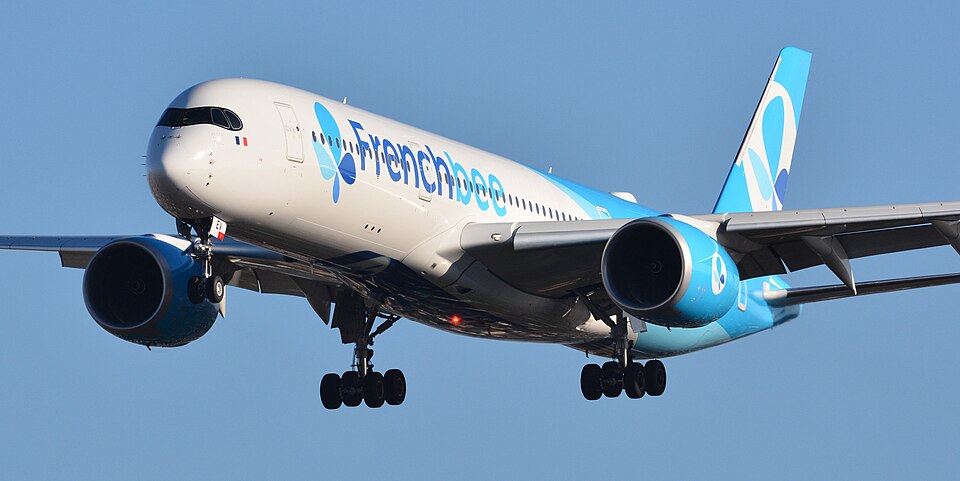
On February 4, 2020, an AIRBUS - A350 - 900 (registration F-HREV) operated by French Bee was involved in an aviation accident near Paris-Orly, FR. This summary draws on records from the French Bureau d'Enquêtes et d'Analyses (BEA); 8 related events involving the same aircraft type or operator are linked below.
On 4 February 2020, French Bee flight FBU711, an Airbus A350-900 (F-HREV), experienced a predictive windshear warning on final approach to Paris-Orly. A go-around resulted in flight path deviations, a low energy alert, and a conflict with a departing aircraft.
Incident Overview and Flight Details<br><br>On 4 February 2020, French Bee flight FBU711, an Airbus A350-900 registered F-HREV, was operating a passenger commercial air transport flight from San Francisco to Paris-Orly. The aircraft was carrying a captain, a copilot, a relief pilot, 10 cabin crew members, and 206 passengers. The flight was the final leg of a Paris–San Francisco–Papeete–San Francisco–Paris roster, with the crew having taken off nearly three hours late from San Francisco. A relief pilot and a cabin crew member were seated on cockpit jump seats for the arrival.<br><br>## Approach and Initial Go-Around<br><br>The aircraft was stabilized on the ILS 25 approach with the copilot as the pilot flying (PF) and the captain as the pilot monitoring (PM). Visibility at Orly was greater than 10 km, with a ceiling at approximately 4,500 ft and a northwesterly wind of about 25 kt. At an altitude of 1,400 ft, the copilot disconnected the autopilot while auto-thrust and flight directors remained engaged. Four seconds later, at 1,350 ft, a predictive windshear warning triggered in the cockpit. The captain ordered a go-around, and the copilot initiated the maneuver by moving the thrust levers to the TOGA detent and subsequently engaging the GA SOFT mode at the captain's request.<br><br>## Flight Path Deviations and Crew Response<br><br>During the go-around, the aircraft exceeded the published missed approach altitude of 2,000 ft at 17:00:05 UTC, reaching an indicated airspeed of 167 kt and a vertical speed of +1,800 ft/min. The copilot did not respond to requests from the captain and relief pilot to stabilize the aircraft at 2,000 ft. At 17:00:29, the copilot leveled off at approximately 2,750 ft, and the aircraft remained stable at around 2,800 ft despite the auto-thrust reducing engine power to idle. The aircraft crossed the threshold of runway 25 at 17:00:37, and air traffic control instructed the crew to turn left to heading 180° and informed them of departing traffic at 4 NM.<br><br>## Captain Takes Control and Conflict with Departing Aircraft<br><br>At approximately 2,800 ft, the captain became aware that the aircraft was too high, that traffic was nearby, and that the copilot was not responding to requests. At 17:00:49, the captain placed his hand on the sidestick, and speedbrakes were extended. The captain engaged AP1 at 17:00:57, and the aircraft turned left onto heading 180° in descent. At 17:01:03, a low energy alert triggered, and the aircraft came into conflict with flight AFR626T taking off from runway 24, triggering a Short Term Conflict Alert (STCA) on the ATC screen. The captain selected a target speed of 260 kt and moved the thrust levers to the TOGA detent to increase speed and stabilize the aircraft at 2,000 ft.<br><br>## Resolution and Final Descent<br><br>The aircraft flew through 2,000 ft at 17:01:26 with an increasing calibrated airspeed of 235 kt and a vertical speed of -2,200 ft/min. This coincided with the point of minimum distance between FBU711 and AFR626T, with a separation of 1.69 NM for 75 ft, though the flight paths were not converging. At 17:01:34, the copilot pressed the AP2 pushbutton, engaging AP2 in V/S and HDG modes. The captain disengaged AP2 and re-engaged AP1, leveling the aircraft from a 10° left bank. The captain selected a heading of 198° and reduced the target speed to 220 kt. At 17:01:42, the captain informed the controller that he was turning towards heading 180, and the controller advised that the traffic was very close and suggested a quick turn.