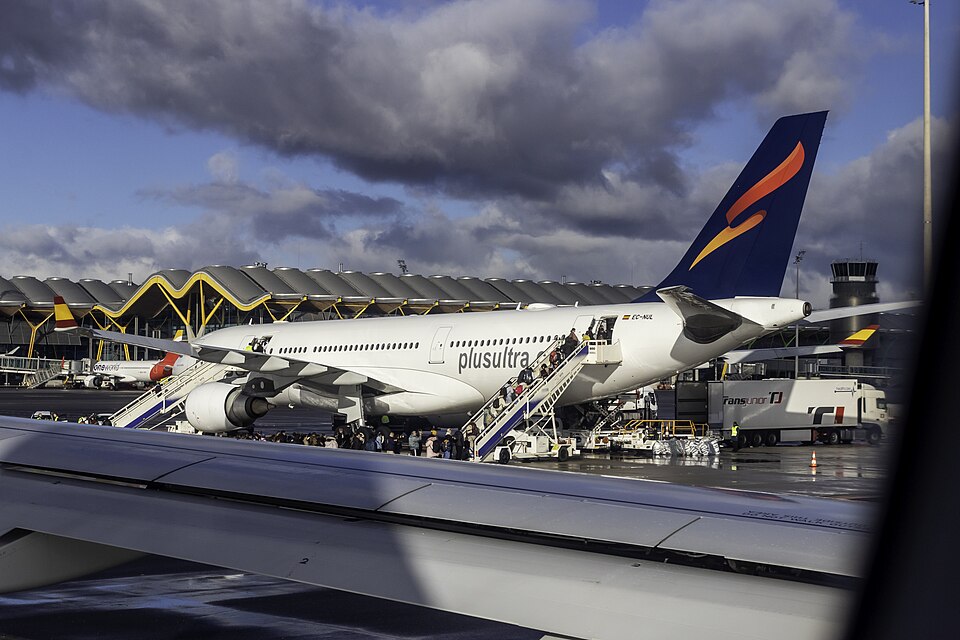
Flight Details
On March 6, 2025, at 00:39 UTC, an Airbus A330-202, registration EC-NUL, serial 749, owned by Plus Ultra Líneas Aéreas, departed Simón Bolívar International Airport (SVMI) in Maiquetía, Venezuela, en route to Adolfo Suárez International Airport (LEMD) in Madrid, Spain. The aircraft carried 11 crew members and 283 passengers.
Approximately 20 minutes after departure, the captain observed a failure in the fuel indication system. The crew immediately applied procedures from the Quick Reference Handbook (QRH) and decided to return to Maiquetía. The aircraft landed without incident, and all crew and passengers were unharmed. The aircraft sustained the aforementioned system failure.
The aircraft is a twin-engine land plane powered by General Electric CF6-80E1 or Rolls-Royce Trent 700 engines. It held a valid airworthiness certificate issued by the Spanish Aeronautical Authority and an A332 type certificate from the Federal Aviation Administration (FAA). At the time of the incident, the aircraft was airworthy per its current airworthiness certificate and maintenance records.
The last scheduled preventive maintenance was performed by OMAC N° 330 – AEROSERVICES 3000, C.A., located at Simón Bolívar International Airport.
Crew Information
The captain, aged 62, held a valid Medical Certificate (expiring 19 June 2025) and an Airline Transport Pilot License with type ratings for A330/350 and A340. The copilot, aged 50, held a valid Medical Certificate (expiring 20 November 2025) and a Commercial Pilot License. Both licenses complied with international regulations.
Meteorological Conditions
At the time of the incident, winds were 4 to 8 knots, visibility was unlimited, and generally good weather prevailed throughout the day.
Investigation
The Junta Investigadora de Accidentes (JIAAC) conducted the investigation. Activities included interviews with the flight crew, review of flight documents (identity cards, licenses, medical certificates, flight logs, flight plan), and requests to the operator for registration and airworthiness certificates, radio station license, insurance policy, and noise certification. Documentation from the maintenance organization (OMAC N° 330) was also requested, including its maintenance organization certificate, approved capabilities list, component control records, airworthiness directives compliance, scheduled maintenance control, and the last maintenance release.
Investigators performed an inspection of the aircraft with technical maintenance personnel (TMA) from the OMAC. They conducted a system report test on the Fuel Control & Monitoring Computers (FCMC). Photographic documentation was taken during the inspection.
Findings
No fuel leaks were detected. The fuel quantity indication on the panel showed no anomalies. However, after testing the FCMC, it was determined that the FCMC N°2 had failures. The FCMC works with sensors that measure fuel flow, pressure, and temperature, adjusting parameters in real time for efficient combustion. A failure in this system can cause incorrect readings and provide erroneous information about available fuel quantity, potentially leading to operational misjudgments.
Probable Cause
The JIAAC determined that the probable cause of the incident was a failure of the Fuel Control & Monitoring Computer (FCMC) N°2, which led to incorrect fuel quantity indications to the flight crew.