Casualties unknown

Conviasa Embraer ERJ-190 aborted takeoff at Simón Bolívar International Airport (YV2966)

AEROPUERTO INTERNACIONAL SIMÓN BOLÍVAR DE, VE

On October 25, 2021, an EMBRAER SA ERJ-190/195 (registration YV2966) operated by CONVIASA was involved in an aviation accident near AEROPUERTO INTERNACIONAL SIMÓN BOLÍVAR DE, VE. This summary draws on records from the Venezuelan Civil Aviation Accident Investigation Board (JIAAC Venezuela); 6 related events involving the same aircraft type or operator are linked below.
Sourcesthe Venezuelan Civil Aviation Accident Investigation Board (JIAAC Venezuela)Primary reportUpdated 2026-09-08Data APIEditorial standards
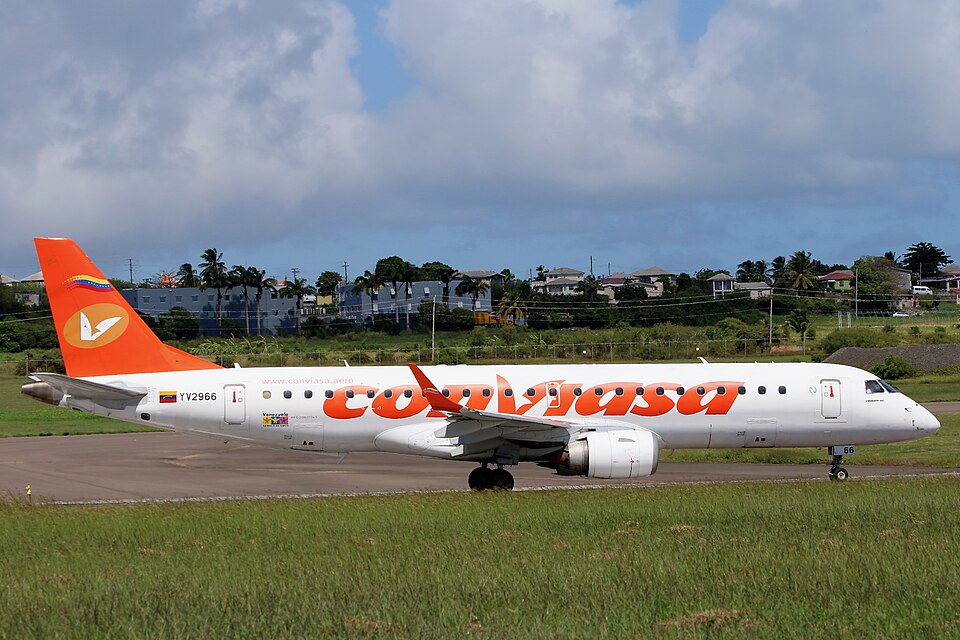
Aircraft registered YV2966
Aircraft registered YV2966. Photo: Colin Cooke Photo / CC BY-SA 4.0, via Wikimedia Commons

On October 25, 2021, a Conviasa Embraer ERJ-190/195 (YV2966) aborted takeoff at Simón Bolívar International Airport due to steering control issues. All 95 people on board were unharmed, and the aircraft sustained no damage.

Incident Overview and Aircraft Details On October 25, 2021, at 15:56 UTC, an Embraer ERJ-190/195 aircraft, registration YV2966, serial number 485, operated by Conviasa, experienced an aborted takeoff at Simón Bolívar International Airport (SVMI) in La Guaira, Venezuela. The aircraft was on a scheduled flight to Santiago Mariño International Airport (SVMG) in Porlamar, Nueva Esparta. During the takeoff roll, the crew reported a loss of steering control, causing the aircraft to deviate sharply to the left. The crew aborted the takeoff and returned to the gate without incident, exiting the runway under their own power to Gate 10. All five crew members and 90 passengers were unharmed, and the aircraft sustained no damage. The aircraft, manufactured by Embraer S.A., held a U.S. Federal Aviation Administration (FAA) type certificate (A57NM) and was airworthy with valid registration and standard airworthiness certificates issued by Venezuela's National Institute of Civil Aeronautics (INAC). ## Crew and Operational Conditions The pilot in command, aged 35, held a valid commercial pilot license and medical certificate from INAC, with instrument rating and E190 captain qualifications. He had 1,450 hours on the aircraft type, 215 hours as pilot in command, and 3,700 total flight hours. The first officer, aged 33, held similar credentials with instrument rating and E190 first officer qualifications, with 320 hours on the aircraft type and 1,350 total flight hours. Weather conditions at the departure airport were unlimited and favorable for instrument flight rules (IFR) operations, according to METAR data. ## Investigation Activities and Findings The investigation, conducted by Venezuela's Civil Aviation Accident Investigation Board (JIAA) under the Ministry of Transport, included reviewing maintenance records, interviewing the flight crew, and conducting engine run tests. The engine test revealed that the left engine failed to generate thrust, with N1 at 17%, N2 at 54%, and ITT readings of approximately 700 and 728°C, while the right engine operated normally. The last scheduled maintenance was performed by OMAC Conviasa S.A. (No. 431) at Simón Bolívar International Airport. The investigation was in the technical, operational, and documentary analysis phase as of the preliminary report date. ## International Notifications In accordance with Annex 13 of the Chicago Convention, the incident was reported to the ICAO ADREP system via form JIAA/NAI 051/2021. The United States, as the state of design and manufacture, was notified, with the NTSB designated as the investigating authority for the state of design and manufacture.

Investigation report by the Venezuelan Civil Aviation Accident Investigation Board (JIAAC Venezuela). Original record: https://www.mppt.gob.ve/download/153168/. This page is a structured re-presentation; facts and quotes are in the Junta de Investigacion de Accidentes de Aviacion Civil (JIAAC), Venezuela - MppT.