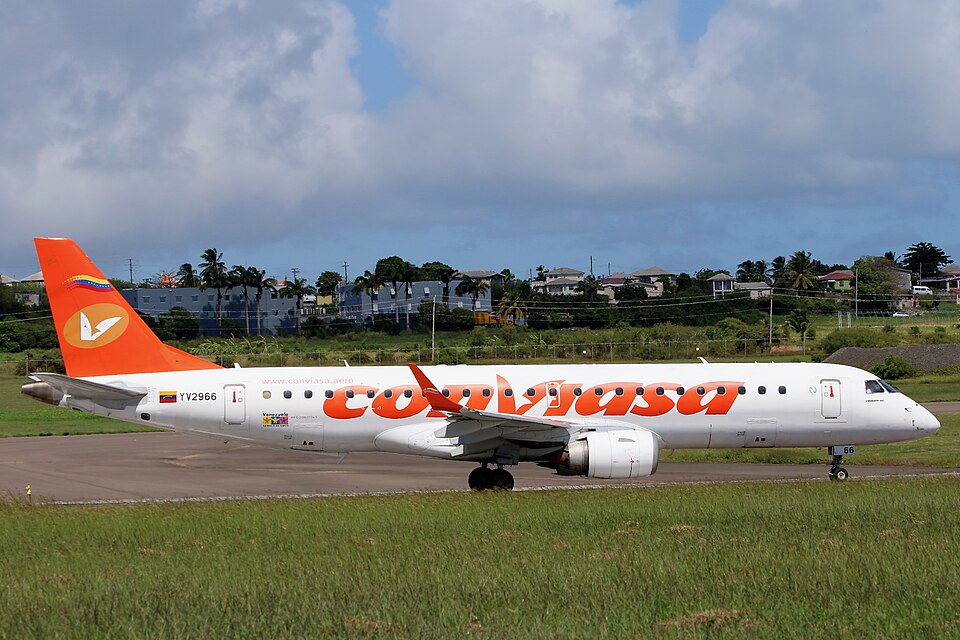
Incident Overview
On October 20, 2023, an Embraer ERJ-190-100 IGW with registration YV2966, operated by Consorcio Venezolano de Industrias Aeronáuticas y Servicios Aéreos S.A. (Conviasa), experienced a technical malfunction during its approach to José Tadeo Monagas International Airport (SVMT) in Maturín, Venezuela. The aircraft had departed from Simón Bolívar International Airport (SVMI) in Maiquetía with 77 people on board, including five crew members and 70 passengers.
Operational Sequence
At 13:16 UTC, while configuring the aircraft for landing at a flight level of 3,000 feet and 37.5 nautical miles from the destination, the pilots selected flaps to position 03. The Electronic Integrated Centralized Aircraft System (EICAS) displayed a "SLAT-FLAP LEVEL DISAG" message, preventing the flaps from extending further than position 02. Following Quick Reference Handbook procedures, the captain canceled the approach and requested authorization to hold at the MEREY waypoint to perform flap checks. During these checks, it was confirmed that the flaps could only extend to position 02 due to the fault.
Return and Landing
Given that the runway length at Maiquetía (SVMI) was superior to that of Maturín (SVMT), the flight crew decided to return to the departure airport. The aircraft landed safely on runway 10L at SVMI at 13:54 UTC with flaps in position 02. All passengers and crew were unharmed, and the aircraft remained airworthy despite the reported failure.
Investigation Findings
The Joint Accident Investigation Board (JIA) conducted a joint inspection with Conviasa maintenance personnel. A fault-finding procedure identified the root cause as a malfunction of the Slat Position Sensor Unit. The component had degraded before reaching its scheduled inspection time, exacerbated by constant exposure to high humidity environmental conditions.
Corrective Action
The faulty Slat Position Sensor Unit was replaced with part number 5913840 (Serial No. A2121) in accordance with maintenance manual 27-83-06/400/000-201A. Following the repair, the aircraft was returned to service.