Incident
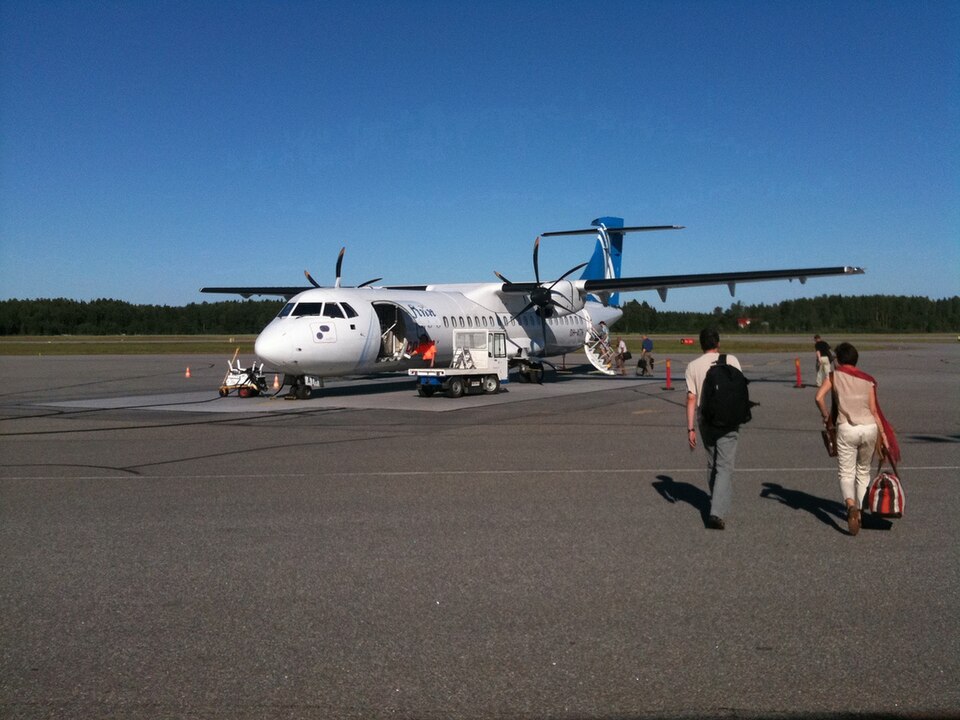
On 19 August 2012 at 03:42 UTC, a serious incident occurred at Helsinki-Vantaa Airport (EFHK) involving an ATR 72-212A twin-engine airliner, registration OH-ATH, operated by Flybe Finland Oy on scheduled flight FCM992T from Tampere-Pirkkala to Helsinki-Vantaa. The aircraft carried 27 passengers and four crew members. During the landing roll on runway 22L, the aircraft veered off the paved surface onto the shoulder strip. The captain regained directional control using nose wheel steering and steered the aircraft back onto the runway. No injuries were reported, and runway equipment was not damaged. The aircraft sustained minor damage, repaired by the operator's maintenance organization.
System Malfunction
While approaching Helsinki-Vantaa, the automatic function of the Travel Limitation Unit (TLU), which limits rudder deflection, failed. The electric motor of the TLU actuator broke, causing the TLU to remain in the high-speed (HI SPD) mode for the remainder of the flight. This mechanically restricted the rudder to a near-centered position. The crew did not engage the TLU standby system. The captain assessed that the normal landing criteria specified in the Quick Reference Handbook (QRH) for a TLU FAIL situation were met, and decided to continue the approach and land.
Landing and Directional Control Loss
Upon touchdown, the captain observed that the rudder pedals felt stuck. Without adequate rudder authority, the aircraft veered off the runway. The captain then used nose wheel steering to guide the aircraft back onto the runway surface.
Investigation Findings
The investigation, conducted in cooperation with the aircraft manufacturer and operator, identified several contributing factors. The immediate cause was the insufficient directional control authority of the mechanically centered rudder. Contributing factors included the failure of the TLU actuator's electric motor, leaving the TLU in HI SPD mode; the crew's failure to activate the TLU standby system due to inadequate system knowledge and unclear QRH instructions; and an asymmetrical transition of propeller blade angles to the BETA range following power reduction at landing, which induced a strong sideways oscillation.
Probable Cause
The serious incident was caused by the mechanically centered rudder's insufficient authority for directional control, which resulted in the aircraft veering off the runway.