Introduction
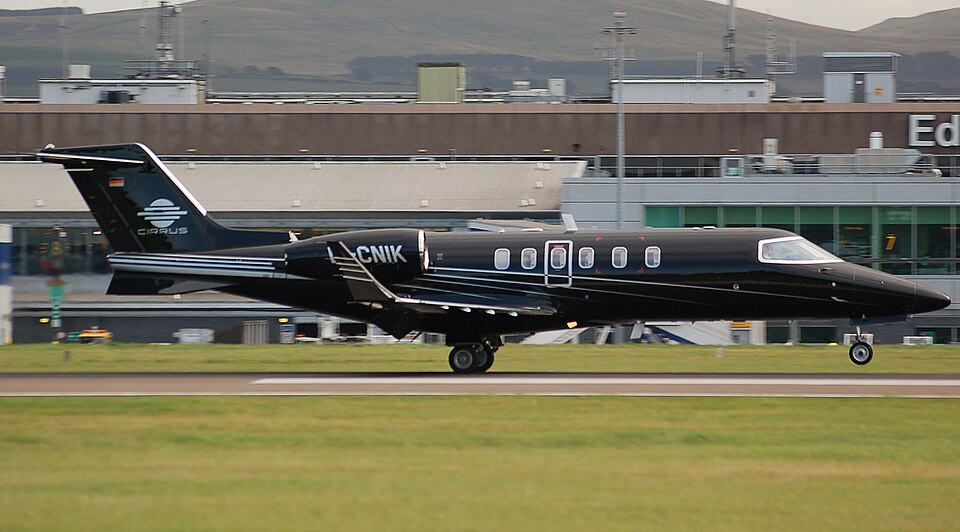
On 17 March 2006, at 2029 UTC, a Learjet 45, registration D-CNIK, was involved in an accident at London Gatwick Airport. The aircraft was being prepared for a public transport flight to Paris. On board were two crew members and no passengers. The commander sustained serious injuries; the co-pilot was uninjured. The aircraft sustained damage to the fuselage and entry door, and a parked motor vehicle was also damaged.
Event Details
The aircraft had arrived earlier that day and was parked on Stand 143, facing south, with the nosewheel chocked on the stand's centerline. Weather conditions were dry and clear with a surface wind from 050° at 18 knots. A handling agent drove the flight crew to the aircraft and parked a ground support vehicle in front of the left wing, facing north.
The co-pilot entered the aircraft, set the parking brake by pulling and turning the handle, then selected all three batteries on, cockpit lights on, and started the right engine. He then turned on the air conditioning. The co-pilot was seated partially in his seat, facing rearward. After a few seconds, he sensed the aircraft moving and climbed fully into his seat to apply toe brakes, but the aircraft was already turning left rapidly, and he could not stop it. He heard a crash as the aircraft struck the parked vehicle. He reduced the thrust lever to idle and later shut down the engine.
Meanwhile, the commander had stowed catering in the galley and went to the rear of the cabin to stow his baggage. He noticed an increase in engine noise and tried to call the co-pilot but could not be heard due to air conditioning noise. As he moved forward and came alongside the steps, he realized the aircraft was moving. He lost his balance and fell from the steps to the ground outside the aircraft. The handling agent was also struck and knocked to the ground.
After the aircraft came to rest, the co-pilot heard calls and looked back; seeing no one, he climbed out over the vehicle partially blocking the doorway and found the commander injured. The handling agent contacted airfield operations for emergency services.
Accident Sequence
The aircraft had been parked on a heading of 169° magnetic, with a Volkswagen Sharan Multi-Purpose Vehicle (MPV) acting as a ground support vehicle alongside. The aircraft moved forward and struck the left side of the MPV, then turned left around the rear of the vehicle and struck the right side, coming to rest against it on a heading of 013° magnetic, approximately 8.6 metres from the centre of the stand marking. The MPV was pushed sideways about 0.6 metres, forcing the left front tyre off its rim.
The commander fell outside the aircraft during the movement. The trailing edge of the nose landing gear door was bent by impact with the commander, and a faint mark on the concrete surface, made by his clothing, followed an arc corresponding to the path of the nosewheel as he was dragged.
Aircraft Information
The Learjet 45 is equipped with two Honeywell TFE731-20 turbofan engines mounted high on the rear fuselage. D-CNIK was not fitted with an auxiliary power unit. The aircraft carried small wooden chocks. The braking system includes normal and emergency/parking brake systems, with an accumulator providing reserve pressure. The nosewheel steering system is controlled by a computer that senses rudder pedal demand. Flight data and cockpit voice recorders were recovered and successfully downloaded.
Recorded Data
The FDR and CVR recorded the event. Data showed that the No. 2 engine thrust lever was moved, and a series of clicks were heard on the flight deck. The No. 2 engine N1 shaft speed increased from idle to 59% about eight seconds later, at which point the aircraft began to move forward. N1 increased to 72%, and the aircraft accelerated forward and turned left. About five seconds later, the thrust lever was moved to idle, and N1 reduced. A noise similar to brakes being applied was recorded, and the aircraft stopped turning on a heading of 013°.
Personnel
The commander, aged 42, held an Airline Transport Pilot's Licence and had 9,500 flying hours, with 2,450 on type. He was a freelance pilot and held a Type Rating Examiner qualification. The co-pilot had been employed for 18 months and had 920 hours on type.